Čeština
 Deutsch


Marco Polo black and gold sword


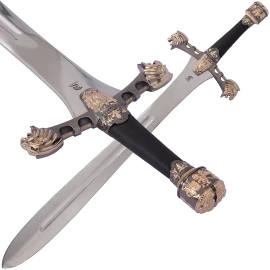
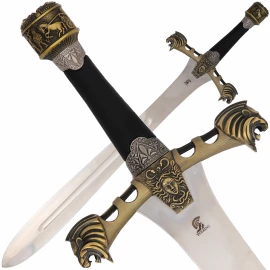
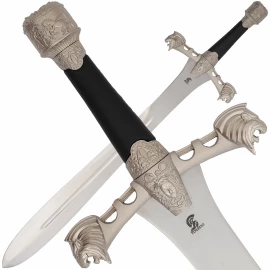
The Marco Polo decorative sword is a striking collector's piece combining an exceptionally broad blade, richly ornamented hilt and bold black-and-gold contrast. Etched historic-style scenes decorate the blade, whilst the strongly curved crossguard carries dense foliate ornament and a coloured shield. Its black beechwood grip features a decorative rosette and gold-coloured details, while a raised figurative relief dominates the pommel. At almost one metre in overall length, the sword makes an imposing wall or stand display. It is intended solely for decoration and is not suitable for practical fencing or combat use. Further product information ...

Would you like to be notified as soon as the item is in stock?
You will receive a short e-mail as soon as we have it back in stock.
Marco Polo black and gold decorative sword
Broad blade and richly decorated hilt
The blade is made from 420 stainless steel, has a blunt edge and features longitudinal recesses or fullers along much of its length. Etched ornamental panels with figurative and animal motifs appear in the upper and central areas. According to the manufacturer, the etched decoration corresponds to patterns and ornaments associated with the 14th century.
The dramatically curved crossguard and pommel are made from Zamak, an alloy of zinc, aluminium, magnesium and copper. Their gold-coloured surfaces contrast with the dark recesses of the foliate ornament. A coloured quartered shield surrounded by figurative motifs occupies the centre of the guard. The black beechwood grip is decorated with a circular rosette and gold-coloured elements. The pommel displays a raised female face surrounded by stylised decoration. We do not assign a specific historical identity to these decorative motifs where this is not reliably documented.
Marco Polo and the cinquedea: two different periods
The supplied product information describes this model as a reproduction of an Italian cinquedea. The historical context needs some qualification, however: Marco Polo lived approximately from 1254 to 1324, whereas surviving Italian cinquedeas are particularly characteristic of the late 15th and early 16th centuries. This model is therefore better understood as a decorative historic-inspired interpretation combining Marco Polo's name, decoration inspired by the 14th century and design elements associated with the later Italian cinquedea, rather than as a reproduction of a weapon from Marco Polo's lifetime.
The name cinquedea refers to its conspicuously broad blade and is traditionally interpreted as meaning “five fingers”, describing the width of the blade near the guard. Historical examples were considerably shorter than this almost metre-long decorative model and are generally classified as daggers or short sidearms. Their broad blades also provided an excellent surface for elaborate Renaissance decoration.
Why the name Marco Polo
Marco Polo was a Venetian merchant and traveller whose account of journeys through Asia had a lasting influence on European perceptions of distant lands. His name gives this sword a medieval theme of travel and adventure. It does not, however, indicate that the model is a copy of a sword documented as having belonged to Marco Polo.
Technical specifications
| Specification | Value |
|---|---|
| Type | decorative historic-style sword |
| Name | Marco Polo |
| Design inspiration | Italian cinquedea |
| Inspiration for etched decoration | 14th-century patterns and ornaments |
| Overall length | approx. 38.82 in / 986 mm |
| Blade length | approx. 31.57 in / 802 mm |
| Crossguard length | approx. 6.69 in / 170 mm |
| Blade width | approx. 2.76 in / 70.08 mm |
| Blade thickness | approx. 0.19 in / 4.72 mm |
| Weight | approx. 4.98 lb / 2,257 g |
| Blade material | 420 stainless steel |
| Edge | blunt |
| Crossguard and pommel material | Zamak – an alloy of zinc, aluminium, magnesium and copper |
| Grip material | beechwood |
| Hilt colour scheme | black and gold |
| Intended use | decoration and collecting |
| Manufacturer | Art Gladius |
| Made in | Toledo, Spain |
All stated dimensions and the weight are approximate and may vary slightly between individual pieces.
Display, care and safety
The sword requires no special preparation before being placed on display. As it weighs more than two kilograms, we recommend a sturdy sword stand or wall hanger with an appropriate load rating. When mounting it on a wall, use fixings suitable for the particular wall construction and check that the complete installation is stable before leaving the sword on display.
Do not use this sword for HEMA, historical or stage fencing, contact combat, cutting practice or technique training. Its blunt blade does not make it a safe training weapon. Given its size and weight, an impact or fall could cause serious injury.
After handling, wipe the blade with a soft, dry cloth and protect it from prolonged exposure to moisture. Keep the beechwood grip and decorated hilt parts away from water and aggressive cleaning products. Do not use abrasive polishes on the black-and-gold ornamental surfaces, as these could alter their decorative finish.
Recommended accessories
For safe display, we recommend a sturdy sword stand or suitably rated wall hanger. If you want to create a display corresponding to the actual period of the cinquedea, combine it with Italian Renaissance decorations, heraldic objects and reproductions of equipment from the 15th to early 16th century. For a Marco Polo theme, maps and decorative objects inspired by the 13th and 14th centuries are more appropriate.
We are here for you!