 Čeština
 Deutsch


Alexander the Great sword with patinated hilt


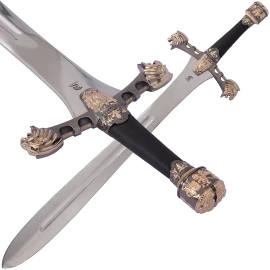
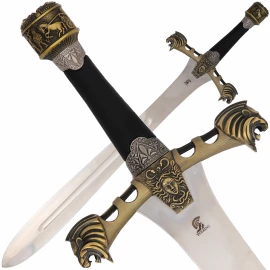
Are you captivated by the epic ancient world and seeking a weapon that infuses your space with sovereign authority and heroic vigour? This monumental decorative sword of Alexander the Great instantly commands attention with its broad leaf-like blade and lavishly sculpted hilt finished in antique patina. The crossguard features snarling lion heads and the mythical relief of Medusa, while the grip wrapped in genuine leather ensures a commanding hold. We present to you an exceptional collector centrepiece and a prestigious addition to your study or private armoury, celebrating the martial glory of Classical antiquity and celebrated Toledo craftsmanship. Further product information ...

 Delivery options
Alexander the Great Decorative Sword, Antique Classical Weapon
Classical Armaments of the 4th Century BC and Macedonian Lore
The visual design of this ceremonial weapon is inspired by the monumental epoch of the ancient Mediterranean during the 4th century BC (specifically the 330s BC during the epic campaigns of Alexander the Great between 336 and 323 BC). In that martial era, short single-handed swords served as the essential secondary sidearm for Macedonian phalangites and Companion cavalry once the lengthy sarissa pike was shattered in combat. This model represents a modern decorative interpretation of ancient regal weaponry. The broad AISI 420 stainless steel blade features a pronounced central fuller and a substantial ricasso. The cast zamak hilt boasts an antique patina finish, showcasing pierced crossguard quillons terminating in sculptural roaring lion heads, while the central block is emblazoned with the serpentine visage of Medusa. The grip is wrapped in genuine black leather and balanced by a massive spherical pommel enriched with classical reliefs of charioteers, warriors, and beasts. Historically, Alexander claimed direct ancestry from the mythic hero Heracles, whose signature emblem was the Nemean lion, and historical depictions such as the Alexander Mosaic show the Gorgoneion emblazoned upon his royal cuirass to strike dread into enemy ranks.
Technical Specifications
| Specification | Value |
|---|---|
| Product type | Decorative ceremonial sword |
| Historical period | Classical Antiquity / 4th century BC (Alexander the Great era) |
| Overall length | 93 cm / 36.61 inches |
| Blade length | 72 cm / 28.35 inches |
| Grip length | 14 cm / 5.51 inches |
| Crossguard width | 23 cm / 9.06 inches |
| Fuller length | 40 cm / 15.75 inches |
| Ricasso length | 16 cm / 6.30 inches |
| Blade width below crossguard | 81.4 mm / 3.20 inches |
| Blade width 10 cm from tip | 70.6 mm / 2.78 inches |
| Ricasso edge thickness | 5.5 mm / 0.22 inches |
| Striking edge thickness | 1.5 mm / 0.06 inches (unsharpened / semi-sharp: 0.5–1.99 mm) |
| Blade tip | Blunt (rounded) |
| Weight | 2536 g / 5.59 lbs |
| Blade material | 420 stainless steel |
| Hilt material | Patinaged cast zamak alloy, genuine cowhide leather |
| Scabbard | Supplied without scabbard |
Due to manual finishing in production, these values are approximate and may vary slightly.
Historical Legacy: Alexander the Great
This sword is crafted in honour of Alexander III of Macedon (356–323 BC), known to history as Alexander the Great. In just over a decade of ceaseless campaigning, this military genius carved out an empire stretching from Greece and Egypt to northwestern India. Undefeated in battle, he bridged East and West, inaugurating the Hellenistic age. This ceremonial sword commemorates his sovereign ambition, uncompromising courage, and timeless battlefield renown.
Care and Safety
The 420 stainless steel blade offers superior protection against rust and corrosion. To keep it pristine, wipe down the blade regularly using a clean, dry microfibre cloth, and protect the sword from sustained dampness. Guard the leather grip against moisture and intense heat sources. Never apply abrasive compounds, wire wool, or harsh solvent cleaners to the patinated zamak fittings, as these will strip the delicate antique finish. We strictly warn you that this is an ornamental display piece and is unsuitable for contact fencing (including HEMA, stage fighting, LARP combat, or cutting tests). Stainless steel cannot withstand dynamic blade-on-blade impacts; strikes carry a severe risk of catastrophic failure and injury. Due to the weapon's substantial weight, exercise care during handling and store it safely away from children.
Recommended Accessories
To create an authentic Classical showcase in the spirit of the 4th century BC, we recommend to you the following additions:
- Wooden Tabletop or Wall Sword Stand: A robust hardwood display stand engineered to securely support heavier swords.
- Wooden Display Wall Plaque: An elegant mounting plaque designed for distinguished wall display in your study.
- 4th-Century BC Greek Helmet Replica: A Classical bronze-finished helmet to complement your ancient Mediterranean showcase.
- Microfibre Care Cloth: A lint-free polishing cloth to dust the blade and patinated hilt without scratching.
The Art Gladius Brand
Hailing from the historic swordmaking city of Toledo, Spain, the Art Gladius brand is globally celebrated for its distinctive visual artistry, rich ornamental detailing, and superb finishing. The makers excel in bringing heraldic motifs, intricate reliefs, and harmonious proportions to life. Their extensive portfolio traverses the tapestry of history and imagination—ranging from Classical Antiquity and medieval knights to celebrated European monarchs and the realms of fantasy.
Important Notice
Decorative swords and daggers by Art Gladius are designed primarily for display and collecting purposes. They are not engineered for contact historical fencing, HEMA, or cutting tests.
We are here for you!