Čeština
 Deutsch


Yuto wakizashi with red saya


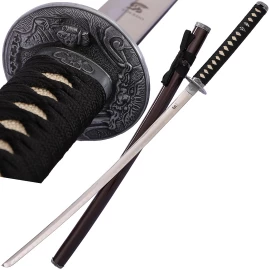
The Yuto wakizashi is a decorative Japanese short sword combining an elegantly curved blade with richly detailed fittings and traditionally styled grip wrapping. Black cord forms a diamond pattern over a light-coloured textured layer, while the circular tsuba carries raised figural decoration inspired by Japanese warrior culture. A glossy red saya with black cord is included. The 440 stainless steel blade is hardened and tempered to 47–51 HRC. Despite these specifications, this wakizashi is strictly a decorative and collectable item and is not designed for fencing, cutting or other forms of practical sword use. Further product information ...

Would you like to be notified as soon as the item is in stock?
You will receive a short e-mail as soon as we have it back in stock.
Yuto wakizashi with red saya
Japanese styling with distinctive details
The combination of black grip wrapping, a light-coloured underlayer and dark silver-toned fittings gives this wakizashi a distinctive appearance. The kashira at the end of the grip features a raised figural scene, while the circular tsuba is likewise covered with detailed relief decoration. Small ornamental elements set beneath the grip wrapping further enhance its Japanese-inspired character.
The curved polished blade features a decorative wavy line along the cutting-edge side, visually reminiscent of a hamon. On this modern decorative wakizashi, it should be regarded as a design feature rather than evidence of traditional differential hardening. The sword is accompanied by a glossy red saya with black cord and a metal end fitting.
The wakizashi in samurai equipment
The wakizashi was a Japanese short sword used particularly during the late medieval and early modern periods. It became especially significant during the Edo period (1603–1868), when samurai carried it together with the longer katana. This pairing was known as the daishō and became a characteristic symbol of samurai social status.
Unlike the longer katana, a wakizashi could in certain circumstances remain with its wearer indoors. Its shorter blade was better suited to confined spaces, and the sword could also serve as a secondary weapon. Historical wakizashi varied considerably in length, construction and the decoration of their fittings.
What the name Yuto means
Yuto is a Japanese masculine given name. Its precise meaning depends on the kanji used to write it, so different written forms may have different interpretations. As no particular kanji spelling is specified for this product, there is no single reliable translation to assign to the name. Yuto serves here as the model's individual name.
Intended use
We recommend the Yuto wakizashi as a decorative piece, collectable or non-functional prop. It displays well on its own on a Japanese sword stand or in a cabinet. You can also combine it with a decorative Yuto katana to create an arrangement visually inspired by the historical daishō.
This wakizashi is not intended for practical use. Do not use it for fencing, cutting, thrusting, contact training or cutting tests. Its decorative construction is not designed to withstand the dynamic stresses placed on a functional fighting sword.
Technical specifications
| Specification | Details |
|---|---|
| Type | Decorative wakizashi |
| Overall length | approx. 29.76 in (756 mm) |
| Blade length | approx. 19.72 in (501 mm) |
| Tsuba dimensions | approx. 2.95 × 2.76 in (75 × 70 mm) |
| Blade width | approx. 1.12 in (28.37 mm) |
| Blade thickness at the tsuba | approx. 0.20 in (5.12 mm) |
| Weight without scabbard | approx. 1.47 lb (665 g) |
| Weight with scabbard | approx. 1.82 lb (827 g) |
| Blade material | 440 stainless steel |
| Blade hardness | 47–51 HRC |
| Scabbard | Glossy red saya with black cord, included |
| Manufacturer | Art Gladius |
| Place of manufacture | Toledo, Spain |
| Measurement tolerance | All figures are approximate and may vary slightly between individual pieces |
Care and safety
- After handling, wipe the blade with a soft, dry cloth to remove fingerprints and moisture.
- For longer-term storage, you can protect the metal parts with a very thin coating of suitable maintenance oil.
- Do not use abrasive cleaners on the polished blade or relief-decorated fittings.
- Protect the lacquered saya from scratches, impacts and prolonged exposure to moisture.
- Do not use the wakizashi for cutting, fencing, thrusting or contact training.
- Always maintain sufficient distance from other people and allow plenty of clear space when handling the sword.
- Store the sword securely and out of the reach of children.
Recommended accessories
For display, we recommend a Japanese sword stand. Combined with a decorative Yuto katana, the wakizashi can form an arrangement inspired by the historical daishō, particularly associated with the Edo period from the 17th to 19th centuries. The wooden box in which the product is packed serves solely to protect the item and is supplied free of charge.
We are here for you!