Čeština
 Deutsch


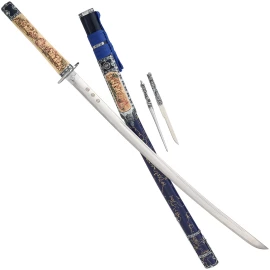
Kanazawa katana in blue and gold


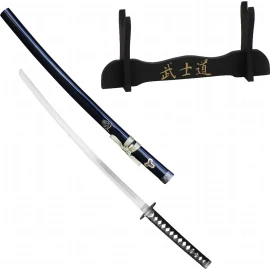
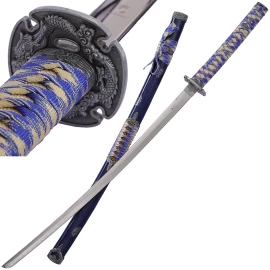
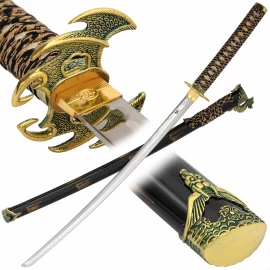
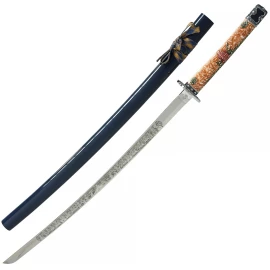
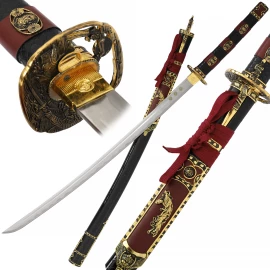
The Kanazawa katana combines a dark blue lacquered scabbard, blue-and-gold grip wrapping and striking gold-coloured fittings to create an impressive decorative Japanese sword. Its curved 440 stainless steel blade is hardened and tempered to 47–51 HRC, with a wavy decorative line running along the cutting-edge side. An elaborate tsuba featuring dragons and further raised ornamentation evoke Japanese decorative traditions. If you are looking for a distinctive samurai-inspired display piece for a study, living room or collection, this nearly metre-long sword has considerable presence. This katana is strictly decorative and is not suitable for practical use. Further product information ...

 Delivery options
Kanazawa decorative katana in blue and gold
Blue saya and gold-coloured fittings
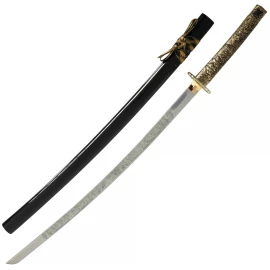
The katana's appearance is built around the contrast between rich blue, gold and the light-coloured underlayer of the grip. The tsuka features dense blue-and-gold cord wrapping over a pale textured surface, with small gold-coloured ornaments visible between the crossings. The kashira at the end of the grip carries raised figural decoration.
A particularly prominent feature is the gold-coloured tsuba decorated with dragons. Raised ornamentation continues across other fittings. The glossy dark blue wooden scabbard, or saya, is complemented by blue-and-gold cord and several gold-coloured decorative elements. Together these details give the sword a much more ceremonial appearance than a restrained Japanese sword mounting.
The polished curved blade features a wavy line along the cutting-edge side, visually reminiscent of a hamon. On this modern decorative katana, it should be regarded as a visual design feature rather than evidence of traditional differential hardening of the blade.
The katana in samurai history
The katana became one of the most recognisable forms of Japanese sword. Its characteristic form developed in medieval Japan and acquired particular cultural significance during the Edo period (1603–1868). Samurai commonly carried a katana together with the shorter wakizashi as a pair known as daishō. The sword consequently served not only as a weapon but also as a visible marker of its wearer's social status.
Japanese sword fittings developed into a sophisticated field of decorative craftsmanship. Tsuba, menuki, fuchi and kashira could feature plants, animals, heraldic emblems and mythological subjects. The dragon decorating the tsuba of this katana belongs to the traditional symbolic creatures of East Asian culture and has associations including strength, water and the forces of nature.
Why the name Kanazawa
Kanazawa is a historic Japanese city that flourished as the centre of the Kaga Domain during the Edo period and became renowned for its arts and crafts. The city remains particularly associated with traditional gold-leaf production. We therefore chose its name for this katana, whose conspicuous gold-coloured fittings and elaborate decorative treatment echo that tradition of ornamental craftsmanship.
Intended use and handling
We recommend this katana as a collectable and decorative display piece or as a non-functional prop for photography, exhibitions and costume presentation. It displays particularly well on a tabletop sword stand or suitable wall mount. Before returning the blade to the saya, make sure it is clean and dry, then insert it slowly without applying sideways pressure.
This katana is not intended for practical use. Do not use it for cutting tests, contact fencing, combat practice, striking or thrusting. Its decorative construction is not designed to withstand the dynamic stresses placed on a functional Japanese sword.
Technical specifications
| Specification | Details |
|---|---|
| Type | Decorative katana |
| Overall length | approx. 38.70 in (983 mm) |
| Blade length | approx. 27.44 in (697 mm) |
| Tsuba dimensions | approx. 3.07 × 3.07 in (78 × 78 mm) |
| Blade width | approx. 1.12 in (28.33 mm) |
| Blade thickness at the tsuba | approx. 0.22 in (5.58 mm) |
| Weight without scabbard | approx. 2.11 lb (958 g) |
| Weight with scabbard | approx. 2.70 lb (1,224 g) |
| Blade material | 440 stainless steel |
| Blade hardness | 47–51 HRC |
| Saya colour | Dark blue |
| Finish | Blue-and-gold wrapping with gold-coloured decorative fittings |
| Manufacturer | Art Gladius |
| Place of manufacture | Toledo, Spain |
| Measurement tolerance | All figures are approximate and may vary slightly between individual pieces |
Care and safety
- After handling, wipe the blade with a soft, dry cloth to remove fingerprints and moisture.
- For longer-term storage, you can protect the metal surfaces with a very thin coating of suitable maintenance oil.
- Do not use abrasive cleaners that could damage the polished blade, decorative fittings or lacquered saya.
- Protect the blue lacquered saya from scratches, impacts, prolonged moisture and sudden temperature changes.
- Do not use the katana for cutting, fencing, thrusting or combat training.
- Always allow plenty of clear space when handling the sword and keep the blade directed away from other people.
- Display the sword in a stable holder and keep it out of the reach of children.
Recommended accessories
For an attractive display, we recommend a tabletop or wall-mounted Japanese sword stand. If you want to create a decorative arrangement inspired by the samurai daishō of the Edo period, corresponding to the 17th–19th centuries, you can pair the katana with a stylistically matching wakizashi. A fabric Japanese sword bag is also useful for protected storage when the sword is not on display. The wooden box in which the product is packed serves solely to protect the item and is supplied free of charge.
We are here for you!