 Čeština
 Deutsch


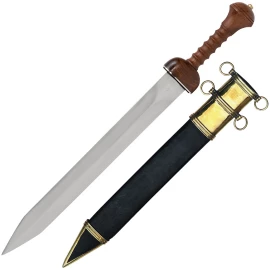
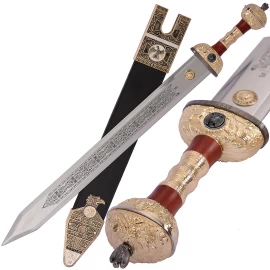
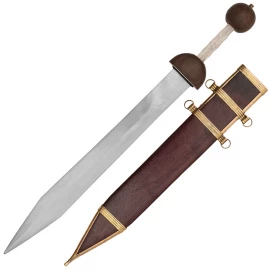
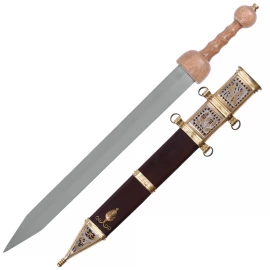
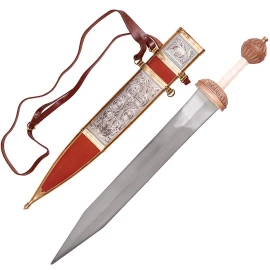
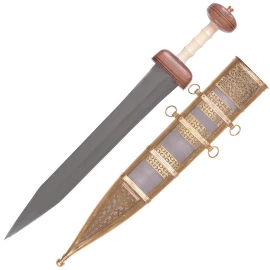
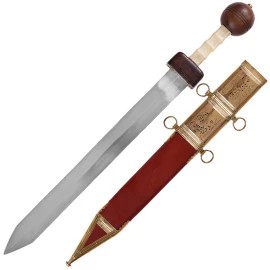
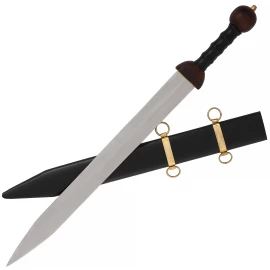
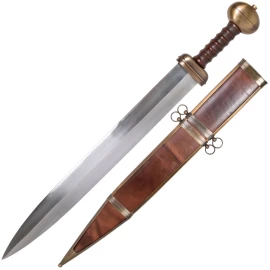
Roman Legionary Gladius Sword, Mainz Pattern


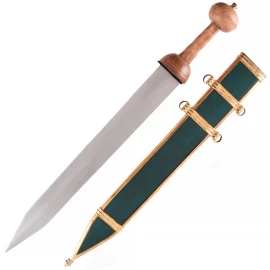
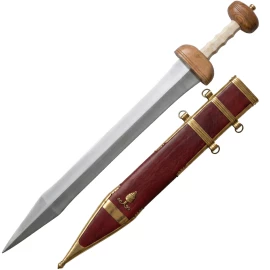
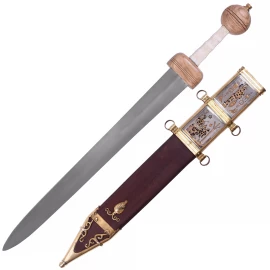
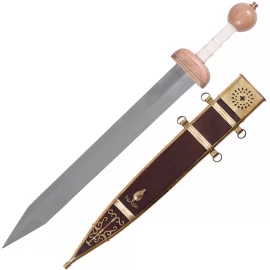
Step directly into the ranks of the Roman legions! We recommend this authentic replica of the iconic Mainz pattern short sword, the very weapon with which Roman legionaries conquered the ancient world. This gladius immediately draws attention with its contoured grip crafted from genuine natural bone, creating a striking contrast against the dark-stained wooden pommel and guard. The high carbon steel blade features a classic wasp-waisted profile terminating in a long, highly lethal thrusting point. It comes complete with a leather-wrapped wooden scabbard embellished with ornate brass appliques and carrying rings. Add a magnificent masterpiece of ancient military history to your collection! Further product information ...

Would you like to be notified as soon as the item is in stock?
You will receive a short e-mail as soon as we have it back in stock.
Roman Legionary Gladius Sword Mainz Pattern with Bone Grip
History and Origins of the Mainz Pattern Gladius
The historical archetype for this sword dates back to the transition period between the late Roman Republic and early Empire, spanning the 1st century BC to the 1st century AD. The Romans originally adopted the short sword concept from the Celtiberians during their campaigns in Hispania (known as the gladius hispaniensis). The Mainz pattern represents a key evolutionary step between the earlier Hispanic style and the later, straight-sided Pompeii pattern. It is distinguished by its subtle blade waist and noticeably elongated point.
In Roman tactical doctrine, the gladius served as the primary sidearm for heavy infantry legionaries. Used in tandem with the large curved shield (scutum), it was devastating in tight battle formations. Shielded behind a wall of wood and iron, soldiers executed fast, deadly thrusts at exposed areas of the enemy's body, rendering the gladius one of the most effective infantry weapons in antiquity.
Origin of the Name Mainz (Mogontiacum)
The name "Mainz pattern" refers to the major Roman legionary fortress and city of Mogontiacum (modern-day Mainz, Germany) along the Rhine frontier. Some of the finest surviving archaeological examples of these swords were excavated from the riverbed of the Rhine near Mainz, providing historians with the benchmark specimen for this specific blade typology.
Usage and Safety Guidelines
Please note that for safety reasons, this sword is a decorative display item not suitable for practical combat, stage fencing, HEMA sparring, or cutting tests. The blade construction is not designed to withstand blade-on-blade impacts, which could cause structural damage or personal injury. It is ideal as a museum-quality display piece, costume accessory for reenactment parades, or historical room décor.
Specifications
| Parameter | Value |
|---|---|
| Blade Material | 1080 / 1065 High Carbon Steel |
| Grip Material | Genuine natural bone, stained hardwood, steel, brass |
| Scabbard Material | Leather-wrapped wood core with brass fittings |
| Overall Sword Length | approx. 70 cm (27.56 in) |
| Blade Length | approx. 50.5 cm (19.88 in) |
| Blade Width at Guard | approx. 5.8 cm (2.29 in) |
| Blade Thickness at Guard | approx. 4.6 mm (0.18 in) |
| Blade Width near Tip | approx. 5.3 cm (2.10 in) |
| Blade Thickness near Tip | approx. 3.8 mm (0.15 in) |
| Edge Thickness | approx. 1 mm (0.04 in) |
| Point of Balance (PoB) | approx. 10.5 cm (4.13 in) from guard |
| Sword Weight | approx. 770 g (1.7 lbs) |
| Scabbard Weight | approx. 402 g (0.89 lbs) |
Care and Safety Instructions
To ensure your Roman gladius remains in pristine condition for years to come, please observe the following maintenance recommendations:
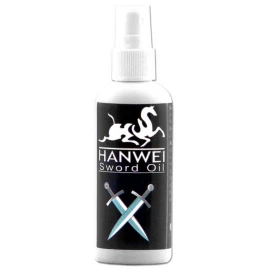
- Blade Maintenance: Wipe the high carbon steel blade dry after handling and apply a thin layer of mineral oil (e.g., Ballistol) or museum-grade wax to prevent rust formation.
- Bone and Wood Care: Protect the natural bone grip and wooden elements from excess moisture, direct sunlight, and extreme temperature fluctuations to prevent cracking.
- Brass Care: Periodically polish the scabbard's brass fittings using a soft cloth and metal polish specially formulated for brass.
- Storage: For long-term storage, do not keep the sword inside its leather sheath continuously, as leather tends to retain atmospheric moisture that promotes steel corrosion.
Recommended Accessories
To complete an authentic Roman legionary impression from the 1st century AD, we recommend pairing this sword with the following historical gear:
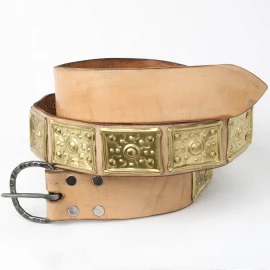
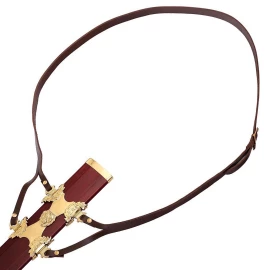
- Leather baldric or military belt (balteus or cingulum militare).
- Chainmail shirt (lorica hamata) or segmented plate armor (lorica segmentata).
- Roman wool tunic and padded undergarment (subarmalis).
- Imperial Gallic or Italic helmet (galea).
- Curved legionary shield (scutum).
We are here for you!