Čeština
 Deutsch


Roman General’s Gladius-Style Sword Maximus


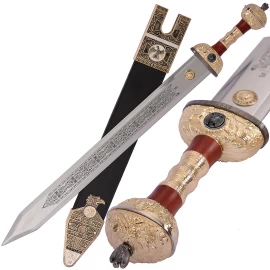
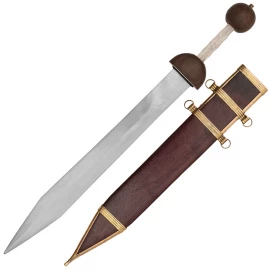
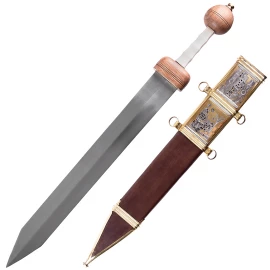
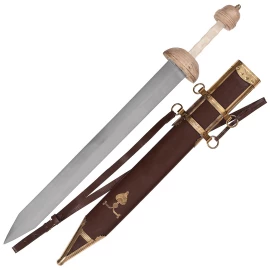
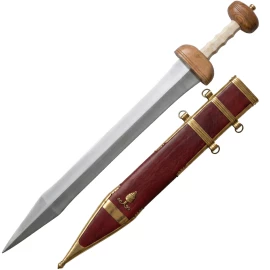
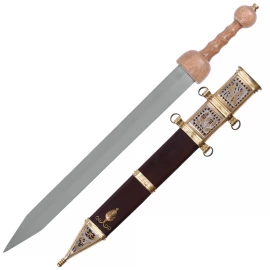
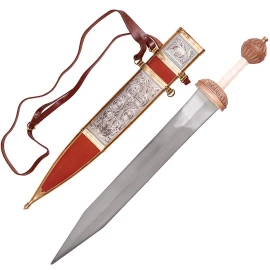
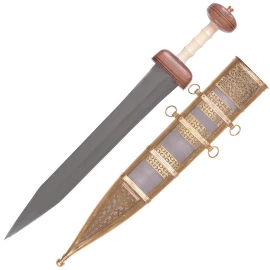
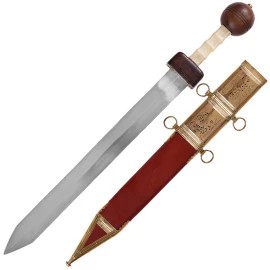
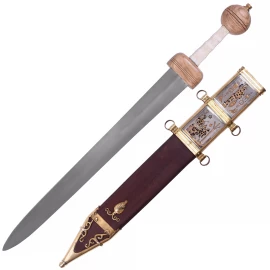
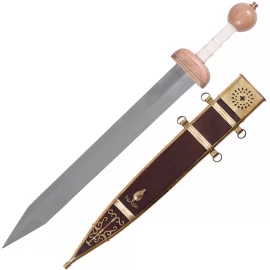
This imposing Roman sword with an extended double-edged blade is designed for collectors, enthusiasts of antiquity and portrayals of high-ranking Roman officers. Its wine-red guard and spherical pommel, pale ivory-effect grip and elaborate brass decoration create the appearance of a prestigious commander’s weapon. A leather-covered wooden scabbard and suspension straps with ornamental fittings and a lion’s head are included. The 1075 high-carbon steel blade is factory sharpened along both edges, so the sword must always be handled with exceptional care and kept securely beyond the reach of children. Further product information ...

 Delivery options
Roman General’s Gladius-Style Sword Maximus
A Prestigious Roman Officer’s Sword
This model is an artistically stylised interpretation of a Roman officer’s sword, drawing inspiration from the late Roman Republic and early Imperial period, approximately the 1st century BC to the 2nd century AD. It is not an exact reconstruction of one particular archaeological find. Instead, it combines the familiar appearance of the Roman gladius, the greater reach of the spatha and the elaborate decoration associated with a ceremonial or high-status sidearm.
The gladius served Roman infantrymen as a secondary weapon for close fighting in compact formations. Its relatively short blade was particularly effective for thrusting through gaps between shields, although the different historical forms could also deliver cuts. At 76.2 cm long, the blade of this sword is substantially longer than that of most surviving gladii and approaches the proportions of a spatha. The spatha was initially associated mainly with cavalry but became increasingly common among Roman infantry during the Imperial period.
Blade, Hilt and Roman Symbolism
The straight blade is made from 1075 high-carbon steel. Both edges are sharpened and converge into a long, symmetrical point. Its width of 5.08 cm gives the weapon a commanding silhouette, while the extended blade provides considerably more reach than a typical short gladius.
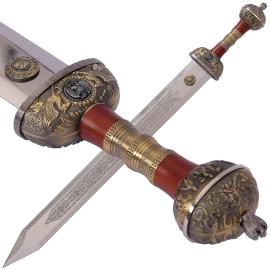
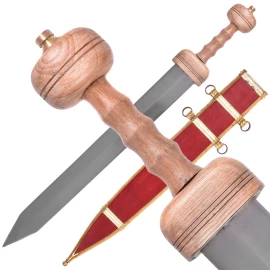
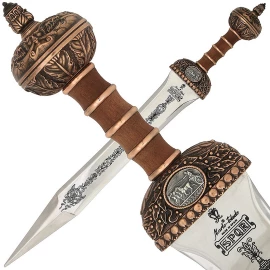
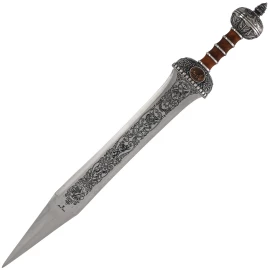
The guard and pommel have wooden foundations with glossy wine-red surfaces. Brass borders, leaf-shaped mounts and raised ornaments emphasise the prestigious character of the design. A stylised ram’s head and the letters SPQR decorate the guard. SPQR abbreviates the Latin phrase Senatus Populusque Romanus, meaning the Senate and People of Rome. Decorative brass leaves embrace the spherical pommel. The pale, sculpted plastic grip resembles carved ivory and includes a medallion bearing a profile of Caesar.
Leather-Covered Scabbard and Suspension Straps
The scabbard has a rigid wooden core covered with wine-red leather. Broad brass mounts are decorated with laurel leaves, suspension rings and a raised lion’s head. A metal chape protects the lower end. Leather straps are included for suspending the scabbard from a belt or separate sword harness.
Before wearing the sword, inspect all straps, fastenings and suspension rings. Adjust the harness so that the scabbard remains stable and does not strike the ground or interfere with your legs. For an officer or centurion portrayal, it may be worn on the left hip. Ordinary legionaries of the early Imperial period usually carried the gladius on the right side.
Safe Handling
Draw the sword in a straight, controlled movement. Do not twist the blade or force either edge against the mouth of the scabbard, as this may damage the leather covering, wooden core or sharpened edges. During costume wear, keep the sword inside its scabbard and secure it against accidental withdrawal.
This sharpened sword is not suitable for stage combat, HEMA sparring, contact re-enactment, partner drills, parrying or blade-to-blade contact. Do not use it for test cutting unless the manufacturer has expressly confirmed that the construction is suitable for that purpose.
Technical Specifications
| Specification | Details |
|---|---|
| Product type | Roman officer’s sword in gladius style |
| Historical inspiration | Late Roman Republic and early Roman Empire |
| Approximate period of inspiration | 1st century BC to 2nd century AD |
| Design character | Prestigious and artistically stylised replica |
| Blade material | 1075 high-carbon steel |
| Blade form | Straight, double-edged and long-pointed |
| Edges | Factory sharpened on both sides |
| Overall length | Approx. 97.8 cm / 38.50 in |
| Blade length | Approx. 76.2 cm / 30.00 in |
| Blade width | Approx. 5.08 cm / 2.00 in |
| Blade thickness | Approx. 4.8 mm / 0.19 in |
| Sword weight | Approx. 1120 g / 2.47 lb |
| Guard and pommel | Wood with a wine-red finish and brass decoration |
| Grip | Sculpted plastic with an ivory-like appearance |
| Hilt decoration | Caesar medallion, ram’s head, leaf ornaments and SPQR lettering |
| Scabbard construction | Wooden core covered with wine-red leather |
| Scabbard decoration | Brass mounts, laurel motifs, lion’s head, suspension rings and chape |
| Suspension system | Leather straps with metal fittings |
| Delivery contents | Sword, scabbard and suspension straps |
| Manufacturer | Windlass Steelcrafts |
| Intended use | Collecting, display, decoration, photography and carefully controlled costume wear |
Care and Safety
- After every handling session, remove fingerprints from the blade with a clean, soft and dry cloth.
- Apply a thin and even coating of suitable sword or weapon maintenance oil to the carbon steel.
- Wear cut-resistant protective gloves when cleaning and always move the cloth away from the sharpened edges.
- Do not store the sword permanently inside the scabbard, as leather and wood may retain moisture and encourage corrosion.
- Keep the leather covering dry and condition it sparingly with a product intended for smooth natural leather.
- Polish the brass parts only with a mild product and keep it away from the leather and coloured wooden surfaces.
- Protect the sword from rain, high humidity, salt water, sudden temperature changes and prolonged direct sunlight.
- Never test the edge with a finger and keep the sword beyond the reach of children and untrained persons.
- Do not throw the sword, use it as a lever, strike hard objects or make contact with another weapon.
Recommended Accessories
To create the appearance of a Roman officer from the 1st to 2nd century AD, we recommend a Roman tunic, a cingulum or balteus military belt, a paludamentum cloak, a Roman helmet and either lorica hamata or lorica segmentata armour. A scutum shield, pugio dagger and caligae complete a legionary outfit. For safe display, use a stable sword stand or secure wall mount. A padded sword bag will help protect the blade, scabbard and fittings during transport.
We are here for you!