Čeština
 Deutsch


Black Prince sword with bronze-finish hilt


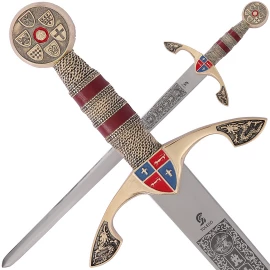
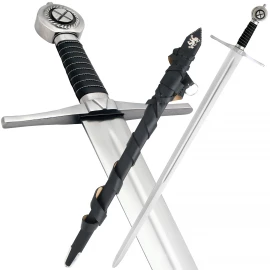
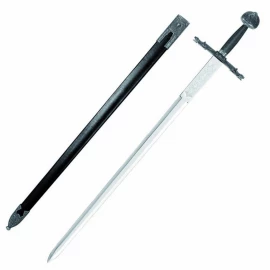
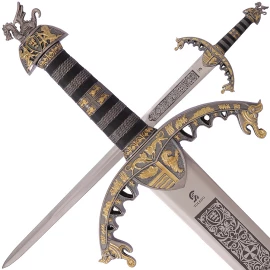
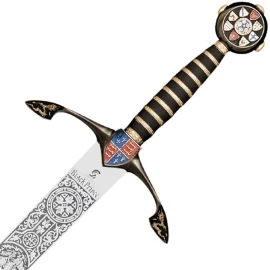
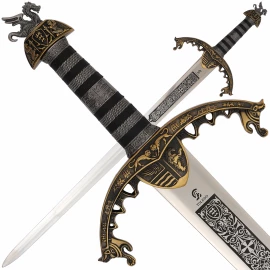
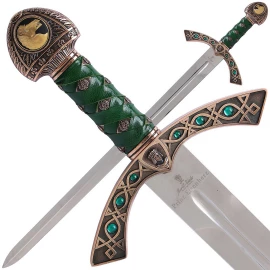
The Black Prince decorative sword commemorates Edward of Woodstock, Prince of Wales, later known as the Black Prince. Its long polished blade contrasts with black ornamental decoration and a striking hilt in bronze and antique-silver finishes. Heraldic shields, an elaborate crossguard and a circular pommel bearing the motto of the Order of the Garter give the sword a distinctly medieval character. If you want an eye-catching collectable for a study, armoury or historically themed interior, this model offers plenty of detail to explore. It is strictly decorative, with a blunt blade, and is not suitable for practical swordsmanship. Further product information ...

Would you like to be notified as soon as the item is in stock?
You will receive a short e-mail as soon as we have it back in stock.
Black Prince decorative sword with bronze-finish hilt
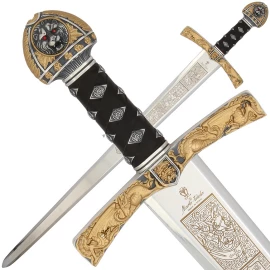
Heraldic decoration in bronze and antique silver
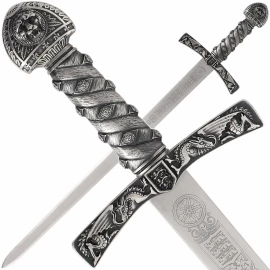
The 420 stainless-steel blade has a long central fuller and extensive black etched decoration combining vegetal, circular, heraldic and figural motifs. The inscription Black Prince is clearly visible near the hilt. The curved crossguard has a bronze appearance, with antique-silver-effect relief panels at its ends and a heraldic shield positioned at the centre.
The black grip is divided by regularly spaced metallic-looking decorative bands. Its substantial circular pommel combines bronze and antique-silver finishes and carries the motto Honi soit qui mal y pense. The overall design is deliberately historic-inspired, referring to the Black Prince and the chivalric culture of the 14th century rather than reproducing a specific surviving sword belonging to Edward of Woodstock.
The Black Prince and 14th-century chivalry
Edward of Woodstock (1330–1376), eldest son of King Edward III of England, was Prince of Wales and an important commander during the Hundred Years' War. He became famous for his role at the Battle of Crécy in 1346 and later commanded Anglo-Gascon forces at the victory of Poitiers in 1356. Although the name “Black Prince” is now inseparable from him, it is not documented as a commonly used nickname in surviving sources from his own lifetime.
Edward was among the first knights of the Order of the Garter, founded by his father Edward III in the 14th century. This explains the pommel inscription Honi soit qui mal y pense, the Order's motto, commonly rendered in English as “Shame on him who thinks evil of it”. The inscription is therefore more than decorative: it directly references the prestigious English order of chivalry with which Edward was closely associated.
Meaning of the name Black Prince
Black Prince is the later name by which Edward of Woodstock became widely known. This decorative sword bears the name because its heraldic ornament and references to the Order of the Garter evoke his position as Prince of Wales, knight and military commander of the 14th century.
Technical specifications
| Specification | Value |
|---|---|
| Type | decorative sword |
| Name | Black Prince |
| Historical inspiration | Edward of Woodstock, Prince of Wales, 14th century |
| Overall length | approx. 44.25 in / 1,124 mm |
| Blade length | approx. 34.65 in / 880 mm |
| Crossguard length | approx. 9.45 in / 240 mm |
| Blade width | approx. 2.02 in / 51.42 mm |
| Blade thickness | approx. 0.20 in / 5.12 mm |
| Weight | approx. 3.21 lb / 1,456 g |
| Blade material | 420 stainless steel |
| Edge | blunt |
| Grip material | Zamak – an alloy of zinc, aluminium, magnesium and copper |
| Surface finish | brass and antique-silver appearance |
| Decoration | etched ornamental, heraldic and figural motifs |
| Pommel inscription | Honi soit qui mal y pense |
| Intended use | decorative and collectable use only |
| Manufacturer | Art Gladius |
| Made in | Toledo, Spain |
All stated dimensions and the weight are approximate and may vary slightly between individual pieces.
Care and safe display
Do not use this sword for fencing, cutting, thrusting, technique practice or contact combat. A blunt blade does not make it a safe training weapon; its weight and rigid construction can still cause injury if mishandled. For display, we recommend a stable sword stand or a sufficiently strong wall hanger.
Wipe the blade with a soft, dry cloth and protect it from prolonged exposure to moisture. Do not use abrasive cleaners, wire brushes or aggressive chemicals on the decorated hilt, as these may damage its finish. Store the sword in dry conditions and out of the reach of children.
Recommended accessories
For secure presentation, pair the sword with a sword stand or wall hanger. For a display inspired by the 14th century, consider a replica knightly shield with English heraldry, mail or plate armour, a bascinet and other decorative pieces associated with medieval chivalry and the Hundred Years' War.
We are here for you!