Čeština
 Deutsch


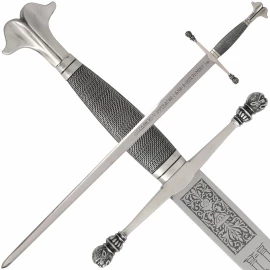
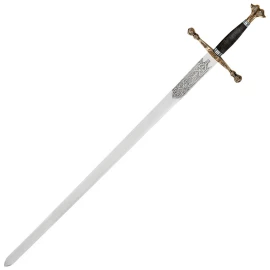
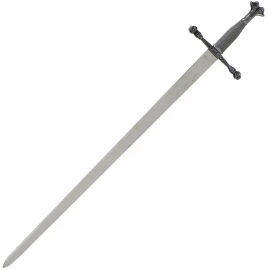
Ceremonial Two-Handed Sword Fernando II Catholic Monarchs


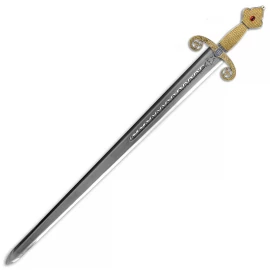
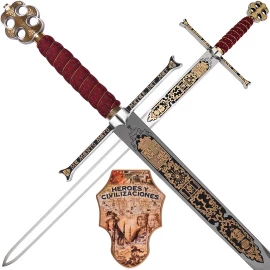
Are you looking, distinguished collector, to own an iconic symbol of Spanish royalty and imperial majesty? The Ceremonial Two-Handed Sword Fernando II will enchant you with its gold-plated hilt, luxurious red velvet grip, and exquisitely engraved stainless steel blade. Crafted in legendary Toledo, Spain, this faithful replica features Latin crossguard inscriptions and the personal heraldic emblems of the Catholic Monarchs. We recommend this grand decorative sword as a breathtaking centerpiece for your study, display room, or historical collection. Further product information ...

 Delivery options
Ceremonial Two-Handed Sword Fernando II Catholic Monarchs
History, Usage, and Cult Prototype
The historical prototype originates from the late 15th century (circa 1492), spanning the transition between the Late Middle Ages and the Renaissance. During this era, massive two-handed ceremonial swords served as supreme emblems of monarchical authority, faith, and state power. This sword accompanied the Spanish Crown as a standard-bearing weapon during official state ceremonies, religious celebrations, and momentous milestones such as the Conquest of Granada in 1492.
According to royal tradition, it was with this very sword that King Ferdinand II and Queen Isabella I knighted Christopher Columbus upon his return from his first voyage to the Americas. In the Throne Hall of the Royal Palace of Barcelona, Columbus was granted the historic titles of "Admiral of the Ocean Sea" and "Viceroy of the Indies".
The polished stainless steel blade is richly embellished with gold and black etched details. Among the engravings, the yoke and bundle of arrows stand out as personal emblems of the Catholic Monarchs representing the dynastic union of Aragon and Castile. Alongside the crowned royal coat of arms and Renaissance scrollwork, the crossguard features engraved Latin inscriptions: TANTO MONTA – MONTA TANTO (the famous motto representing equal rule) and ME MENTO METO MATER DEI MIEI.
Significance of the Name Fernando II
This sword bears its honorary name Fernando II in tribute to King Ferdinand II of Aragon (1452–1516). Alongside Queen Isabella I of Castile, he laid the foundations for unified Spain, sponsored Christopher Columbus's transoceanic exploration, and established Spain as a global power. Naming this weapon honours his statesmanship legacy.
Technical Specifications
| Specification | Metric Value | Imperial Value |
|---|---|---|
| Overall Length | approx. 1210 mm / 121 cm | approx. 47.64 in |
| Blade Length | approx. 930 mm / 93 cm | approx. 36.61 in |
| Guard Width | approx. 275 mm | approx. 10.83 in |
| Blade Width at Guard | approx. 45.3 mm | approx. 1.78 in |
| Blade Thickness at Guard | approx. 5.0 mm | approx. 0.20 in |
| Blade Width 10 cm / 3.94 in from Tip | approx. 34.7 mm | approx. 1.37 in |
| Blade Thickness 10 cm / 3.94 in from Tip | approx. 5.0 mm | approx. 0.20 in |
| Ricasso Length | approx. 280 mm | approx. 11.02 in |
| Point of Balance (POB) | approx. 16.5 cm from guard | approx. 6.50 in from guard |
| Edge Thickness | approx. 1.0 mm | approx. 0.04 in (unsharpened/decorative) |
| Blade Material | Stainless steel with gold etched detailing | Stainless steel with gold etched detailing |
| Hilt Material | Gold-plated alloy (24K gold finish), red velvet grip | Gold-plated alloy (24K gold finish), red velvet grip |
| Total Weight | approx. 2516 g | approx. 5.55 lbs |
| Manufacturing Location | Toledo, Spain | Toledo, Spain |
| Intended Purpose | Decorative and collecting display only | Decorative and collecting display only |
Care and Safety Instructions
The stainless steel blade is highly resistant to tarnishing; simply wipe clean with a soft microfiber cloth after handling. Clean the gold-plated hilt and red velvet grip gently with a dry cloth only—avoid chemical metal polishes or abrasive cleansers, which could strip the gold layer or ruin the velvet.
SAFETY WARNING: This sword is strictly a decorative collector's item. For safety reasons, it is NOT intended for contact fencing, HEMA sparring, stage combat, or target cutting tests! The hilt construction and edge thickness (1.0 mm) are not designed for metal-on-metal impacts. Misuse may result in product damage or injury.
Recommended Accessories
To display this 15th-century royal sword with distinction, we recommend a wooden wall display rack or tabletop sword stand. To complete a Renaissance display, consider pairing it with a velvet mantle or period-style costume.
We are here for you!