Čeština
 Deutsch


Richard the Lionheart sword, bronze finish


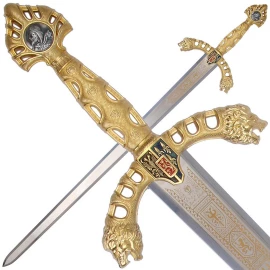
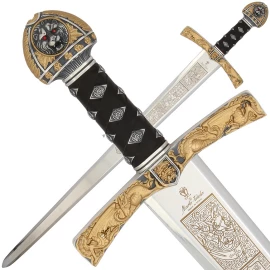
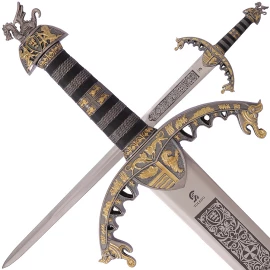
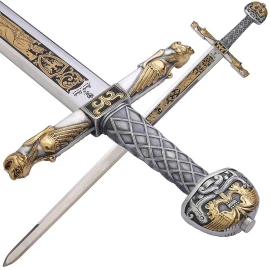
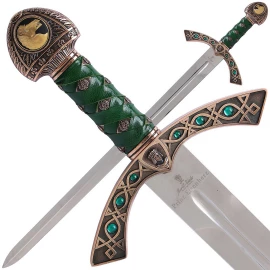
This monumental Richard the Lionheart decorative sword evokes one of the most famous English kings of the Middle Ages. Measuring more than a metre in length, it combines a polished blade with contrasting black ornament and an exceptionally elaborate hilt finished in gold and dark metallic tones. The guard, grip and pommel feature heraldic and medieval-inspired motifs, including lions, shields, a dragon and small figural scenes. It makes an imposing collectable for a study, armoury or historically themed interior. This sword is strictly decorative, has a blunt blade and is not suitable for practical swordsmanship. Further product information ...

Would you like to be notified as soon as the item is in stock?
You will receive a short e-mail as soon as we have it back in stock.
Richard the Lionheart decorative sword, bronze finish
Rich decoration with a bronze-style finish
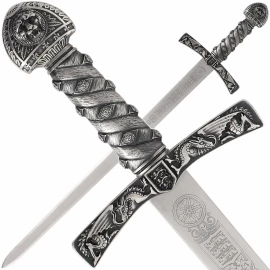
The 420 stainless-steel blade features a long central fuller and a prominent black ornamental panel combining vegetal, heraldic and geometric motifs. The hilt contrasts dark metallic tones with a gold-coloured bronze appearance. Its curved, openwork crossguard terminates in stylised animal heads, while the centre incorporates a shield bearing heraldic-style designs.
The black grip is divided by decorative metal bands and spiral sections with a chain-like texture. A sculpted winged dragon crowns the pommel. Small figures, animals, buildings and decorative signs can also be seen across the hilt. The result is a modern historic-inspired composition based on Richard I and medieval imagery rather than an exact copy of a documented personal sword belonging to the king.
Richard the Lionheart and the late 12th century
Richard I of England (1157–1199) reigned from 1189 until his death. His famous epithet, the Lionheart, or Coeur de Lion in French, reflected his reputation as a courageous warrior. He spent much of his reign outside England and became particularly renowned for his role in the Third Crusade of 1189–1192, during which he fought the forces of Sultan Saladin.
European knightly swords of Richard's period were primarily functional weapons, normally combining a straight double-edged blade with a simple crossguard and much more restrained decoration than this model. This decorative sword therefore represents a romantic historic interpretation of the celebrated medieval king rather than a precise 12th-century reproduction. An interesting aspect of Richard's reign is that he spent relatively little of his roughly ten years as king in England, with his political interests also focused heavily on the Plantagenet territories in France.
Meaning of the name Richard the Lionheart
The name commemorates Richard I of England, known as Richard the Lionheart, one of the best-known figures of medieval European chivalric history. His military reputation, participation in the Crusades and later legendary image as a warrior king provide the historical inspiration for the elaborate symbolism of this collectable sword.
Technical specifications
| Specification | Value |
|---|---|
| Type | decorative sword |
| Name | Richard the Lionheart |
| Historical inspiration | Richard I of England, 12th century |
| Overall length | approx. 43.15 in / 1,096 mm |
| Blade length | approx. 34.09 in / 866 mm |
| Crossguard length | approx. 9.45 in / 240 mm |
| Blade width | approx. 1.97 in / 50.14 mm |
| Blade thickness | approx. 0.20 in / 5.20 mm |
| Weight | approx. 3.51 lb / 1,594 g |
| Blade material | 420 stainless steel |
| Edge | blunt |
| Hilt material | Zamak – an alloy of zinc, aluminium, magnesium and copper |
| Hilt finish | bronze appearance with dark and gold-coloured details |
| Decoration | historic-inspired heraldic, animal, figural and ornamental motifs |
| Intended use | decorative and collectable use only |
| Manufacturer | Art Gladius |
| Made in | Toledo, Spain |
All stated dimensions and the weight are approximate and may vary slightly between individual pieces.
Safe display and care
This sword is not designed for fencing, cutting, thrusting, technique practice or any form of contact use. A blunt blade does not make it a safe training weapon. When handling it, bear in mind its length of over 3.5 ft / 1 m and weight of approximately 3.5 lb / 1.6 kg. For display, we recommend a sturdy sword stand or sufficiently strong wall hanger.
Wipe the blade regularly with a clean, dry, soft cloth and protect it from prolonged moisture and dirt. Do not clean the decorated hilt with abrasive products, wire brushes or aggressive chemicals, as these may damage its finish. Store the sword in dry conditions and out of the reach of children.
Recommended accessories
A sturdy sword stand or wall hanger is ideal for displaying this piece. For a presentation inspired by the 12th century, you can complement it with a replica knightly shield, mail armour, a Norman or early great helm and other decorative pieces associated with the period of the Crusades.
We are here for you!