Čeština
 Deutsch


Type XVIa Longsword Zawisza Czarny with Floral Scabbard


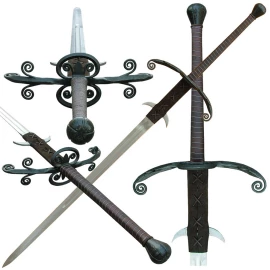
Named in tribute to the celebrated Polish knight Zawisza Czarny, this elegant longsword combines a late-medieval-inspired blade with distinctly decorative fittings. Its spring-steel blade measures 91 cm (35.8 in), incorporates a short central fuller and tapers considerably towards the point. The hilt features a gently curved floral crossguard, a black silicone-covered grip and a peened, strongly faceted pommel. A black scabbard with embossed floral decoration and a suspension belt is included. The measured edge thickness is only 0.4 mm (0.016 in), meaning that this is a sharpened weapon and must not be used for HEMA sparring or any other person-to-person contact fencing. Further product information ...

Would you like to be notified as soon as the item is in stock?
You will receive a short e-mail as soon as we have it back in stock.
Type XVIa Longsword Zawisza Czarny with Floral Scabbard
Character and construction
At 121 cm (47.6 in) overall, this is a relatively compact longsword or hand-and-a-half sword. The 22.5 cm (8.9 in) grip provides sufficient room for secure two-handed handling, whilst the blade measures 91 cm (35.8 in). The sword itself weighs 1.458 kg (3.21 lb), with its point of balance 10.5 cm (4.1 in) ahead of the crossguard. This gives the weapon perceptible blade presence rather than concentrating its mass immediately around the hands.
The blade is 50.3 mm (1.98 in) wide beneath the guard and narrows to 21.7 mm (0.85 in) at a point 10 cm (3.9 in) behind the tip. This pronounced profile taper creates a well-defined point and reflects the character of later medieval swords designed to retain useful cutting capability whilst offering increasingly effective thrusting geometry.
A central fuller approximately 35 cm (13.8 in) long occupies the stronger part of the blade. A fuller alters the distribution of material within the blade section and can contribute to the relationship between mass and stiffness. It is not a “blood groove”, a persistent but technically incorrect popular description.
Spring steel and blade stiffness
The manufacturer specifies spring steel and a flex rating of 15 kg (33.1 lb). A flex measurement describes resistance to bending and therefore provides an indication of the relative stiffness of a training or functional blade. At 15 kg, this is a comparatively stiff blade with positive feedback during handling.
Flex, however, must never be interpreted on its own as evidence that a sword is safe for contact fencing. The measured edge thickness of this example is only 0.4 mm (0.016 in). Under a practical edge classification this is a sharpened edge. Consequently, even if some of the sword's dimensional characteristics resemble those of modern HEMA longswords, this sharp configuration is not suitable for striking a training partner.
Floral crossguard and distinctive pommel
The crossguard measures 24 cm (9.4 in) and curves gently towards the blade. Its visible surfaces carry an elaborate floral pattern, including ornament around the central section of the guard. The decoration gives the hilt a more prestigious appearance than the plain fittings normally associated with utilitarian training swords.
The grip has a black silicone-rubber surface and is subtly shaped around its middle to help locate the hands during two-handed use. The hilt terminates in a strongly faceted peened pommel with a flared silhouette described by the manufacturer as fishtail-inspired.
A peened construction means that the end of the tang has been mechanically spread over the pommel to secure the hilt assembly. Peening is one of the traditional methods used to assemble European sword hilts.
Oakeshott Type XVIa
The manufacturer identifies this model as an Oakeshott Type XVIa. This classification is associated with European longsword blades of the 14th and 15th centuries. Typical features include a long blade, a fuller occupying the upper portion and increasing taper towards a defined point.
Within medieval sword development, Type XVIa represents a particularly interesting compromise between cut and thrust. The blade retains enough breadth to remain effective in cutting, yet its narrowing profile and point provide greater thrusting potential than many earlier, broader cutting swords.
This development coincided with substantial changes in European armour during the 14th and 15th centuries. Mail continued to be used, but was increasingly supplemented by plate elements and ultimately by complete plate harness. Accurate thrusting towards less protected areas therefore became increasingly relevant alongside the traditional cut.
Oakeshott's system primarily classifies blades rather than complete swords. Crossguards, pommels and grip forms can therefore vary considerably between weapons fitted with blades belonging to the same type.
Zawisza Czarny – a knight synonymous with reliability
The model is named in honour of Zawisza Czarny of Garbów, of the Sulima coat of arms, one of the most celebrated Polish knights of the late Middle Ages. Born around 1370, he became known not only as a warrior and tournament knight but also as a diplomat and courtier with strong links to the court of Sigismund of Luxembourg.
In 1410 Zawisza fought on the Polish side at the Battle of Grunwald against the Teutonic Order. He also took part in international tournaments, diplomatic missions and the Polish delegation to the Council of Constance.
He was killed in 1428 during fighting against the Ottomans at the Danube fortress of Golubac. His later reputation became so deeply rooted in Polish culture that the expression meaning “to rely on someone as on Zawisza” came to describe exceptional trustworthiness and dependability.
This sword is not a reproduction of a weapon documented as having belonged to Zawisza Czarny. Its name pays tribute to a historical knight whose lifetime corresponds well with the period associated with Type XVIa longswords.
Black floral scabbard and belt
The supplied black scabbard has a synthetic-leather outer surface embossed with a fine floral pattern running along most of its length. A metal chape protects the lower end and visually complements the bright steel-coloured fittings of the sword.
Two suspension fittings allow the scabbard to be carried from the included black belt. The belt measures 130 cm (51.2 in) in length and 3 cm (1.18 in) in width, with a material thickness of approximately 2.20 mm (0.087 in).
Technical specifications
| Specification | Value |
|---|---|
| Type | European longsword / hand-and-a-half sword, manufacturer designation Oakeshott XVIa |
| Overall length | 121 cm (47.6 in) |
| Blade length | 91 cm (35.8 in) |
| Grip length | 22.5 cm (8.9 in) |
| Crossguard length | 24 cm (9.4 in) |
| Fuller length | 35 cm (13.8 in) |
| Blade width below guard | 50.3 mm (1.98 in) |
| Blade width 10 cm behind tip | 21.7 mm (0.85 in) |
| Edge thickness | 0.4 mm (0.016 in) |
| Blade edge | Sharp |
| Blade tip | Sharp / pointed |
| Blade material | Spring steel |
| Blade flex | 15 kg (33.1 lb) according to the manufacturer |
| Point of balance | 10.5 cm (4.1 in) ahead of the guard |
| Pommel | Peened, faceted |
| Grip surface | Black silicone rubber |
| Sword weight | 1.458 kg (3.21 lb) |
| Scabbard weight | 346 g (0.76 lb) |
| Scabbard | Black synthetic-leather surface with floral embossing and metal chape |
| Belt length | 130 cm (51.2 in) |
| Belt width | 3 cm (1.18 in) |
| Belt material thickness | 2.20 mm (0.087 in) |
| Intended use | Collecting, reenactment presentation and solo practice; not for person-to-person contact fencing |
As functional swords receive a degree of manual finishing, dimensions, weight, point of balance and minor surface details may vary slightly between individual examples.
Practical use and safety
The measured edge thickness of 0.4 mm (0.016 in) means that this is a sharpened weapon. This particular sword must therefore not be used for HEMA sparring, contact stage combat, LARP fighting or any other form of person-to-person swordplay. The stated 15 kg flex rating does not alter this restriction.
The sword is suitable as a collectable, for historically inspired presentation and for controlled solo practice. The available specifications do not explicitly confirm this particular configuration for repeated target cutting, so we do not present cutting practice as an automatically approved use.
- Handle the sword only where there is ample clear space around you.
- Keep both the edge and point directed away from your body while drawing or sheathing it.
- Store the weapon securely away from children and unauthorised persons.
- Do not strike another steel weapon, metal objects, stone or concrete.
- Never handle a sharp sword while under the influence of alcohol or other intoxicating substances.
Care and maintenance
Spring steel requires protection against corrosion. After handling, wipe the blade thoroughly with a soft dry cloth, remove fingerprints and apply a very thin protective layer of suitable blade or gun oil. Pay particular attention to the area around the guard and to the fuller, where moisture can remain unnoticed.
Never leave a damp blade stored inside the scabbard for an extended period. The synthetic-leather surface of the scabbard can be cleaned with a lightly damp cloth; avoid aggressive solvents. The silicone grip normally requires little more than wiping with a clean cloth. Avoid oily treatments on the grip, as these can make the surface unnecessarily slippery.
Recommended accessories
For secure display and storage we recommend a stable sword stand or suitable wall mounting system. Routine maintenance is easier with corrosion-protection oil for carbon and spring steels together with soft cleaning cloths. If you wish to incorporate the sword into an outfit inspired by the late 14th or early 15th century, period-appropriate clothing, a gambeson and other late-medieval equipment make suitable complementary items.
About Swordier
Swordier is associated with Longquan in Zhejiang Province, an area with a long tradition of blade making and metalworking. Modern Swordier production combines this regional craft background with contemporary manufacture of functional European and fantasy-inspired swords.
The brand focuses on practical constructions using carbon and spring steels, aiming to offer an attractive relationship between price, materials, construction and finish rather than relying primarily on luxury branding. The Zawisza Czarny model also demonstrates the more decorative side of the range: a functional spring-steel blade is paired with an ornate hilt and floral scabbard without reducing the sword to a purely decorative object.
We are here for you!