Čeština
 Deutsch


Scottish Sword William Wallace, 13th Century


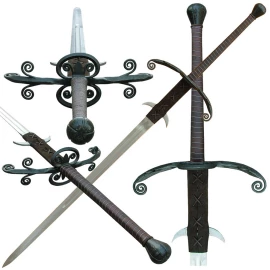
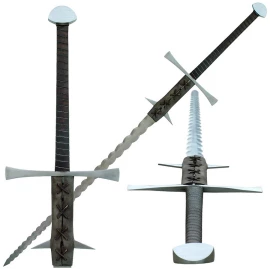
Are you looking for a commanding historical weapon to infuse your home with the fierce spirit of medieval freedom, warrior? We recommend this decorative Scottish two-handed sword William Wallace! This impressive display piece immediately catches the eye with its straight blade made of hardened 440 stainless steel, a broad crossguard with spherical finials, and a natural light wood grip designed for a comfortable two-handed hold. The pear-shaped pommel and antiqued Zamak fittings add a noble finish. Display this Toledo-crafted replica proudly on your wall or in your private armory! Further product information ...

 Delivery options
The following variants are currently available:
Decorative Scottish Two-Handed Sword William Wallace 13th Century
Historical Context and Scottish Two-Handed Swords
The artistic and structural design of this sword draws inspiration from High Middle Ages two-handed and longswords dating from the 13th to 14th century. During this era, massive cutting swords emerged in Scotland, serving as the direct structural precursors to the famous Highland claymores of later centuries. Typologically, it reflects classic medieval longswords featuring a straight double-edged blade and a broad crossguard.
In 13th-century warfare, a two-handed sword was deployed on the battlefield to break heavy infantry formations and sever the shafts of enemy pikes. The long blade combined with the leverage of a two-handed hilt allowed a skilled warrior to deliver cleaving strikes of immense force. Featuring ornate etching on the upper blade, this display model was crafted in the renowned workshops of Art Gladius® in Toledo, Spain—a city world-famous for its swordsmithing heritage.
Significance of the Name – William Wallace
This sword proudly bears the name of Sir William Wallace (c. 1270–1305), the legendary Scottish knight, national hero, and primary leader during the First War of Scottish Independence. Wallace attained enduring renown for his fierce leadership and decisive victory over a larger English army at the Battle of Stirling Bridge in 1297. Naming this weapon after Wallace pays homage to chivalric bravery, honor, and the steadfast fight for national liberty.
Technical Specifications
| Parameter | Value |
|---|---|
| Product Type | Decorative sword / Historical replica |
| Historical Period | High Middle Ages (13th–14th century) |
| Overall length of sword | 107 cm / 42.1 in |
| Blade length | 82 cm / 32.3 in |
| Crossguard width | 22.5 cm / 8.9 in |
| Wooden grip length | 17.5 cm / 6.9 in |
| Blade etching length | 15.5 cm / 6.1 in |
| Blade width under guard | 37.8 mm / 1.49 in |
| Blade width 10 cm (3.9 in) from tip | 26 mm / 1.02 in |
| Edge thickness | 1.4 mm / 0.06 in |
| Weight of sword | 1335 g / 2.94 lbs |
| Weight of scabbard | 331 g / 0.73 lbs |
| Blade material | Hardened 440 stainless steel (47–51 HRC) |
| Guard & pommel material | Antiqued Zamak (zinc-aluminium-magnesium-copper alloy) |
| Grip material | Natural light wood |
| Origin | Toledo, Spain (Art Gladius®) |
| Age restriction | Sale restricted to persons aged 18 and over |
Care and Safety Instructions
Important Safety Notice: For safety reasons, this item is strictly a decorative display piece not suitable for practical use (such as HEMA fencing, SCA combat, stage fighting, sparring, or cutting tests). Neither the 440 stainless steel blade nor the cast alloy fittings are engineered to withstand structural impacts; practical contact carries a severe risk of blade breakage and personal injury.
To preserve its appearance, follow these care recommendations:
- Blade Maintenance: The 440 stainless steel blade does not require heavy oiling. Wipe the surface regularly with a dry cotton or microfibre cloth to remove dust and fingerprints.
- Hilt & Wood Care: Clean the antiqued Zamak guard and pommel using only a dry cloth. Do not use harsh chemical cleaners that could strip the patina. The wooden grip can be treated occasionally with natural wood wax.
- Storage: Store the sword in a dry indoor environment protected from direct moisture.
- Prohibited Actions: Never strike hard objects with the sword, and do not use it for thrusting, prying, or combat practice.
Recommended Accessories
We recommend complementing your 13th-century Scottish display with matching items from our range:
- Wooden Wall Display Board or Forged Wall Hooks: For safe, elegant, and prominent wall presentation.
- Scottish Tartan Sash: A traditional textile accessory authentic to Scottish heritage.
- 13th-Century Leather Sword Belt: A period-accurate belt ideal for mounting the scabbard with historical attire.
We are here for you!