Čeština
 Deutsch


Bohuš of Otaslavice Gothic Type XXa Longsword


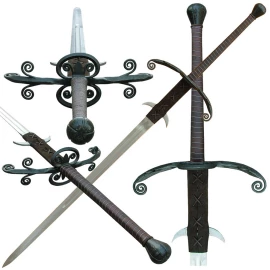
The Bohuš of Otaslavice Gothic longsword is a sharpened, functionally constructed hand-and-a-half sword inspired by European weapons of the 14th and 15th centuries. Swordier classifies the blade as Oakeshott Type XXa, a designation consistent with its broad tapering profile and distinctive three-fuller arrangement. The sword measures 120 cm (47.2 in) overall, weighs 1.588 kg (3.50 lb), and has a 22.5 cm (8.9 in) grip offering ample space for two-handed control. An ornate curved crossguard and decorative fishtail-style pommel give the hilt a strongly individual appearance. A black decorated scabbard and belt are included. Further product information ...

 Delivery options
Bohuš of Otaslavice Gothic Type XXa Longsword
A broad triple-fullered Type XXa blade
The blade measures 89.5 cm (35.2 in) in length and is 48.6 mm (1.91 in) wide immediately below the guard. It tapers gradually towards the point, remaining 34.8 mm (1.37 in) wide at 10 cm (3.9 in) behind the tip. It is therefore still a substantial blade in its forward section rather than a narrow thrusting profile, although the point itself remains clearly defined.
Its most distinctive structural feature is the three-fuller layout. The long central fuller extends for approximately 80 cm (31.5 in), while the two shorter fullers in the forte measure about 30 cm (11.8 in). Multiple fullers are among the most recognisable characteristics of Oakeshott Types XX and XXa. A fuller is not a “blood groove”; it is a structural method of managing the distribution of material and mass within a blade.
The blade is made from spring steel and is specified at approximately 49–53 HRC. The supplied data also gives a flex or stiffness value of over 16 kg (35.3 lb). The measured striking-edge thickness is only 0.3 mm (0.012 in), placing this sword clearly within our sharpened category. The point is likewise sharp rather than rounded for training safety.
Balance and handling character
Overall length is 120 cm (47.2 in), while the measured sword weighs 1.588 kg (3.50 lb). Its point of balance lies 15.5 cm (6.1 in) forward of the crossguard, so a noticeable proportion of the weapon's mass remains in the blade.
This does not automatically make the sword clumsy. The 22.5 cm (8.9 in) grip provides useful two-handed leverage, and the blade narrows progressively towards the point. The resulting character is that of a substantial, cut-capable late-medieval longsword rather than an exceptionally light modern fencing sword, whilst the defined point still provides useful point control.
Decorated crossguard and fishtail pommel
The crossguard measures 24 cm (9.4 in) and its arms curve gently towards the blade. Their visible surfaces carry raised floral and scrolling decoration. The effect is distinctly prestigious, although the basic construction remains a traditional crossguard without the side rings and additional branches that became increasingly common on later Renaissance hilts.
The black grip is 22.5 cm (8.9 in) long and, according to the manufacturer, is covered in genuine leather. Its subtly shaped profile gives the hands useful tactile orientation and leaves ample room for a comfortable two-handed hold.
The hilt terminates in a broad decorative pommel described by Swordier as a fishtail pommel. Polished surfaces and relief ornament echo the decoration of the guard. The pommel on this model is specified as peened, meaning that the end of the tang is mechanically secured over the pommel rather than relying on an exposed threaded nut.
Oakeshott Type XXa
Swordier describes this model as Oakeshott Type XXa. The typology developed by British arms historian Ewart Oakeshott classifies medieval European sword blades primarily through their profile, cross-section, taper, fuller arrangement and point geometry.
Type XX is known for broad blades with multiple fullers, typically combining a longer central fuller with two shorter parallel fullers in the forte. Subtype XXa generally has stronger profile taper and a more acute point than the parent type. Those characteristics correspond well with the overall concept of this Swordier blade.
Historical swords of Types XX and XXa are particularly associated with the 14th and 15th centuries. They demonstrate how late-medieval blades could retain considerable cutting width while also developing a more purposeful point for accurate thrusting.
Oakeshott's system should nevertheless be understood as a modern scholarly tool. Medieval sword makers did not describe their products as “Type XXa”, and surviving originals display considerable individual variation.
The longsword in the age of plate armour
During the 14th and 15th centuries, European armour changed considerably. Mail continued to be used, but increasingly sophisticated plate components protected a growing proportion of the body. This development encouraged sword designs that could deliver both effective cuts and accurately controlled thrusts towards gaps or less heavily protected areas.
The extended grip of the longsword gave the fencer greater leverage, more precise point control and greater authority when working against an opposing blade. Surviving late-medieval fencing traditions also make clear that the longsword was far more than a weapon for large sweeping cuts. Its repertoire included cuts, thrusts, parries, blade engagement, pommel strikes, grappling actions and, in appropriate situations, half-sword techniques in which part of one's own blade was deliberately grasped.
The broad, triple-fullered blade of this model reflects the technologically mature sword culture of the later Middle Ages, when cutting and thrusting qualities could be combined within the same weapon.
Bohuš of Otaslavice
The model name commemorates Bohuš of Otaslavice and evokes the knightly environment of medieval Moravia. Otaslavice was associated with local noble residences and fortifications during the Middle Ages, making it an appropriate regional setting for a late-Gothic-inspired sword.
This sword is not presented as a reproduction of a documented personal weapon belonging to Bohuš of Otaslavice. The name provides a connection with Moravian knightly culture rather than claiming historically proven ownership of a sword of this exact design.
A sharp functional sword – uses and limitations
This model has a genuinely sharpened blade and is described as functionally constructed. Because of its sharp edge, pointed tip and relatively high blade stiffness, however, it is not suitable for HEMA sparring, contact reenactment, stage fighting or any other person-to-person fencing.
- suitable as a functional collector's longsword
- suitable for responsible solo handling by an experienced user
- suitable for controlled cutting practice on appropriate soft targets
- suitable for historical presentation inspired by the 14th and 15th centuries
- not suitable for HEMA sparring or contact historical fencing
- not suitable for stage combat involving strikes against another person
For cutting practice, avoid metal, stone, concrete, very hard dry timber and other unyielding targets. The sharp edge should likewise not be subjected to hard edge-on-edge impacts against other steel weapons.
Scabbard and belt
The sword is supplied with a black scabbard weighing approximately 348 g (0.77 lb). Its surface carries a subtle embossed pattern that complements the decorated hilt, while the lower end is finished with an ornate metal chape. Suspension straps are also fitted.
A belt approximately 130 cm (51.2 in) long and 3 cm (1.18 in) wide is included. The leather is approximately 2.2 mm (0.087 in) thick. Together, the belt and suspension allow the scabbard to be worn at the hip and complete the sword as a coherent historically inspired set.
Technical specifications
| Specification | Value |
|---|---|
| Manufacturer | Swordier |
| Type | Sharpened historically inspired longsword / hand-and-a-half sword |
| Manufacturer's typology | Oakeshott Type XXa |
| Overall length | 120 cm (47.2 in) |
| Blade length | 89.5 cm (35.2 in) |
| Crossguard length | 24 cm (9.4 in) |
| Grip length | 22.5 cm (8.9 in) |
| Pommel construction | Peened |
| Pommel form | Stylised fishtail |
| Long fuller length | 80 cm (31.5 in) |
| Short fuller length | 30 cm (11.8 in) |
| Blade width below guard | 48.6 mm (1.91 in) |
| Blade width 10 cm from point | 34.8 mm (1.37 in) |
| Striking-edge thickness | 0.3 mm (0.012 in) |
| Blade edge | Sharp |
| Blade point | Sharp / pointed |
| Blade material | Spring steel |
| Blade hardness | Approximately 49–53 HRC according to supplied data |
| Blade flex / stiffness | Over 16 kg (35.3 lb) according to supplied data |
| Grip covering | Genuine leather according to manufacturer |
| Point of balance | 15.5 cm (6.1 in) forward of the crossguard |
| Sword weight | 1.588 kg (3.50 lb) |
| Scabbard weight | 348 g (0.77 lb) |
| Belt length | 130 cm (51.2 in) |
| Belt width | 3 cm (1.18 in) |
| Belt leather thickness | 2.2 mm (0.087 in) |
| Intended use | Collecting, solo handling and controlled cutting practice |
Because of manufacturing and hand-finishing tolerances, dimensions, weight and balance may vary slightly between individual examples.
Safety
This is a genuinely sharp weapon capable of causing severe or fatal injury. Handling is recommended only for responsible adults or under appropriate expert supervision.
- Use only in a sufficiently large clear area with no people, animals or obstacles within the blade's movement radius.
- Never use it for HEMA sparring, contact reenactment or stage combat against another person.
- For cutting practice, use only appropriate soft targets mounted securely on a stable stand.
- Inspect the blade, guard, grip and peened pommel before every use.
- Use the scabbard during transport and secure the suspension properly.
- Store securely out of reach of children and unauthorised persons.
- Never handle a sharp sword whilst under the influence of alcohol or other intoxicating substances.
Care and maintenance
Spring steel is not stainless. After every handling session, remove fingerprints, perspiration and moisture with a soft dry cloth, then apply a very thin protective film of suitable blade oil.
After practical use, inspect the edge and point carefully. Treat any early signs of corrosion promptly and avoid aggressive abrasive products that may damage the blade geometry or surface finish. Never place the sword in its scabbard while the blade is damp.
Keep the leather grip, scabbard and belt dry and away from direct heat. Genuine leather may occasionally be treated with a suitable leather balm, which should first be tested on an inconspicuous area.
Recommended accessories
For routine maintenance we recommend oil suitable for carbon and spring-steel blades, a soft cleaning cloth and an appropriate leather-care product. A secure sword stand or wall mount is useful for display. For an outfit inspired by the 15th century, choose a suitable late-Gothic garment, gambeson, mail or plate armour and other accessories from the same general period.
About Swordier
Swordier is associated with Longquan in Zhejiang Province, China, a region with a long tradition of blade making and metalworking. Its current range combines historically inspired designs with modern production and uses various carbon and spring steels according to the individual model.
This longsword is particularly notable for its functional spring-steel blade, peened pommel, elaborate triple-fuller geometry and richly decorated hilt. Swordier generally focuses on comparatively affordable functional swords, offering collectors an attractive balance of material, construction, finish and price without relying primarily on luxury-brand positioning.
We are here for you!