Čeština
 Deutsch


Late Gothic Side-Ring Bastard Sword Zdislav of Sternberg


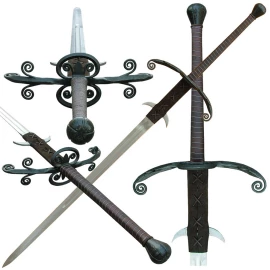
The Zdislav of Sternberg bastard sword is a sharpened, historically inspired hand-and-a-half sword drawing on European weapons of the late 15th and early 16th centuries, when late Gothic sword design was beginning to develop into the more complex hilts of the Renaissance. Its 91 cm (35.8 in) spring-steel blade is combined with a long leather-covered grip and an elaborate guard incorporating protective side rings. At 1.409 kg (3.11 lb), with a point of balance only 5 cm (2.0 in) forward of the guard, it remains notably controllable for its size. The manufacturer also presents it for controlled cutting demonstrations, but its sharp edge completely rules out person-to-person contact fencing. Further product information ...

 Delivery options
Late Gothic Side-Ring Bastard Sword Zdislav of Sternberg
A bastard sword or hand-and-a-half sword
The terms bastard sword and hand-and-a-half sword are commonly used for weapons occupying the space between the conventional one-handed arming sword and the full longsword. Their extended hilts allow a secure two-handed grip, while their proportions may still permit occasional one-handed manipulation. This Swordier measures 121.5 cm (47.8 in) overall and has a leather-covered gripping section approximately 22 cm (8.7 in) long, placing its handling character firmly within the two-handed and hand-and-a-half family.
The measured example weighs 1.409 kg (3.11 lb). Its point of balance is only 5 cm (2.0 in) ahead of the crossguard. This concentrates much of the perceived mass reasonably close to the hands and supports accurate point control and rapid changes of direction, while the 91 cm (35.8 in) blade still retains a clear physical presence through the movement.
Sharpened spring-steel blade with strong profile taper
The blade is 91 cm (35.8 in) long. Width immediately below the guard is 47.7 mm (1.88 in), narrowing markedly towards the point; approximately 10 cm (3.9 in) behind the tip it measures 22.3 mm (0.88 in). This creates an extended and clearly defined point that reflects the late-medieval trend towards increasingly effective thrusting geometry without abandoning useful cutting ability.
A fuller approximately 35 cm (13.8 in) long occupies the upper portion of the blade. A fuller is not a so-called blood groove. It is a structural feature used to manage the distribution of material within the blade section and may influence its mass and stiffness. The supplier also describes the blade as hollow ground, meaning that the bevel surfaces are formed with a concave profile.
The blade is made from spring steel and is specified at approximately 49–53 HRC. The measured striking-edge thickness is only 0.4 mm (0.016 in). Under our classification this is unequivocally a genuinely sharpened sword.
Side-ring guard – an early step towards the complex Renaissance hilt
The defining feature of this model is its side-ring hilt. The principal crossguard measures 28.3 cm (11.1 in), while additional protective metal loops extend around the sides of the hilt. Their total projection across the grip direction is approximately 10.5 cm (4.1 in).
During the later 15th century, European sword hilts increasingly incorporated additional hand protection. The traditional straight or curved crossguard was supplemented by side rings, finger guards and additional branches. These made it more difficult for an opposing blade to reach the fingers and also complemented evolving methods of gripping and manipulating the weapon.
During the 16th century such additions developed into progressively more elaborate guards and eventually into the complex hilts associated with Renaissance side-swords, cut-and-thrust swords and rapiers. This Swordier captures that transitional visual language particularly well.
Long leather grip and sculpted spiral pommel
The leather-covered gripping section measures approximately 22 cm (8.7 in). Black genuine leather surrounds the grip, with a visible longitudinal seam and a gently shaped central transition that gives the hands a useful tactile reference. The generous length provides comfortable two-handed spacing and good leverage during changes of direction and point control.
The polished pommel is strongly sculpted, with a distinctive spiral-ribbed form. The supplier describes it as a decorative scent-stopper-style design. It is, however, sufficiently stylised that we do not use the pommel alone as evidence for an exact historical classification of the complete sword.
The available information does not conclusively establish how the pommel is secured to the tang. We therefore do not describe it as either peened or threaded.
Between the late Gothic period and the Renaissance
Stylistically, the sword fits most convincingly into the transition between the later Middle Ages and the early Renaissance. During the late 15th century the longsword and hand-and-a-half sword remained important weapons, yet hilt design was evolving rapidly towards more complete protection of the hand.
Blade design was changing as well. The increasing sophistication of plate armour made accurate thrusting increasingly significant and encouraged long, rigid points. This did not mean that cutting blades disappeared. Many late-medieval swords still combined highly effective edges with increasingly purposeful thrusting geometry.
That transitional character is clearly expressed here. The long two-handed grip and substantial blade remain rooted in the medieval longsword tradition, while the side rings anticipate the progressively more complex guards of the Renaissance.
Typology – avoiding a forced Oakeshott classification
The supplier's designation includes the wording “Type XVIIlb”. This is not a standard form used in the conventional Oakeshott typology of European sword blades. The combination of an extended hand-and-a-half grip, pronounced profile taper, relatively short fuller and long point certainly resembles several late-medieval blade families, but an exact classification would require more information about the blade cross-section and its complete three-dimensional geometry.
We therefore describe the model more cautiously as a late Gothic hand-and-a-half sword with an early complex side-ring hilt, rather than assigning an exact Oakeshott category that the available evidence cannot securely support.
Zdislav of Sternberg
The model name commemorates Zdislav of Sternberg, a Bohemian nobleman from the important Sternberg family whose lifetime belongs to the closing decades of the 15th century. The Central European environment of the Jagiellonian period provides an appropriate cultural setting for the transitional late-Gothic character of this sword.
This model is not presented as a reproduction of a documented personal sword belonging to Zdislav of Sternberg, nor do we claim that he carried a weapon of this precise form. His name serves as a historical reference to the Bohemian and Central European world that broadly corresponds to the sword's stylistic inspiration.
For collectors and controlled cutting demonstrations
The manufacturer presents this model as a functional sharpened sword suitable for collecting and for controlled cutting demonstrations. For any practical cutting we recommend only suitable soft targets, a secure cutting stand and an experienced user.
- suitable as a functional collector's bastard sword or hand-and-a-half sword
- suitable for controlled cutting practice on appropriate soft targets
- suitable for responsible solo handling by experienced users
- suitable for historical presentation inspired by the late 15th and early 16th centuries
- not suitable for HEMA sparring or contact historical fencing
- not suitable for stage combat involving strikes against another person
The sharpened blade should also not be subjected to hard blade-on-blade contact with other steel weapons. Such use may damage the edge and creates a serious safety risk to both the user and people nearby.
Scabbard and belt
The set includes a black scabbard weighing approximately 457 g (1.01 lb). It is leather covered and fitted with a suspension system. Particularly noticeable are the decorated metal fittings with floral motifs, which complement the more prestigious appearance of the sword's hilt.
A leather belt approximately 130 cm (51.2 in) long and 3 cm (1.18 in) wide is also included. The belt leather is approximately 2.2 mm (0.087 in) thick. The suspension straps allow the scabbard to be worn at the hip and complete the sword as a more coherent historically inspired set.
Technical specifications
| Specification | Value |
|---|---|
| Manufacturer | Swordier |
| Type | Sharpened historically inspired bastard / hand-and-a-half sword |
| Stylistic context | Late Gothic to early Renaissance |
| Overall length | 121.5 cm (47.8 in) |
| Blade length | 91 cm (35.8 in) |
| Crossguard length | 28.3 cm (11.1 in) |
| Leather-covered grip length | 22 cm (8.7 in) |
| Total projection of side-ring protection | 10.5 cm (4.1 in) |
| Fuller length | 35 cm (13.8 in) |
| Blade width below guard | 47.7 mm (1.88 in) |
| Blade width 10 cm from point | 22.3 mm (0.88 in) |
| Striking-edge thickness | 0.4 mm (0.016 in) |
| Blade edge | Sharp |
| Blade point | Sharp / pointed |
| Blade material | Spring steel |
| Blade hardness | 49–53 HRC according to supplied specification |
| Blade grind | Hollow ground according to supplier |
| Point of balance | 5 cm (2.0 in) forward of the crossguard |
| Sword weight | 1.409 kg (3.11 lb) |
| Grip covering | Genuine leather according to manufacturer |
| Scabbard covering | Genuine leather according to manufacturer |
| Scabbard weight | 457 g (1.01 lb) |
| Belt length | 130 cm (51.2 in) |
| Belt width | 3 cm (1.18 in) |
| Belt leather thickness | 2.2 mm (0.087 in) |
| Intended use | Collecting, solo handling and controlled cutting practice |
Because of manufacturing and hand-finishing tolerances, dimensions, weight, balance and other values may vary slightly between individual examples. The figures above refer to the measured sword or to the supplied manufacturer specifications.
Safety
This sword has a genuinely sharp blade and is capable of causing severe or fatal injury. It is not intended for person-to-person contact fencing. We recommend handling only by responsible adults or under suitable expert supervision.
- Handle the sword only in a sufficiently large clear space with no people, animals or obstacles within the blade's movement radius.
- Never use it for HEMA sparring, contact stage combat or any other strikes against a person.
- For cutting practice, use only appropriate soft targets mounted on a stable stand.
- Inspect the blade, crossguard, side rings, grip and pommel before every use.
- Use the scabbard for transport and ensure that all suspension components are properly secured.
- Store the sword securely and out of reach of children and unauthorised persons.
- Never handle a sharp weapon while under the influence of alcohol or other substances that impair judgement or coordination.
Care and maintenance
Spring steel is not stainless. After every handling session remove fingerprints, perspiration and moisture with a soft dry cloth, then protect the steel with a very thin film of suitable blade oil.
After cutting practice, inspect the edge and point carefully. Avoid cutting metal, stone, concrete, heavy knots in timber or other hard and unpredictable targets. Never put the blade into the scabbard while damp, and inspect it periodically during long-term storage.
Keep the leather grip, scabbard and belt dry and away from direct heat. Use only care products suitable for genuine leather and test them first on an inconspicuous area.
Recommended accessories
For regular maintenance we recommend a suitable oil for carbon and spring-steel blades, a soft cleaning cloth and an appropriate leather-care product. A sturdy sword stand or wall mount is useful for safe display. For an outfit inspired by the period around 1500, choose clothing, belts, armour and accessories appropriate to the late-Gothic and early-Renaissance environment of Central Europe.
About Swordier
Swordier is associated with Longquan in Zhejiang Province, China, a region with a long tradition of sword making and metalworking. Its range includes historically and fantasy-inspired swords as well as modern training weapons, using different carbon and spring steels according to the particular model.
In this hand-and-a-half sword, Swordier combines a sharpened spring-steel blade with relatively low weight, close balance, an unusually elaborate side-ring hilt and a complete scabbard-and-belt set. This combination of functional construction, distinctive styling and comparatively accessible pricing makes Swordier particularly interesting to collectors looking for more than a purely decorative sword.
We are here for you!