Čeština
 Deutsch


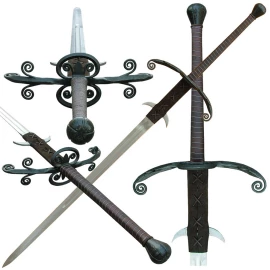
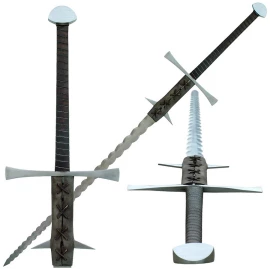
Two-Handed Sword William Wallace Stirling


Are you looking for a commanding historical centerpiece that brings the fierce spirit of the Scottish Highlands and the struggle for independence into your study, living room, or private armory, history enthusiast? The Decorative Two-Handed Sword William Wallace Stirling 13th Century is a monumental Scottish claymore replica produced by master armorers in Toledo, Spain. Measuring over 54 inches in total length, this impressive sword features a nickel-plated Zamak hilt, a distinctive leather-wrapped ricasso grip, and a polished 440 stainless steel blade. We recommend adding this magnificent piece of Scottish heritage to your collection today! Further product information ...

Would you like to be notified as soon as the item is in stock?
You will receive a short e-mail as soon as we have it back in stock.
Decorative Two-Handed Sword William Wallace Stirling 13th Century
Historical Context and 13th-Century Two-Handed Swords
The historical proportions of this two-handed sword reflect the turn of the 13th to 14th century (c. 1290–1305), the heroic era of the First War of Scottish Independence. During this period, long two-handed claymores gained prominence on battlefields, allowing Scottish warriors to strike powerful cleaving blows against armored English knights.
A defining feature of this sword style is the extended hilt and the leather-wrapped ricasso section just above the crossguard. This leather grip allowed fencers to utilize a half-sword technique, choking up on the blade for improved leverage and point control in close-quarters combat. The blade is forged from 440 stainless steel, hardened and tempered to 47–51 HRC for a lasting mirror polish and rust resistance. The straight crossguard and heavy pommel are cast from nickel-plated Zamak alloy, while the long wooden-core grip is wrapped in dark leather for comfortable two-handed handling.
Significance of the Name Stirling and William Wallace
This sword proudly bears the name Stirling in honor of Sir William Wallace (1270–1305), the legendary Scottish knight and leader during the Wars of Independence. At the Battle of Stirling Bridge on September 11, 1297, Wallace led his infantrymen to an immortal victory over a far larger English army. Naming this two-handed sword Stirling pays homage to the patriot who ignited the flame of Scottish freedom.
Technical Specifications
| Specification | Value |
|---|---|
| Product Type | Decorative Scottish two-handed sword replica (claymore) |
| Historical Era | Turn of 13th/14th Century (Scottish Independence Wars) |
| Blade Material | 440 Stainless Steel (hardened & tempered to 47–51 HRC) |
| Hilt & Guard Material | Nickel-plated Zamak alloy with leather wrap |
| Overall Sword Length | approx. 138.2 cm / 54.4 in (1382 mm) |
| Blade Length | approx. 102.8 cm / 40.5 in (1028 mm) |
| Crossguard Width | approx. 29.4 cm / 11.6 in (294 mm) |
| Blade Width at Guard | approx. 51.08 mm / 2.01 in |
| Blade Thickness at Guard | approx. 4.32 mm / 0.17 in |
| Total Sword Weight | approx. 2741 g / 6.04 lbs / 96.7 oz |
| Manufacturer | Art Gladius (Toledo, Spain) |
Care Instructions and Safety Guidelines
Important Safety Notice: For safety reasons, this item is strictly a decorative display piece unsuitable for practical combat or drill use (e.g., not for HEMA contact sparring, stage combat, LARP, or cutting/thrusting tests). The 440 stainless steel blade is not engineered for sword-on-sword impacts, and practical fencing risks blade breakage and severe injury!
To preserve its appearance, follow these simple care guidelines:
- Surface Cleaning: Wipe the blade and nickel-plated hilt periodically with a soft, dry microfiber cloth to remove dust and fingerprints.
- Avoid Chemicals: Do not use harsh chemical polishes, steel wool, or abrasive pads, which will strip the nickel finish or scratch the stainless steel blade.
- Display Environment: Keep the sword indoors in a dry environment.
Recommended Accessories
To create a complete 13th-century medieval display, we recommend pairing this sword with these matching items from our store:
- Heavy Duty Wooden Wall Sword Mount: For safely mounting this large two-handed sword on a wall.
- Microfiber Metal Care Cloth: For gentle cleaning of the nickel plating and stainless steel blade.
- 13th-Century Scottish Kilt or Tartan Plaid: Period-accurate attire to complement your historical reenactment room.
We are here for you!