Čeština
 Deutsch


Sword Excalibur King Arthur with Optional Scabbard


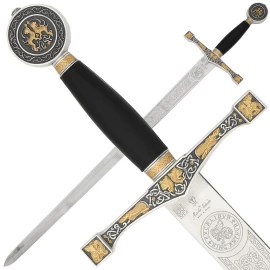
Are you looking for a mythical display weapon steeped in the world's most famous knightly lore to bring the noble atmosphere of Camelot into your living room, study, or private armory, history enthusiast? The Decorative Legendary Sword Excalibur King Arthur with Optional Scabbard is an exquisite collectible produced in the famous swordsmithing workshops of Toledo, Spain. Featuring an antiqued silver-finish crossguard adorned with Celtic knots and dragon terminals, a wheel pommel inscribed with Excalibur King Arthur, and a polished 440 stainless steel blade with rich etchings, we recommend adding this iconic sword to your display today! Further product information ...

 Delivery options
The following variants are currently available:
Decorative Legendary Sword Excalibur King Arthur with Optional Scabbard
Historical Context and 12th/13th-Century Arthurian Swords
While the historical origins of King Arthur trace back to Sub-Roman Britain in the 5th and 6th centuries, the artistic craftsmanship of this display sword references the High Middle Ages and the 12th and 13th centuries. During this era, Arthurian romances flourished across courtly Europe. Reflecting High Medieval sword design, the single-handed arming blade (Oakeshott type Xa/XI) served as a noble's primary emblem of status, Christian faith, and chivalric virtue, its crossguard forming the sacred shape of the cross.
The blade is forged from 440 stainless steel, hardened and tempered to 47–51 HRC, providing a mirror finish and high corrosion resistance. The ricasso area features etched scrollwork, heraldic castles, lions, crowns, and the official Toledo mark. The hilt is cast from antiqued metal alloy in a silver finish. The straight quillons display intricate Celtic knotwork and beast heads, paired with a wire-textured grip for a secure hold. The heavy wheel pommel holds a quartered shield surrounded by the embossed text EXCALIBUR • KING ARTHUR. An optional black scabbard fitted with antiqued mounts showcasing the sword in the stone is available.
Significance of the Name Excalibur
This sword proudly bears the mythical name Excalibur in honor of the magical blade of King Arthur. According to medieval legend, Arthur proved his rightful claim to the throne of Britain by drawing the sword from the anvil and stone set by the wizard Merlin, or received it directly from the Lady of the Lake (Nimue/Viviane). The name Excalibur derives from the Welsh Caledfwlch ("hard-cleaving"). Naming this sword Excalibur pays homage to vision, justice, and the chivalric ideals of the Round Table.
Technical Specifications
| Specification | Value |
|---|---|
| Product Type | Decorative mythical sword replica |
| Historical Era | 12th/13th Century (Arthurian Romance Era) |
| Blade Material | 440 Stainless Steel (hardened & tempered to 47–51 HRC) |
| Hilt & Guard Material | Antiqued metal alloy in silver finish |
| Overall Sword Length | approx. 101.2 cm / 39.8 in (1012 mm) |
| Blade Length | approx. 80.9 cm / 31.9 in (809 mm) |
| Crossguard Width | approx. 20.5 cm / 8.1 in (205 mm) |
| Blade Profile at Guard | approx. 37.51 mm x 3.66 mm / 1.48 in x 0.14 in |
| Sword Weight (without scabbard) | approx. 1057 g / 2.33 lbs / 37.3 oz |
| Sword Weight with Scabbard | approx. 1427 g / 3.15 lbs / 50.3 oz |
| Scabbard | Optional (Black wrap with antiqued mounts) |
| Manufacturer | Art Gladius (Toledo, Spain) |
Care Instructions and Safety Guidelines
Important Safety Notice: For safety reasons, this item is strictly a decorative display piece unsuitable for practical combat or drill use (e.g., not for HEMA contact sparring, stage combat, LARP, or cutting/thrusting tests). The 440 stainless steel blade is not engineered for sword-on-sword impacts, and practical fencing risks blade breakage and severe injury!
To preserve its appearance, follow these simple care guidelines:
- Surface Cleaning: Wipe the blade and hilt periodically with a soft, dry microfiber cloth to remove dust and fingerprints.
- Avoid Chemicals: Do not use harsh chemical polishes, steel wool, or abrasive pads, which will strip the antiqued silver finish or scratch the etched blade.
- Display Environment: Keep the sword indoors in a dry environment.
Recommended Accessories
To create a complete 12th/13th-century medieval display, we recommend pairing this sword with these matching items from our store:
- Wooden Tabletop or Wall Sword Stand: For displaying the sword safely and presentably indoors.
- Toledo Wooden Wall Display Plaque: An ornate display plaque with a blade clip for wall mounting.
- Decorative Knight of Jerusalem Wall Shield: A Crusader display shield designed specifically to cross behind this sword.
We are here for you!