Čeština
 Deutsch


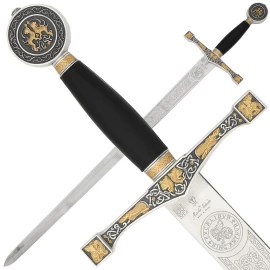
Excalibur sword with bronze-finish hilt
1x


Excalibur is one of the most famous swords in European legend, and this decorative interpretation turns its story into a striking collector's display piece. The long stainless-steel blade carries contrasting etched ornament inspired by Arthurian imagery, while the bronze-finish hilt features interlaced patterns and fantastical creatures. A black grip covered with genuine cowhide creates a strong contrast with the metal fittings. Measuring approximately 43.90 in / 1,115 mm overall, the sword makes an imposing wall display or collector's piece. Its blunt blade is intended exclusively for decorative purposes and not for practical sword use. Further product information ...

Would you like to be notified as soon as the item is in stock?
You will receive a short e-mail as soon as we have it back in stock.
Excalibur decorative sword with bronze-finish hilt
Elaborate decoration inspired by Arthurian legend
The most striking feature of the blade is its extensive black-and-white etched decoration. Interlaced ornament is combined with figurative and heraldic-looking imagery and the prominent inscription EXCALIBUR. The hilt continues the theme with interwoven patterns and stylised fantastical creatures. Small relief motifs appear at the ends of the long crossguard, while the large circular pommel bears a prominent winged mythical creature.
The hilt has a bronze-coloured finish. The grip has a plastic core covered with genuine cowhide, while the hilt fittings are made from Zamak, an alloy of zinc, aluminium, magnesium and copper. The overall design is a decorative fantasy interpretation of a medieval sword rather than an exact reconstruction of a particular surviving historical weapon.
Excalibur in the legends of King Arthur
King Arthur and his knights belong to a broad body of medieval British and French legendary literature that developed in written form particularly from the 12th century onwards. Within this tradition, Excalibur became Arthur's extraordinary sword and eventually one of the best-known symbols of the Arthurian cycle. Medieval accounts differ considerably in their details, however, so there is no single historically documented appearance that can be assigned to the legendary Excalibur.
The famous sword drawn from the stone is also not identical with Excalibur in every version of the story. In some important medieval traditions, Arthur receives Excalibur from the Lady of the Lake. These changing narratives gave later artists considerable freedom in depicting the legendary weapon, and this sword should therefore be understood as a modern decorative interpretation of the tradition.
Meaning of the name Excalibur
Excalibur is the established name of King Arthur's legendary sword. The form of the name developed through medieval literary tradition from earlier names used for Arthur's sword. On this product, the name primarily identifies its connection with Arthurian legend, a theme reinforced by the symbolic and ornamental decoration of the blade and hilt.
Technical specifications
| Specification | Value |
|---|---|
| Type | decorative sword |
| Name | Excalibur |
| Overall length | approx. 43.90 in / 1,115 mm |
| Blade length | approx. 34.41 in / 874 mm |
| Crossguard length | approx. 9.45 in / 240 mm |
| Blade width | approx. 2.02 in / 51.37 mm |
| Blade thickness | approx. 0.21 in / 5.29 mm |
| Weight | approx. 4.02 lb / 1,825 g |
| Blade material | 420 stainless steel |
| Edge | blunt |
| Hilt fittings | Zamak – an alloy of zinc, aluminium, magnesium and copper |
| Grip | plastic core covered with genuine cowhide |
| Hilt finish | bronze colour |
| Decoration | etched blade and elaborate hilt ornament inspired by the legends of King Arthur |
| Intended use | decorative only |
| Manufacturer | Art Gladius |
| Made in | Toledo, Spain |
All stated dimensions and the weight are approximate and may vary slightly between individual pieces.
Use, care and safety
This Excalibur is a decorative sword only. It is not suitable for HEMA, stage or contact fencing, striking drills or test cutting. A blunt blade can still cause injury when handled carelessly. Do not swing the sword near other people or strike other weapons or solid objects with it. If displaying it on a wall, use a secure mounting system suitable for the sword's weight and make certain it cannot fall accidentally.
After handling, wipe the blade with a soft, dry cloth and protect it from prolonged exposure to moisture. Avoid soaking the leather grip and do not use abrasive cleaners on the etched decoration or bronze-finish fittings. Store the sword in dry conditions and out of the reach of children.
Recommended accessories
For safe display, we recommend a sturdy wall hanger or sword stand. Excalibur can be combined with decorative pieces inspired by the 12th–15th centuries, such as knightly shields, heraldic objects, medieval figures or other swords associated with the Arthurian tradition.
We are here for you!