Čeština
 Deutsch


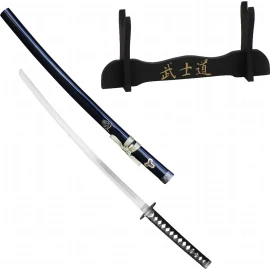
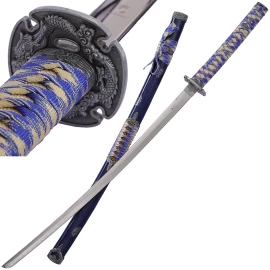
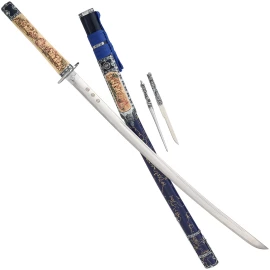
Sekigahara katana with dark blue saya
1x


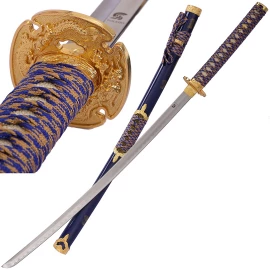
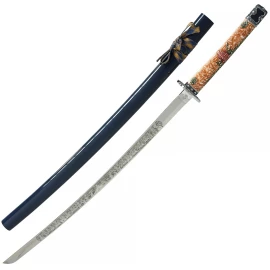
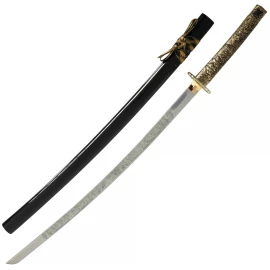
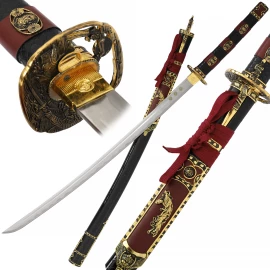
The Sekigahara decorative katana combines a sharp AISI 440 stainless-steel blade with a dark blue, high-gloss lacquered bamboo saya. Its richly decorated antique-silver-coloured fittings immediately catch the eye: the openwork tsuba depicts samurai on a battlefield, while further warrior imagery continues along the hilt. Dark cotton wrapping contrasts with the pale textured surface underneath, which imitates traditional rayskin. A false hamon is produced by contrasting matt and polished blade finishes. We recommend this katana as a striking collector's display piece and interior decoration, not for cutting practice or sword training. Further product information ...

 Delivery options
Sekigahara decorative katana with dark blue saya
Samurai decoration in an antique silver finish
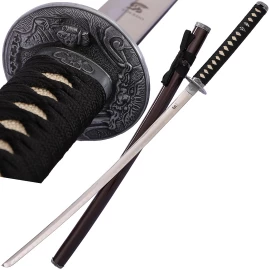
The hilt has an ABS plastic core with a non-slip textured relief imitating traditional rayskin, covered by dark cotton wrapping. Decorative menuki are visible between sections of the crossed wrap. Another prominent feature is the metal fitting around the central section of the grip, decorated with a raised samurai scene.
The circular tsuba is an elaborate openwork composition depicting samurai on a battlefield. Antique-silver-coloured decoration continues across the fuchi and kashira. The kashira depicts a samurai wielding his sword in battle. The tsuba, kashira and menuki are made from Zamak, an alloy of zinc, aluminium, magnesium and copper.
Sharp blade with a decorative hamon
The gently curved blade is made from AISI 440 stainless steel and has a sharp edge. A wavy line runs beside the cutting edge to imitate the appearance of a hamon. On this model, however, it is not the visible result of traditional differential hardening. The effect is created by contrasting matt and polished surface finishes.
The saya is made from bamboo wood and has a smooth, glossy dark blue lacquered finish, complemented by a dark sageo cord. The overall design therefore combines deep blue lacquer, dark hilt wrapping, pale sections visible beneath the wrap and richly decorated metal fittings with an antique silver appearance.
The katana in Japanese history
The katana is one of the best-known forms of Japanese sword. Its classic form developed in medieval and early modern Japan and became particularly closely associated with the samurai of the Sengoku and Edo periods. By the late 16th century and throughout the Edo period, the katana was characteristically worn through the obi with its edge facing upwards. Together with the shorter wakizashi, it formed the daishō, the paired swords that became a distinctive symbol of samurai status.
Historical Japanese swords were more than weapons. Their tsuba, menuki, fuchi and kashira provided highly skilled metalworkers with surfaces for elaborate artistic decoration. Subjects ranged from warriors and animals to plants, legends and religious imagery. The richly decorated fittings of this ornamental katana freely evoke that artistic tradition.
Why the name Sekigahara
Sekigahara recalls the battle fought in 1600 between major coalitions of Japanese daimyō. The victory of the side led by Tokugawa Ieyasu contributed substantially to his subsequent rise and the establishment of the Tokugawa shogunate in 1603. We chose the name because of the prominent battlefield scenes featuring samurai on the sword's fittings. It does not mean that this product reproduces a particular sword used at Sekigahara.
Technical specifications
| Specification | Value |
|---|---|
| Type | decorative katana |
| Name | Sekigahara |
| Overall length | approx. 39.29 in / 998 mm |
| Blade length | approx. 28.35 in / 720 mm |
| Blade width | approx. 1.16 in / 29.5 mm |
| Blade thickness at the habaki | approx. 0.23 in / 5.92 mm |
| Blade thickness at the yokote | approx. 0.11 in / 2.74 mm |
| Tsuba dimensions | approx. 2.83 × 2.83 in / 72 × 72 mm |
| Blade material | AISI 440 stainless steel |
| Edge | sharp |
| Hamon | false hamon produced by contrasting matt and polished surface finishes |
| Hilt core | ABS plastic with a non-slip textured relief imitating rayskin |
| Hilt wrapping | cotton ribbon |
| Tsuba, kashira and menuki material | Zamak – an alloy of zinc, aluminium, magnesium and copper |
| Tsuba motif | samurai on a battlefield |
| Kashira motif | samurai wielding a sword on a battlefield |
| Saya material | bamboo wood |
| Saya finish | dark blue, polished and lacquered |
| Weight with saya | approx. 2.49 lb / 1,128 g |
| Weight without saya | approx. 1.97 lb / 893 g |
| Intended use | decorative only |
| Manufacturer | Art Gladius |
| Made in | Toledo, Spain |
All stated dimensions and weights are approximate and may vary slightly between individual pieces.
Care and safety
This katana is decorative and is not intended for test cutting, sword training, contact combat or striking objects. Nevertheless, its blade is sharp and capable of causing serious or fatal injury. Always treat it as a sharp object, never point or swing it towards another person, and do not handle it close to bystanders. Any handling of the sharp blade is entirely at your own risk. Keep the sword securely stored and out of the reach of children.
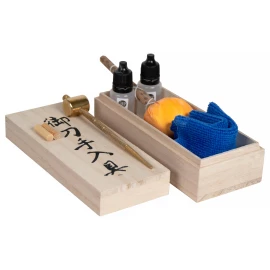
After handling, wipe the blade with a soft, dry cloth to remove fingerprints and moisture. Store the katana in dry conditions. Do not use abrasive cleaners on the lacquered saya or decorative fittings. When returning the blade to the saya, move slowly and under full control to avoid damaging the edge or scabbard and to reduce the risk of injury.
Recommended accessories
For secure display, we recommend a stable katana stand. To create a presentation inspired by the 16th and 17th centuries, you can complement it with a decorative wakizashi, Japanese armour, a kabuto or other objects associated with samurai culture. A soft cloth and a product suitable for lightly protecting steel blades are also useful for routine care.
We are here for you!