Čeština
 Deutsch


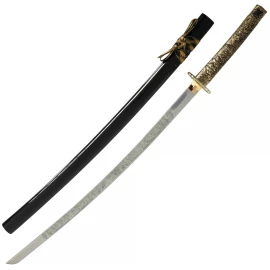
Masamune katana with relief grip and decorated blade


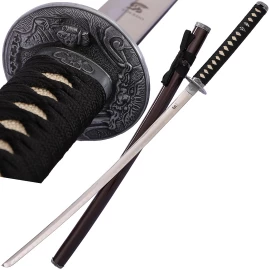
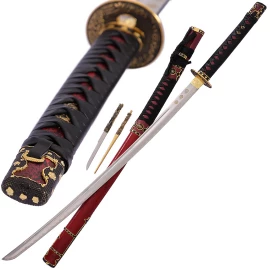
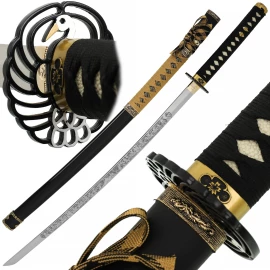
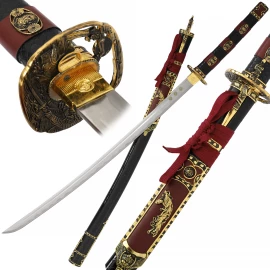
The Masamune katana is a striking decorative Japanese sword distinguished by its richly sculpted grip and extensive blade decoration. Scenes of samurai warriors, architecture and ornamental details are complemented by an openwork round tsuba and a dark red lacquered saya with black cord. The blade is made from 440 stainless steel, hardened and tempered to 47–51 HRC, but the sword itself is designed solely for display and collecting. We recommend it for a sword stand, a themed interior or as a non-functional prop. It is not intended for fencing, cutting or any other practical sword use. Further product information ...

 Delivery options
Masamune katana with relief grip and decorated blade
Elaborate decoration inspired by Japanese warriors
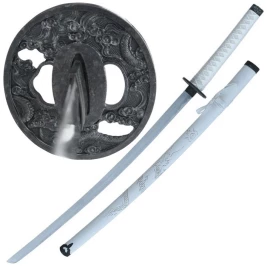
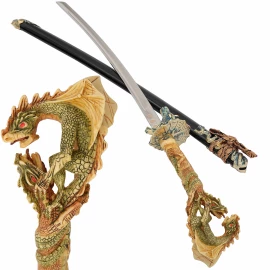
The most distinctive feature is the long silver-coloured grip covered with raised scenes of samurai warriors. The detailed relief continues towards the end of the grip, where a dragon motif can be seen. Small coloured details further enrich the design. The openwork round tsuba has an elaborate radial pattern, while its bright metallic finish visually complements the grip.
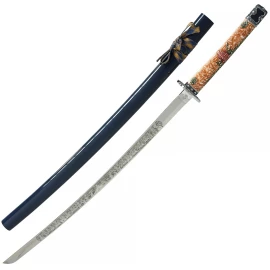
The polished blade is also extensively decorated. A long etched scene depicting warriors and buildings runs across much of its surface, accompanied by several circular medallions near the guard. This ornamentation is modern and decorative and should not be regarded as evidence of a particular historical blade. A dark red lacquered saya with black cord is included, providing a strong visual contrast with the silver-coloured sword.
Masamune and the Japanese sword tradition
The name Masamune is associated with the legendary Japanese swordsmith Gorō Nyūdō Masamune, who worked around the turn of the 13th and 14th centuries. His work is traditionally associated with the Sagami tradition and represents one of the most celebrated chapters in the history of Japanese swordmaking. Surviving blades attributed to Masamune are highly valued historical works.
The historical katana gradually became one of the best-known weapons of the samurai. Its importance extended beyond combat: fine blades and their mountings were the work of several specialised craftsmen, while their decoration could express the owner's taste, social position and cultural symbolism.
The meaning of the name Masamune
The name of this model refers to Masamune, the renowned medieval Japanese swordsmith. Here, the name expresses inspiration from the tradition of Japanese swordmaking. This product is nevertheless a modern decorative katana manufactured in Toledo, Spain, rather than a replica of a specific surviving Masamune blade.
Intended use
The katana is intended exclusively for decorative and collecting purposes. It makes an impressive display on a Japanese sword stand, in a cabinet or within an interior inspired by samurai culture. Its elaborate relief grip and decorated blade make it particularly suitable for displays where the sword itself is intended to become a focal point.
Do not use this katana for fencing, cutting, striking practice or blade-to-blade contact. Its decorative construction is not designed to withstand the dynamic stresses placed on a functional sword.
Technical specifications
| Specification | Details |
|---|---|
| Type | Decorative katana |
| Overall length | approx. 38.39 in (975 mm) |
| Blade length | approx. 27.72 in (704 mm) |
| Tsuba dimensions | approx. 3.15 × 2.72 in (80 × 69 mm) |
| Blade width | approx. 1.12 in (28.42 mm) |
| Blade thickness at the tsuba | approx. 0.23 in (5.96 mm) |
| Weight without scabbard | approx. 2.64 lb (1,198 g) |
| Weight with scabbard | approx. 3.23 lb (1,465 g) |
| Blade material | 440 stainless steel |
| Blade hardness | 47–51 HRC |
| Blade finish | Polished, with extensive decorative etching |
| Grip | Richly decorated with raised relief |
| Scabbard | Dark red lacquered saya, included |
| Manufacturer | Art Gladius |
| Place of manufacture | Toledo, Spain |
| Measurement tolerance | All figures are approximate and may vary slightly between individual pieces |
Care and safety
- After handling, wipe the blade with a soft, dry cloth to remove fingerprints and moisture.
- For long-term storage, you can protect the metal parts with a very thin coating of suitable maintenance oil.
- Clean the relief grip and decorated blade without abrasive products that could damage the ornamental finish.
- Protect the lacquered saya from impacts, scratches and prolonged exposure to moisture.
- Do not use the katana for cutting, contact fencing or striking practice.
- Allow sufficient clear space around you whenever handling the sword, taking its length and weight into account.
- Store the sword securely out of the reach of children.
Recommended accessories
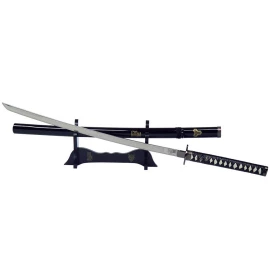
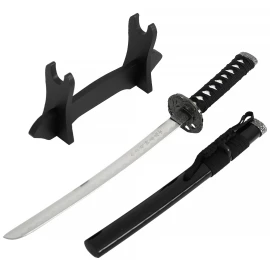
For display, we recommend a katana stand or a suitable wall mount designed to hold a decorative sword securely. You can complement a Japanese-themed display with a wakizashi or tantō; pairing a katana with a shorter wakizashi recalls the daishō particularly associated with the Edo period (1603–1868). The wooden box in which the product is packed serves solely as protective transport packaging and is supplied free of charge.
We are here for you!