Čeština
 Deutsch


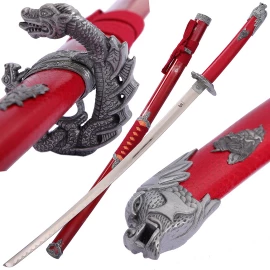
Tokugawa katana with red saya


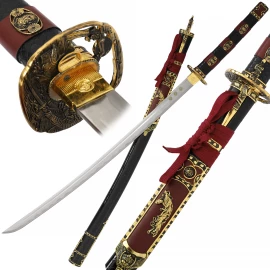
The Tokugawa katana is a striking decorative Japanese sword finished in black, red and gold. Its long curved blade of high-carbon Toledo steel is complemented by an ornate round tsuba, a black-wrapped grip and a distinctive red lacquered saya. Gold-coloured fittings and decorative motifs reinforce its Japanese-inspired appearance. The ensemble also includes two small decorative implements carried alongside the scabbard. We recommend this katana for collecting, interior display, themed settings or use as a non-contact prop. The blade is not sharpened, and the sword is not intended for practical fencing or cutting. Further product information ...

 Delivery options
Tokugawa decorative katana with red saya
Red and black katana with ornate details
The blade has a characteristically curved profile and a long groove. Three gold-coloured circular medallions decorate the area close to the tsuba. The round tsuba combines black and gold-coloured surfaces with raised ornamental detailing. The grip has a red base covered by black cross-wrapping made from synthetic material, with gold-coloured decorative elements visible between parts of the wrap.
A particularly distinctive feature is the red lacquered saya with fine black decoration. Black and gold-coloured fittings and black cord complement the scabbard. Part of the saya is also wrapped in black over a red base, visually linking it with the sword's grip. The resulting ensemble has a coherent and deliberately elaborate appearance.
Tokugawa and the age of the samurai
The name Tokugawa refers to one of the most important families in Japanese history. Tokugawa Ieyasu emerged victorious from the Battle of Sekigahara in 1600 and was appointed shōgun in 1603. The Tokugawa shogunate subsequently ruled Japan until 1867, with most of this era being known as the Edo period.
The katana became one of the most recognisable symbols of the samurai class. During the Edo period it was generally worn edge upwards through the obi sash. Samurai frequently paired it with the shorter wakizashi, forming a matched combination known as daishō. The precise form and decoration of blades, mountings, grips and scabbards varied considerably according to period, school and the status of the owner.
The meaning of the name Tokugawa
The name of this decorative sword recalls the Tokugawa family, which shaped Japan's political order for more than two and a half centuries. The family is historically associated with a crest of three hollyhock leaves known as mitsuba aoi. This model should nevertheless be regarded as a modern decorative sword inspired by Japanese samurai aesthetics, rather than an exact replica of a particular historical Tokugawa katana.
Intended use
This katana is intended solely for decorative and collecting purposes. It is suitable for display on a sword stand, in a cabinet or themed interior, as well as for use as a non-functional photographic or costume prop. The blade is not sharpened and is not intended to be sharpened later.
Do not use this katana for cutting, tameshigiri, contact fencing, striking practice or blade-to-blade contact. Its decorative construction is not designed for the dynamic stresses imposed on a functional Japanese sword. Despite its blunt edge, its length and weight mean that improper use can still cause serious injury.
Technical specifications
| Specification | Details |
|---|---|
| Type | Decorative katana |
| Overall length | approx. 38.86 in (987 mm) |
| Blade length | approx. 28.50 in (724 mm) |
| Tsuba dimensions | approx. 3.03 × 2.76 in (77 × 70 mm) |
| Blade width | approx. 1.19 in (30.19 mm) |
| Blade thickness at the tsuba | approx. 0.23 in (5.78 mm) |
| Weight without scabbard | approx. 2.28 lb (1,034 g) |
| Weight with scabbard | approx. 3.24 lb (1,471 g) |
| Blade material | High-carbon Toledo steel |
| Edge | Not sharpened |
| Grip wrapping | Synthetic material |
| Scabbard | Red lacquered saya with black wrapping and cord |
| Manufacturer | Art Gladius |
| Place of manufacture | Toledo, Spain |
| Measurement tolerance | All figures are approximate and may vary slightly between individual pieces |
Care and safety
- After handling, wipe the blade with a soft, dry cloth and protect the metal surface with a thin coating of suitable maintenance oil.
- Clean the red lacquered scabbard and decorative fittings gently without abrasive cleaning products.
- Store the katana in a dry environment and protect it from moisture.
- Do not attempt to sharpen the blade and never use it for cutting or contact fencing.
- Do not test the flexibility of the blade by forcibly bending it or striking hard objects.
- Draw the blade from the saya slowly and under control, and take equal care when returning it to the scabbard.
- Store the sword securely out of the reach of children.
Recommended accessories
For display, we recommend a katana stand, which will show off the contrast between the red saya and the black-and-gold fittings particularly well. You can complement a themed collection with a decorative wakizashi, tantō or other items inspired by the Edo period (1603–1868). The wooden box in which the product is packed serves solely as protective transport packaging and is supplied free of charge.
We are here for you!