Čeština
 Deutsch


Cazoleta rapier with gold-coloured details


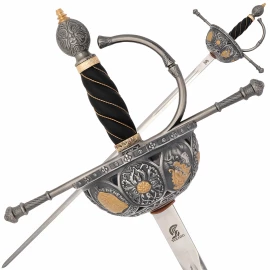
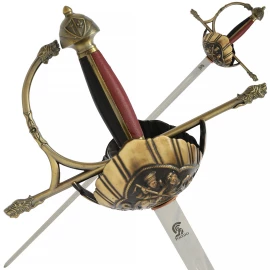
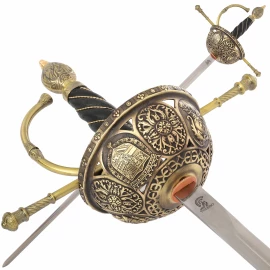
The Cazoleta decorative rapier stands out with its long slender blade and richly ornamented cup-shaped guard, a characteristic feature of Spanish rapiers of the early modern period. Patinated nickel is contrasted by prominent gold-coloured ornament, quillons and a curved knuckle guard. The black grip with spiralling gold-coloured detailing adds further visual contrast. If you are looking for a striking historic-style weapon for a collection or interior display, this model brings distinctive Toledo character. It is, however, strictly a decorative object with a blunt blade and is not intended for practical fencing. Further product information ...

 Delivery options
Cazoleta decorative rapier with gold-coloured details
Distinctive Spanish-style cazoleta guard
The dominant feature of this rapier is its large cup-shaped guard with openwork sections and several circular panels filled with raised ornament. Its darker patinated surface contrasts strongly with the gold-coloured decoration. The gold-coloured finish continues onto the long quillons and curved knuckle guard. Foliate and other stylised relief motifs are clearly visible; without further evidence, however, we do not attribute a specific heraldic meaning to them.
The black grip is divided by a fine spiralling gold-coloured element and bordered by decorated collars. Its oval pommel combines a dark finish with a prominent gold-coloured foliate relief. The long straight blade features a narrow longitudinal fuller and a blunt edge.
Cazoleta and Spanish rapiers of the 17th century
Although the original product designation refers to the 16th century, the cup-shaped cazoleta guard is particularly characteristic of Spanish rapiers of the 17th century. The rapier itself had already developed across Europe during the 16th century as a civilian sidearm and fencing weapon. As hilts evolved, increasingly complex systems were devised to protect the sword hand, with the deep cup guard representing one of their later forms.
The Spanish rapier tradition is also associated with the fencing system known as La Verdadera Destreza. Its authors explored distance, angles and the geometry of movement in considerable detail. Historical rapiers were genuine weapons used primarily for thrusting and personal defence. This modern piece only evokes their appearance and should not be used to practise historical fencing techniques.
Meaning of Cazoleta
The Spanish term cazoleta refers to a small bowl or cup-shaped form and, in historical weapon terminology, describes the characteristic cup-shaped hand guard. This prominent constructional feature gives the model its name. The name does not refer to a particular historical person, nor does it imply that the product is an exact reproduction of a specific surviving weapon.
Technical specifications
| Specification | Value |
|---|---|
| Type | decorative rapier with cazoleta cup guard |
| Name | Cazoleta |
| Historical inspiration | early modern Spanish rapiers, cazoleta particularly characteristic of the 17th century |
| Overall length | approx. 44.41 in / 1,128 mm |
| Blade length | approx. 35.51 in / 902 mm |
| Quillon span | approx. 11.89 in / 302 mm |
| Blade width | approx. 0.93 in / 23.54 mm |
| Blade thickness | approx. 0.17 in / 4.41 mm |
| Cup guard diameter | approx. 5.28 in / 134 mm |
| Weight | approx. 3.65 lb / 1,657 g |
| Edge | blunt |
| Cup guard finish | patinated nickel and gold-coloured finish |
| Intended use | decoration and collecting |
| Manufacturer | Art Gladius |
| Made in | Toledo, Spain |
All stated dimensions and the weight are approximate and may vary slightly between individual pieces.
Care and safety
This rapier is not intended for HEMA, historical or stage fencing, contact combat, technique practice, cutting or thrusting. Even a blunt blade is not safe for contact with another person, and the length and weight of the piece can cause serious injury if handled improperly. Before displaying it, check that the stand is stable or that the wall hanger is securely fitted. Keep the rapier out of the reach of children.
After handling, wipe the blade with a soft, dry cloth and protect the entire piece from moisture. Do not use abrasive polishes, wire brushes or aggressive chemicals on the patinated and gold-coloured guard. These could damage or permanently alter its decorative finish.
Recommended accessories
For display, we recommend a stable rapier stand or wall hanger. You can complement it with a decorative main-gauche, period-style belt and other accessories inspired by 17th-century Spain. Reproductions of early modern clothing accessories and decorative weapons also make suitable companions for a historically themed display.
We are here for you!