Čeština
 Deutsch


Carranza Bell Rapier for HEMA


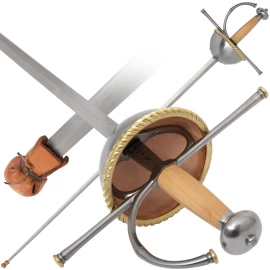
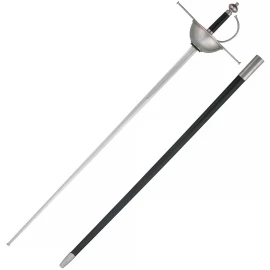
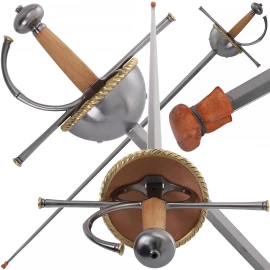
Friend, do you want to train the Spanish school of swordsmanship with a rapier that looks historically convincing and still meets modern safety expectations? This training bell rapier combines a long flexible blade, a deep steel cup guard and a comfortable reddish-brown leather grip. It is built for HEMA rapier, technical drilling, thrusts, parries and blade engagement. With its blunt widened tip, thick edges and well-balanced hilt, it gives you a confident fencing feel in the style of the 17th century. Further product information ...

 Delivery options
Carranza Bell Rapier for HEMA
A Bell Rapier for Spanish Swordsmanship
This rapier is inspired by European weapons of the 17th century, especially Spanish and southern Italian cup-hilt rapiers. In Spanish, this guard form is often called taza, meaning cup. The closed steel cup protected the fencing hand much better than earlier ring and swept hilts. That made this type of rapier ideal for precise, technical and strongly defensive fencing systems.
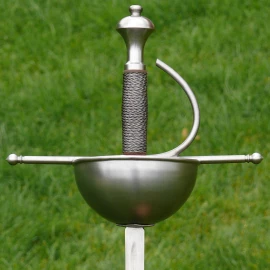
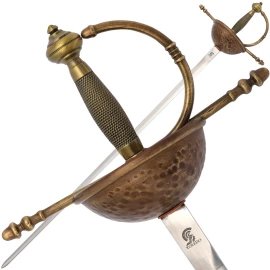
The long narrow blade is designed mainly for the thrust. It has reinforced blunt edges and a widened safety tip. The maker’s mark is visible near the shoulder of the blade, and the profile tapers evenly towards the point. The hilt consists of a deep metal cup, a long straight crossguard with turned finials and a knuckle bow, which is the metal loop protecting the fingers. The spherical pommel balances the weapon and completes the elegant outline of a late Renaissance rapier.
Grip, Cup Guard and Control
The grip is covered in reddish-brown leather and stitched lengthwise. Its short shape supports the historical grip with the index finger placed over the guard inside the cup, giving you finer point control. The deep cup protects the back of the hand, fingers and knuckles, while the long crossguard helps with binds, leverage and line control. This makes the rapier a strong choice for studying Spanish La Verdadera Destreza.
Historical Background
In the 17th century, the rapier was carried by townsmen, nobles, soldiers and duelists. It was no longer a heavy battlefield sword, but a specialised sidearm for personal defence and single combat. Spanish Destreza treated fencing almost as geometry in motion, focusing on circles, angles, distance and exact control of the point. Masters such as Jerónimo Sánchez de Carranza and Luis Pacheco de Narváez helped shape a system for which the bell rapier was exceptionally well suited.
Technical Specifications
| Parameter | Value |
|---|---|
| Weapon type | Training bell rapier |
| Historical inspiration | Spain and Southern Europe, 17th century |
| Intended use | HEMA training, technical fencing, sparring with protective gear |
| Blade material | High-carbon spring steel |
| Blade hardness | Approx. 49 to 53 HRC |
| Overall length | 120 cm, 47.24 in |
| Blade length | 101 cm, 39.76 in |
| Crossguard length | 30.5 cm, 12.01 in |
| Cup diameter | 14.5 cm, 5.71 in |
| Pommel height | 5.8 cm, 2.28 in |
| Point of balance | 6 cm, 2.36 in from the guard |
| Blade width at guard | 18.9 mm, 0.74 in |
| Blade width 10 cm from the tip | 7.6 mm, 0.30 in |
| Edge thickness | 3.9 mm, 0.15 in |
| Blade flex | Approx. 6 kg, 13.23 lb |
| Rapier weight | 1056 g, 2.33 lb |
| Grip | Wooden core, reddish-brown leather covering |
| Guard | Steel cup with crossguard and knuckle bow |
| Blade tip | Blunt, widened and rounded |
| Blade edge | Blunt, 2.0 mm and above |
| Scabbard | Not included according to the supplied information |
Because the final stages of production are completed by hand, these values are approximate. The delivered piece may differ slightly.
The Historical Link to Carranza
Jerónimo Sánchez de Carranza was a Spanish nobleman, soldier and fencing theorist of the 16th century. He is closely associated with the development of La Verdadera Destreza. His teachings influenced Spanish rapier fencing for decades. This rapier is named in his honour, as its cup hilt and long thrusting blade clearly evoke the world of Iberian fencing masters.
Care and Safety
After each training session, wipe the rapier dry, especially the blade, the inside of the cup and any areas touched by sweaty gloves. Protect the steel regularly with a thin layer of suitable weapon oil. The leather grip should occasionally be treated with an appropriate leather balm. Do not leave the rapier in a damp bag, and do not store it next to a heater, as excessive dryness can damage the leather.
Safety warning: Although this is a training rapier with a blunt tip and blunt edges, it must only be used with full protective equipment. We recommend a HEMA mask, throat protection, a sturdy fencing jacket, chest protection, elbow and forearm guards, groin protection and rapier gloves. Never thrust into hard objects, walls, wood or steel targets. Before fencing, regularly check the tip, blade and guard for damage. Do not use a damaged weapon.
Recommended Accessories
- 1600N HEMA mask for rapier fencing inspired by the 16th and 17th centuries.
- Padded fencing jacket in a 16th to 17th century style for safer thrusting practice.
- Rapier gloves with finger and wrist protection for technical 17th century fencing.
- Weapon oil and cleaning cloth for regular protection of high-carbon steel.
- Padded rapier bag for safely carrying the long blade to training and tournaments.
Swordier: A Brand That Lives Steel
Swordier combines traditional hand-forging techniques, quality high-carbon steel and a sharp sense of practical weapon balance. Production takes place in Longquan, Zhejiang Province, the most famous sword-making city in China, with a metalworking tradition reaching back more than 2600 years. Behind the brand are enthusiasts who truly live steel. For them, a sword or rapier is not merely a product, but a symbol of strength, honour and craftsmanship. That is why we recommend Swordier to you, friend, when you want a functional replica with real character.
We are here for you!