Čeština
 Deutsch


Galeazzo of Mantua HEMA Training Longsword


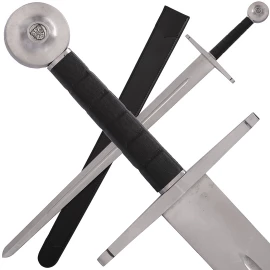
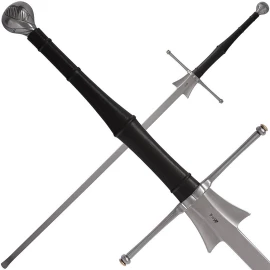
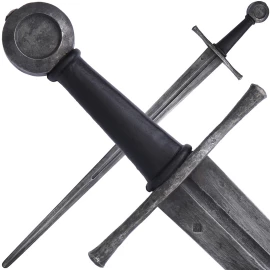
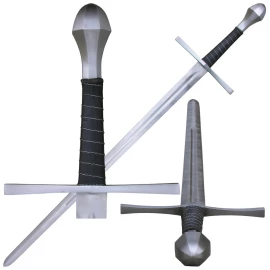
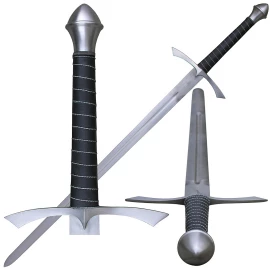
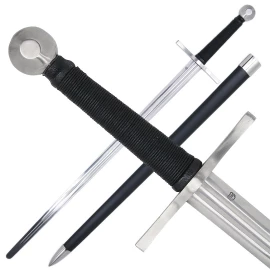
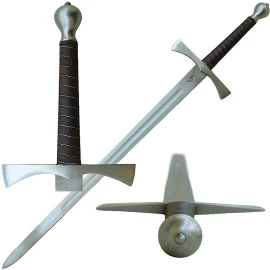
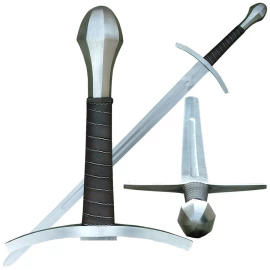
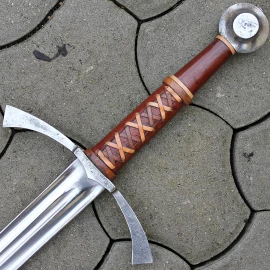
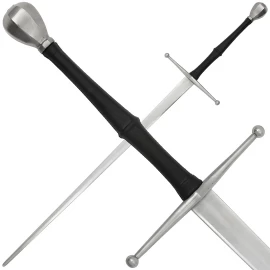
If you are looking for a longsword for regular historical European martial arts practice, this Swordier model combines modern training features with the proportions of a late-medieval-inspired weapon. Its blunt spring-steel blade has a 2.3 mm (0.09 in) edge, a widened 16.8 mm (0.66 in) spatulated safety tip and a flex rating of approximately 12 kg (26.5 lb). It is therefore intended for HEMA drills and controlled sparring. A black genuine-leather grip, restrained crossguard with upturned terminals and faceted pommel preserve the clean appearance of a historical longsword. Further product information ...

 Delivery options
Galeazzo of Mantua HEMA Training Longsword
Designed around HEMA training
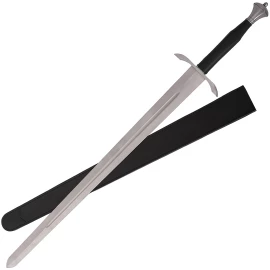
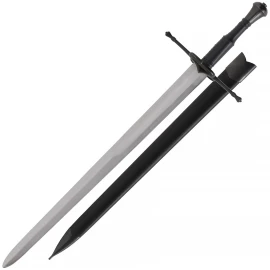
The sword measures 121 cm (47.6 in) overall, with a 90 cm (35.4 in) blade. Its 23 cm (9.1 in) grip provides ample room for a secure two-handed hold even when wearing substantial HEMA gloves. The grip is covered in textured black genuine leather to provide reliable purchase during guard transitions, winding, blade engagement and rapid changes of direction.
The blade is made from heat-treated spring steel with a stated hardness of 49–53 HRC. It measures 46.6 mm (1.83 in) wide immediately below the crossguard and narrows to 14.7 mm (0.58 in) at a point 10 cm (3.9 in) behind the tip. This pronounced profile taper recalls late medieval swords with increasingly thrust-capable blade geometry, although the end of the blade has deliberately been modified for modern training.
A central fuller extends for 65 cm (25.6 in). A fuller is sometimes incorrectly referred to as a “blood groove”; its actual function concerns the distribution of material through the blade section and therefore affects mass and stiffness.
Distal taper and handling
According to the manufacturer, blade thickness decreases from 5.5 mm (0.22 in) at the base to approximately 3 mm (0.12 in) towards the tip. This distal taper progressively reduces material further along the blade and has an important influence on the sword's dynamic handling.
The sword weighs 1.453 kg (3.20 lb), while its point of balance lies approximately 7 cm (2.8 in) ahead of the crossguard. Together with the long grip and substantial pommel, these figures provide a combination in which the blade retains perceptible presence while remaining manageable during rapid stops, redirections and transitions between attack and defence.
Spatulated safety tip and blunt edges
The clearest difference from a sharp longsword is the blade termination. Rather than narrowing to a sharp point, it finishes in a widened and rounded spatulated tip. At approximately 16.8 mm (0.66 in) wide, this spreads pressure over a larger area during a thrust than a narrow point would.
The edges measure 2.3 mm (0.09 in) thick and are therefore classified as blunt. A flex rating of approximately 12 kg (26.5 lb) also allows the blade to yield under suitable thrusting loads. These features reduce risk but do not make a steel sword inherently safe without appropriate protective equipment, control and responsible training.
Crossguard, grip and pommel
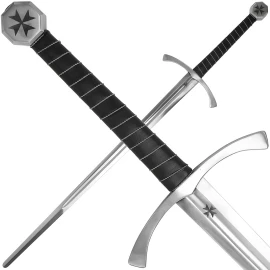
The straightforward steel crossguard measures 26.5 cm (10.4 in). Its arms rise gently towards the terminals, each ending in a short upward hook. The result is a clean, restrained silhouette compatible with the overall late-medieval-inspired character of the sword.
The manufacturer states that the crossguard is heat treated for additional resistance to deformation. Nevertheless, marks and minor wear on both guard and blade should be regarded as normal on a training weapon regularly used in steel-on-steel fencing.
The hilt terminates in a faceted pommel resembling forms commonly described as scent-stopper pommels. Its principal practical role is to counterbalance the long blade. The pommel is peened, meaning that the end of the tang is mechanically spread over the pommel to secure the assembly.
A modern trainer inspired by the late medieval longsword
This is not a reproduction of one particular surviving historical sword. It is a modern functional interpretation of the European longsword adapted to contemporary HEMA practice.
The long two-handed grip, strongly tapering blade and overall proportions recall longswords associated particularly with the fourteenth and fifteenth centuries. The manufacturer relates the design to Oakeshott Type XVIII. Because the training blade deliberately incorporates widened blunt edges and a spatulated point, however, it should not be treated as a strict typological specimen. It is more accurately described as a HEMA training longsword with geometry inspired by late medieval Type XVIII swords.
Galeazzo of Mantua and the Italian martial tradition
The model name refers to Galeazzo of Mantua and, more broadly, evokes the knightly martial culture of northern Italy around the turn of the fifteenth century. This is also the cultural world associated with the celebrated fencing master Fiore dei Liberi, whose surviving works preserve sophisticated systems for the longsword, dagger, spear and armoured combat.
This sword should not be presented as a reconstruction of a documented personal weapon belonging to Galeazzo of Mantua. His name provides the historical inspiration, while the physical design of the sword answers the requirements of present-day HEMA practice.
Technical specifications
| Specification | Value |
|---|---|
| Type | HEMA training longsword |
| Overall length | 121 cm (47.6 in) |
| Blade length | 90 cm (35.4 in) |
| Grip length | 23 cm (9.1 in) |
| Crossguard length | 26.5 cm (10.4 in) |
| Fuller length | 65 cm (25.6 in) |
| Blade width below guard | 46.6 mm (1.83 in) |
| Blade width 10 cm behind tip | 14.7 mm (0.58 in) |
| Edge thickness | 2.3 mm (0.09 in) |
| Blade edge | Blunt |
| Blade tip | Blunt, widened and rounded |
| Tip width | 16.8 mm (0.66 in) |
| Distal taper | 5.5 mm (0.22 in) at base → approx. 3 mm (0.12 in) near tip |
| Blade material | Spring steel |
| Blade hardness | 49–53 HRC |
| Blade flex | Approx. 12 kg (26.5 lb) |
| Point of balance | 7 cm (2.8 in) ahead of the guard |
| Grip covering | Genuine leather |
| Pommel construction | Peened |
| Weight | 1.453 kg (3.20 lb) |
| Intended use | HEMA drills, technical practice and controlled sparring |
Because the sword is manually finished, the stated dimensions and weight should be treated as approximate. Individual examples may vary slightly.
What kind of training is it suitable for?
The manufacturer specifically positions this model for regular HEMA practice, technical drills and sparring. The combination of approximately 12 kg (26.5 lb) flex, blunt edges and a widened safety tip is designed for contact with comparable steel training swords.
This does not mean that unrestricted sparring is risk-free. A steel longsword weighing almost 1.5 kg can cause serious bruising, fractures and injuries to the hands or head even without a sharp edge. Intensity must always be adjusted to the experience of both fencers, the protective equipment being worn and the rules of the relevant club or tournament.
Safety during HEMA sparring
- Wear a quality fencing mask with back-of-head protection, a suitable HEMA jacket, rigid throat protection and heavy protective gloves.
- Add forearm, elbow, knee and torso protection as appropriate to the intensity of training.
- Inspect the blade, point, crossguard, grip and pommel before every training session.
- Remove any sharp burrs created on the edges during steel contact before using the sword again.
- Do not use the trainer against sharpened weapons or blades with substantially different contact characteristics.
- Do not strike trees, metal structures, stone, concrete or other hard immovable objects.
- Never handle the sword while under the influence of alcohol or other intoxicating substances.
Care and maintenance
Spring steel is not stainless. After every training session, wipe sweat and moisture from the blade, allow it to dry thoroughly and apply a very thin film of suitable corrosion-protection oil or wax intended for carbon steel.
Inspect the edges regularly after intensive sparring. Small raised burrs caused by blade contact should be carefully smoothed with an appropriate fine tool before the next session so that no hazardous sharp projections remain. Keep the genuine-leather grip dry and treat it only occasionally with a product intended for real leather.
Recommended accessories
For this HEMA longsword we recommend a complete set of protective equipment: fencing mask with back-of-head protection, throat guard, HEMA jacket, heavy gloves and suitable joint protection. A padded long-weapon bag is useful for transport. For routine maintenance, keep suitable corrosion-protection oil or wax, soft cloths and a fine tool for safely dressing minor edge burrs.
About Swordier
Swordier is a manufacturer associated with Longquan in Zhejiang Province, China, an area with a long tradition of blade making and metalworking. Its range includes both sharpened functional swords and models developed specifically for contemporary HEMA practice.
On this longsword the emphasis is on the practical combination of spring steel, suitable heat treatment, approximately 12 kg (26.5 lb) flex, a training-oriented safety tip and balanced handling. Swordier therefore appeals to practitioners looking for a functional training sword with an attractive relationship between materials, construction, practical utility and price.
We are here for you!