 Čeština
 Deutsch


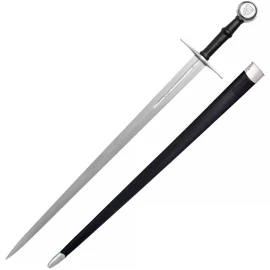
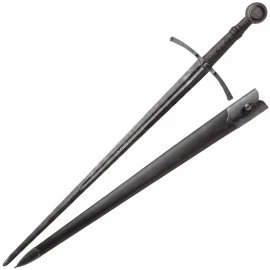
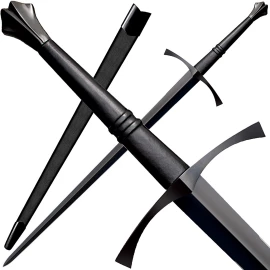
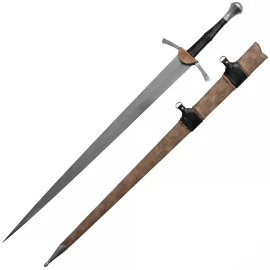
Oakeshott XIIa Medieval War Sword with Black Scabbard


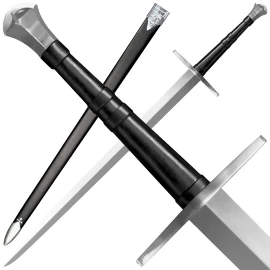
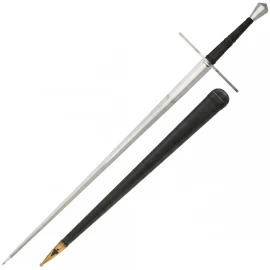
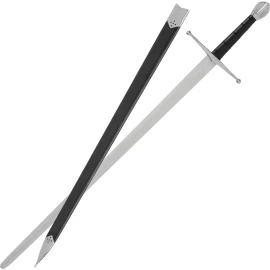
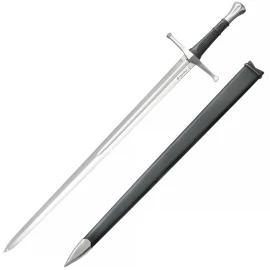
This substantial Oakeshott Type XIIa medieval war sword combines a long double-edged spring-steel blade with an extended grip suitable for hand-and-a-half or two-handed use. Its pronounced fuller, substantial distal taper, straightforward crossguard and faceted peened pommel recall the great European war swords of the High Middle Ages. A black wood-cored scabbard with an integrated suspension system is included. We recommend this functional sword primarily for collecting, historical presentation, solo practice and controlled test cutting; because of its thin edge and acute point, it is not intended for contact fencing. Further product information ...

 Delivery options
Oakeshott XIIa Medieval War Sword with Black Scabbard
A classic Type XIIa war-sword blade
The centrepiece of the sword is its approximately 92.5 cm (36.4 in) blade, made from high-performance spring steel. At the guard it measures about 46.5 mm (1.83 in) wide and gradually narrows towards the point. At 10 cm (3.9 in) from the tip it remains approximately 26 mm (1.02 in) wide. This noticeable profile taper is one of the characteristics that distinguishes Oakeshott Type XIIa from some of the broader, less strongly tapering Type XIIIa war swords.
A long fuller, approximately 84.5 cm (33.3 in) in length, runs along most of the blade. Sometimes inaccurately called a “blood groove”, the fuller is in fact a method of redistributing material within the blade section and reducing unnecessary mass. On this model it remains clearly visible well into the forward part of the blade.
The blade also incorporates substantial distal taper, meaning that its thickness decreases towards the point. Swordier specifies approximately 5.5 mm (0.22 in) at the base and around 2.5 mm (0.10 in) towards the tip. The blade is therefore not a constant-thickness steel bar: its changing section plays an important role in weight distribution, responsiveness and overall handling.
The point of balance on the measured example lies approximately 10 cm (3.9 in) forward of the crossguard. Combined with a sword weight of about 1.46 kg (3.22 lb), this leaves a perceptible degree of blade presence appropriate to a medieval war sword without turning the piece into an unnecessarily cumbersome display weapon.
A hilt built for hand-and-a-half or two-handed use
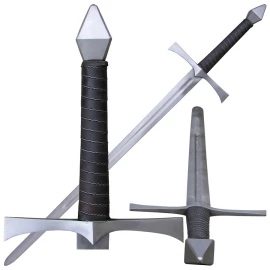
The plain steel crossguard is approximately 24 cm (9.4 in) across. Its arms have a very slight curve and smoothly rounded terminals. The appearance is restrained and functional rather than highly ornamental, complementing the purposeful character of the sword.
The grip is approximately 19.5 cm (7.7 in) long, providing comfortable space for both hands. It is covered in genuine black leather and incorporates a raised central section that gives the hands a useful tactile reference. This makes it easier to maintain a consistent grip whilst changing guards or carrying out solo cutting movements.
A prominent faceted stainless-steel pommel with a satin finish completes the hilt. In addition to its visual role, the pommel contributes to balancing the long blade. Swordier specifies a peened construction, with the end of the tang mechanically peened over the pommel. This is a traditional and robust method of assembling a European sword hilt.
Black wood-cored scabbard and suspension
The sword is supplied with a black scabbard built around a wooden core with a black PU covering. A metal chape protects the lower end, whilst the visible black straps provide a practical suspension arrangement for wearing the sword from a belt.
On the measured example, the suspension loops can accommodate a belt up to approximately 5.5 cm (2.2 in) wide. The scabbard itself weighs around 476 g (1.05 lb). It is therefore useful not only for display and transport, but also when assembling a historically inspired presentation outfit.
Oakeshott Type XIIa and the medieval war sword
The Oakeshott typology classifies medieval European swords primarily by the geometry of their blades. Type XIIa can broadly be understood as the larger relative of the classic Type XII: it generally combines a long blade, substantial fuller, progressive profile taper and an extended grip that allows the second hand to assist in controlling the weapon.
These large swords are particularly associated with the High Middle Ages, broadly from the later 13th century into the 14th century. Modern arms literature often describes them as war swords, great swords or great war swords. They should not be confused with the enormous dedicated two-handed swords of the 16th century. Rather, they occupy an important position between the traditional single-handed knightly sword and later medieval longswords.
The extended hilt gave the user greater leverage and control, whilst the long, broad blade retained considerable cutting capacity. Compared with some related great-sword forms, Type XIIa also develops a more pronounced taper towards the point, giving it a more useful thrusting tip without abandoning its fundamentally cut-oriented character.
The development of these swords coincided with a period in which European mail armour was becoming increasingly comprehensive and was gradually supplemented by additional protective elements. It would, however, be misleading to describe Type XIIa simply as a specialised weapon designed to “pierce plate armour”. Its geometry remains first and foremost that of a large medieval cutting sword rather than the specialised stiff thrusting blades of the later Middle Ages.
Functional construction and intended use
This Swordier model is not simply a decorative wall-hanger. The spring-steel blade, peened hilt construction and pronounced distal taper are consistent with a functional sword. The manufacturer gives a blade flex rating of approximately 14 kg. This figure describes a mechanical characteristic of the blade and should not be interpreted as a safety certification for sparring.
The measured edge thickness is approximately 0.5 mm (0.02 in). Under the Outfit4Events classification system this places it in the not fully sharp category, although an edge this thin can still cause severe injury. The point itself is acute and sharp.
We recommend the sword for collecting, study of medieval sword construction, solo technique practice and – for suitably experienced users – controlled test cutting on appropriate soft targets. It is not intended for HEMA sparring, stage combat, reenactment fighting or any other person-to-person contact. Hard edge-on-edge impacts may also nick or otherwise damage the relatively thin cutting edges.
Technical specifications
| Weapon type | medieval war sword / longsword |
|---|---|
| Typology | Oakeshott Type XIIa |
| Overall length | approx. 120 cm (47.2 in) |
| Blade length | approx. 92.5 cm (36.4 in) |
| Crossguard length | approx. 24 cm (9.4 in) |
| Grip length | approx. 19.5 cm (7.7 in) |
| Fuller length | approx. 84.5 cm (33.3 in) |
| Blade width at the guard | approx. 46.5 mm (1.83 in) |
| Blade width 10 cm from the point | approx. 26 mm (1.02 in) |
| Distal taper | approx. 5.5 → 2.5 mm (0.22 → 0.10 in) |
| Point of balance | approx. 10 cm (3.9 in) forward of the guard |
| Sword weight | approx. 1459 g (3.22 lb) |
| Scabbard weight | approx. 476 g (1.05 lb) |
| Blade material | high-performance spring steel |
| Grip material | genuine leather |
| Hilt fittings | stainless steel |
| Pommel | stainless steel, satin polished, peened |
| Scabbard | wooden core, black PU covering, suspension straps |
| Maximum belt width for suspension loops | approx. 5.5 cm (2.2 in) |
| Blade flex rating | approx. 14 kg (30.9 lb) |
| Blade edge | approx. 0.5 mm (0.02 in) – not fully sharp under Outfit4Events classification |
| Blade point | sharp / acute |
| Recommended use | collection, historical presentation, solo practice, controlled test cutting |
As the sword receives a degree of hand finishing, the stated dimensions, weights and balance measurements should be regarded as approximate. Minor variation between individual examples is normal.
Safe handling
This sword has a very thin edge and an acute point and is capable of causing severe or fatal injury. We recommend that functional edged weapons are handled only by responsible adults or under appropriate expert supervision.
- Inspect the blade, crossguard, grip and pommel before every practical session.
- Make certain that there is ample clear space in every direction when practising alone.
- For test cutting, use a stable cutting stand and suitable soft targets only.
- Do not strike metal, stone, concrete, hard dry timber or another steel weapon.
- Never use this sword for contact fighting against another person.
- Store it securely and out of reach of children or unauthorised persons.
- Never handle a functional sword whilst under the influence of alcohol or other intoxicating substances.
Care and maintenance
Spring steel is susceptible to corrosion and therefore requires regular protection. After each use or contact with bare skin, wipe the blade thoroughly with a soft dry cloth and apply a very thin film of suitable blade oil or conservation wax intended for carbon steel.
The genuine leather grip may occasionally be treated with a mild product intended specifically for natural leather. The PU covering on the scabbard should not be treated in the same way as genuine hide; in most cases a soft, slightly damp cloth is sufficient. Avoid aggressive solvents and abrasive cleaners.
Never return a wet or dirty blade to the scabbard. When the sword is stored for extended periods, inspect the steel regularly, as trapped moisture inside any scabbard can encourage localised corrosion.
Recommended accessories
- blade oil or conservation wax suitable for carbon and spring steel,
- soft cloths and non-aggressive blade-care products,
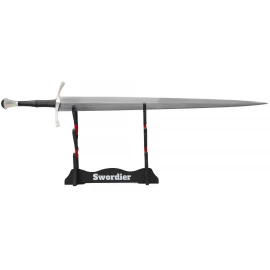
- a stable sword stand for safe display,
- a cutting stand and suitable soft targets for controlled test cutting,
- for historical presentation, clothing, belts and equipment appropriate to roughly the later 13th to early 14th century.
About Swordier
Swordier specialises in functional historically inspired swords and other edged weapons produced in the Longquan area of Zhejiang Province, China, a region with a long tradition of blade and metalworking craftsmanship. Depending on the individual model, the company uses a variety of carbon and spring steels and places emphasis on functional blade geometry, heat treatment, secure hilt construction and practical balance.
This sword illustrates that approach particularly well: a spring-steel blade with meaningful distal taper, peened pommel, genuine leather grip and usable wood-cored scabbard form a practical overall package rather than a purely decorative display piece. For customers looking for a historically inspired European sword with an attractive balance between price, materials and functional construction, Swordier offers an interesting alternative to considerably more expensive small-batch reproductions.
We are here for you!