Čeština
 Deutsch


Medieval serving knife with sheath


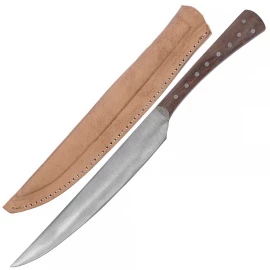
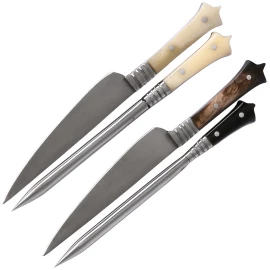
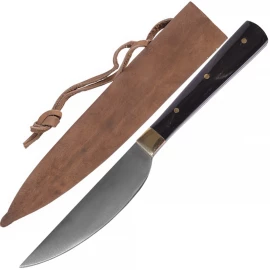
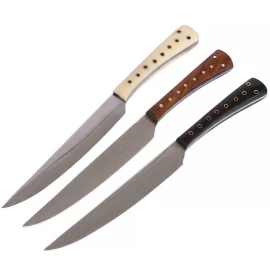
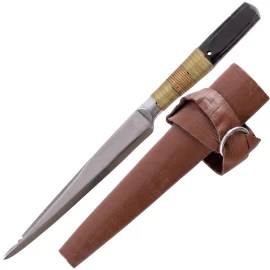
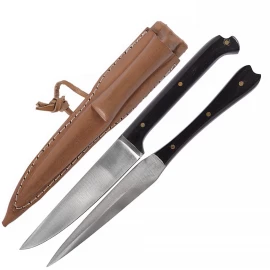
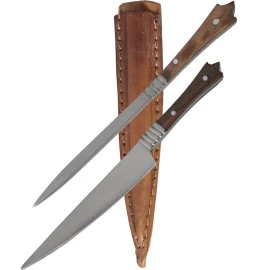
Add this medieval serving knife with sheath to your collection or historical display. Its broad blade, curved edge profile and pronounced point recall utensils used to prepare and present food at period feasts. Three rivets and a golden-coloured fitting at the blade’s base give the handle a simple yet distinctive appearance. Choose hardwood, bone or horn handle scales to suit your display. Made in small batches using traditional methods, the knife makes an interesting collector’s piece or educational exhibit. Although its construction is functional, we offer it as a decorative item that is not certified for food contact. Further product information ...

 Delivery options
The following variants are currently available:
Medieval serving knife with sheath for historical displays
Broad blade and natural handle materials
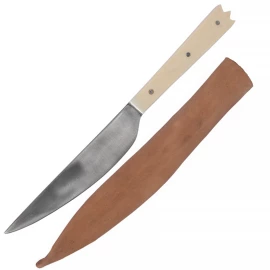
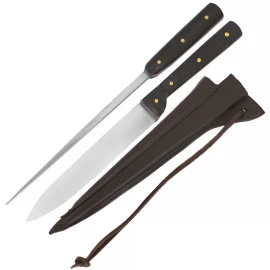
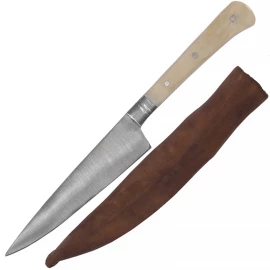
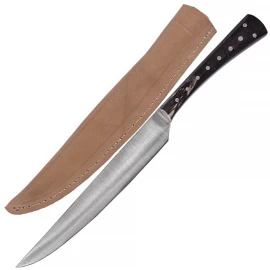
The blade has a largely straight spine and a noticeably curved lower edge tapering towards the point. A small stamped mark appears near its base. A golden-coloured fitting highlights the transition to the handle; its precise material is not specified. Three visible rivets secure the shaped handle scales.
A sheath is included. The photographs show a brown sheath with a thong at its opening. The illustrated handle variants represent the choices available for one knife. Natural colours and markings in wood, bone or horn may vary. The precise metal used for the blade is not specified.
The knife at a historical feast
According to the supplied description, similar knives appear in depictions of feasts from the 13th–16th centuries. This makes the piece suitable for a themed presentation of medieval and Renaissance dining. It is not documented as a copy of one particular historical original.
Larger knives historically served to divide and present food. An interesting distinction is that between a personal eating knife and utensils used to serve a shared table: a matching place setting for every diner was not universal throughout this period.
Technical specifications
| Specification | Value |
|---|---|
| Overall length | Approx. 322 mm / 12.68 in |
| Blade length | Approx. 222 mm / 8.74 in |
| Maximum blade width | Approx. 41.6 mm / 1.64 in |
| Blade thickness at the handle | 2.1 mm / 0.083 in |
| Edge thickness | Approx. 0.5 mm / 0.020 in |
| Weight | Approx. 168 g / 5.93 oz |
| Handle scale options | Hardwood, bone or horn |
| Included accessory | Sheath |
| Manufacturer | Marshal Historical |
Display and safe handling
Before displaying the knife, check that the handle scales are secure and place it on a stable support. Insert it into the sheath slowly, keeping your fingers clear of the blade’s path. Do not use it to prepare, serve or eat food. The knife is not certified for food contact. Its stated edge thickness does not guarantee safety: the blade and point can cause injuries. It is unsuitable for contact fencing or LARP and must be kept away from children.
Care and recommended accessories
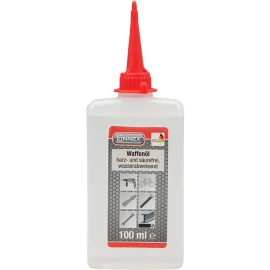
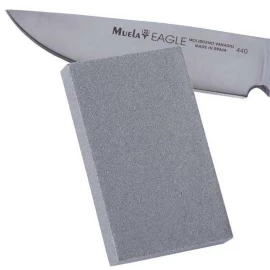
Remove dust with a soft, dry cloth. Do not soak the knife or place it in a dishwasher or microwave. Protect it from heat and dry it thoroughly before returning it to the sheath. Test any suitable protective treatment on an inconspicuous area first.
For a display inspired by the 14th–16th centuries, we recommend a wooden serving board, ceramic tableware and a linen tablecloth. For actual dining, choose separate utensils suitable for food contact.
We are here for you!