 Čeština
 Deutsch


Falkirk Long Medieval Socketed Arrowhead


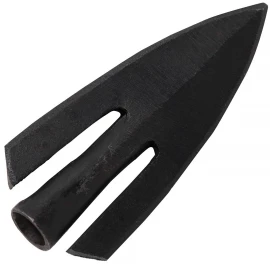
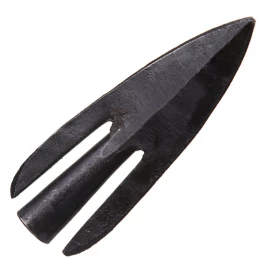
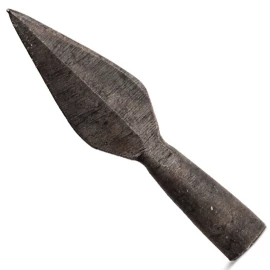
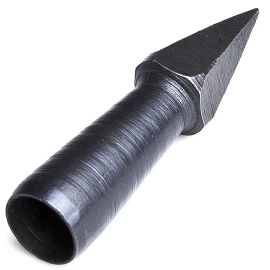
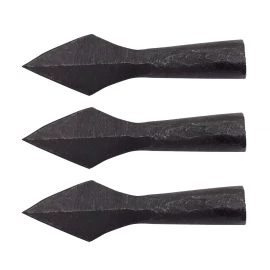
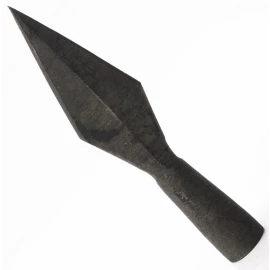
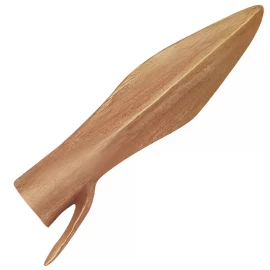
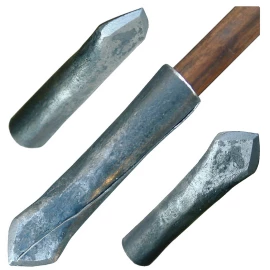
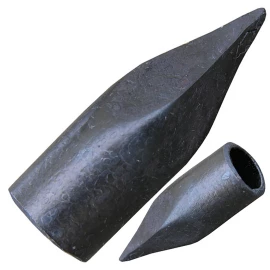
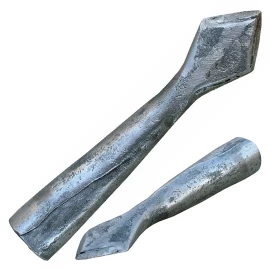
Looking for a convincing addition to your medieval archery collection? The Falkirk long arrowhead by Marshal Historical features an elongated, slender blade, pronounced longitudinal ridges and a straightforward, functional design inspired by historical European archery. Its hollow socket allows you to mount it on a suitably sized wooden shaft to create a decorative arrow reminiscent of those used during the High and Late Middle Ages. Choose between a bright, ground and polished finish or a darker, forged finish. Whether displayed individually, incorporated into a historical presentation or added to a collection of medieval arms, this distinctive arrowhead makes an interesting exhibit. Further product information ...

 Delivery options
The following variants are currently available:
Falkirk Long Medieval Socketed Arrowhead
Design and Construction
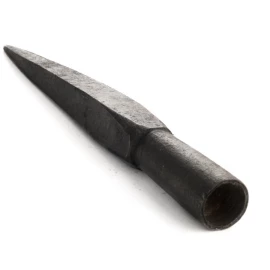
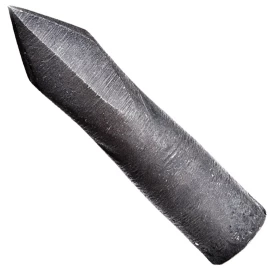
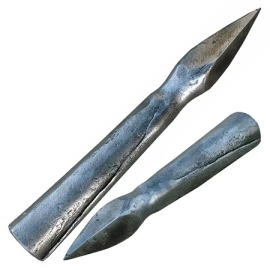
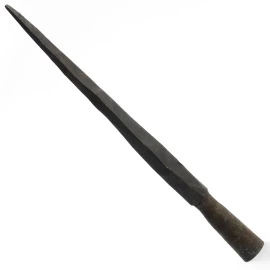
The Falkirk medieval arrowhead has a long, narrow, slightly leaf-shaped blade that gradually tapers from its widest point towards a pronounced tip. Distinct longitudinal ridges and angled surfaces create its characteristic faceted profile. There are no barbs, engravings or decorative embellishments, giving the piece a simple, purposeful appearance.
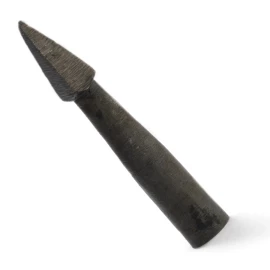
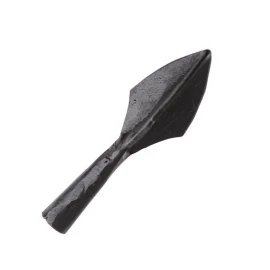
At the rear, the blade narrows into a hollow, slightly flared conical socket designed to receive the end of a wooden arrow shaft. Socketed construction was widely used on historical arrowheads. Unlike a tanged arrowhead, whose projecting tang fits into the wood, a socketed arrowhead encloses the end of the shaft.
The arrowhead is available in two finishes:
- Ground (polished) finish: A bright, silvery-grey metal surface with visible grinding marks and sharply defined longitudinal ridges.
- Forged finish: A darker, irregularly coloured surface displaying visible working marks and contrasting lighter areas.
Both versions share the same basic shape. The different finishes allow you to select the appearance that best complements your collection or intended historical display.
Historical Background: Medieval Arrowheads
Slender iron arrowheads formed part of the varied equipment used by European archers during the 13th to 15th centuries. Medieval smiths produced numerous designs, ranging from broad hunting heads and narrow leaf-shaped forms to specialised armour-piercing types. Certain narrow, pointed designs are commonly described in modern English terminology as bodkin arrowheads.
The shape of an arrowhead reflected its intended purpose, manufacturing techniques and the archery equipment with which it was used. A narrow profile could offer advantages against particular types of protection. However, actual penetration depended on several factors, including the quality of the metal, point geometry, impact energy and the construction of the target's armour. A slender shape alone does not establish that an arrowhead could penetrate plate armour.
The Falkirk model resembles long, narrow medieval European arrowheads. It is not, however, documented as an exact reproduction of a particular archaeological find, and its design cannot be confidently assigned to a single historical arrowhead classification.
Why Is It Called Falkirk?
The name commemorates the Battle of Falkirk, fought in Scotland on 22 July 1298. During this engagement, the English army commanded by King Edward I defeated the Scottish forces led by William Wallace. The Scots employed dense formations of spearmen known as schiltrons. English and Welsh archers played an important role in weakening these defensive formations through sustained missile fire.
Falkirk is consequently remembered as an important example of the tactical significance of archery in medieval warfare. The name of this arrowhead refers to that historical event. It does not imply that an identical arrowhead was recovered from the battlefield.
Technical Specifications
| Specification | Details |
|---|---|
| Product type | Long socketed arrowhead |
| Historical inspiration | European archery of the 13th–15th centuries |
| Overall length | 109 mm (4.29 in) |
| Blade length | 77 mm (3.03 in) |
| Blade width | Approx. 11.5 mm (0.45 in) |
| Blade edge thickness | Approx. 1.23 mm (0.048 in) |
| Internal socket diameter | 6.7 mm (0.26 in) |
| External socket diameter at the end | 9.15 mm (0.36 in) |
| Weight per arrowhead | Approx. 19 g (0.67 oz) |
| Attachment method | Hollow socket for fitting onto a wooden shaft |
| Blade profile | Long, narrow, faceted blade with longitudinal ridges and a pointed tip |
| Barbs | None |
| Available finishes | Ground (polished) or forged |
| Decoration | None |
| Recommended use | Collecting, decoration and historical display |
| Manufacturer | Marshal Historical |
How to Fit the Arrowhead onto a Wooden Shaft
If you intend to assemble a decorative medieval arrow, obtaining a properly fitting shaft is particularly important. The stated internal socket diameter of 6.7 mm (0.26 in) provides a useful starting point when selecting a wooden shaft. We recommend measuring the actual socket opening before assembly.
Carefully shape the end of the shaft so that it fits evenly inside the socket without excessive movement. The arrowhead should align with the longitudinal axis of the shaft. For decorative assembly, you can secure the connection with a suitable adhesive designed for bonding wood and metal. Follow the adhesive manufacturer's instructions and allow it to cure fully.
Never force or hammer the arrowhead onto a shaft that is too large. Doing so could split the wood or deform the socket. Equally, an excessively loose connection will not provide a secure fit.
Care and Safety Instructions
After handling, wipe the arrowhead with a soft, dry cloth and store it in a dry environment. Avoid prolonged exposure to water or moisture. If the metal is susceptible to corrosion, an appropriate metal preservative may be applied. On the ground and polished version, avoid harsh cleaning chemicals and coarse abrasives that could alter the surface finish.
Warning: This arrowhead has a pronounced point capable of causing serious puncture injuries. Always handle it carefully and cover the point with a suitable protective cap during storage or transport. Never direct it towards people or animals.
The supplied product information does not confirm that this arrowhead is suitable for practical archery. We therefore recommend it exclusively for decorative, collecting and historical display purposes. It is not suitable for contact LARP, combat demonstrations involving shooting towards participants or any activity in which it could strike another person. Keep it out of the reach of children.
Recommended Accessories
To create a decorative arrow inspired by the 13th to 15th centuries, we recommend a suitable straight wooden shaft, natural feathers for fletching and strong linen thread to secure them. A historical longbow and bowstring can complement the finished display and help illustrate medieval archery equipment. For presenting a larger collection, consider a wooden display stand or a reproduction medieval arrow quiver appropriate to the chosen period.
We are here for you!