 Čeština
 Deutsch


Johannes Lecküchner HEMA Langes Messer


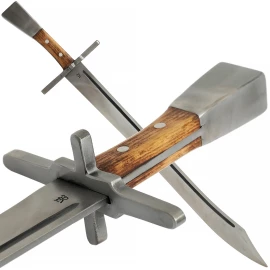
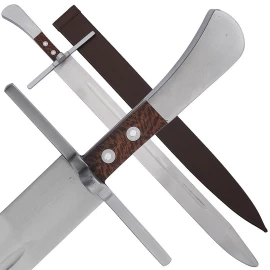
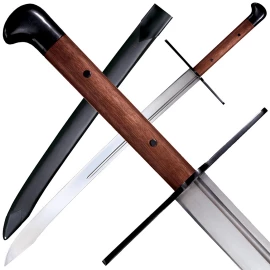
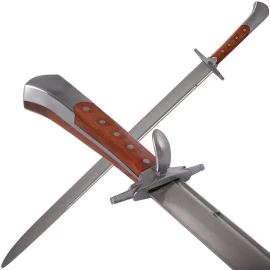
This HEMA Langes Messer trainer is a modern functional interpretation of the Central European long knife of the late Middle Ages. Designed for technical practice and contact fencing, it combines a flexible 60Si2Mn spring-steel blade with substantial 2.9 mm (0.11 in) blunt edges, pronounced distal taper and a rolled safety point. The riveted wooden grip scales, crossguard and characteristic lateral hand-protection lug known as a Nagel reflect important features of historical Messers. At approximately 866 g (1.91 lb), with its point of balance about 7.5 cm (3.0 in) ahead of the guard, it offers a particularly interesting platform for modern HEMA study of historical German Messer fencing. Further product information ...

 Delivery options
Johannes Lecküchner HEMA Langes Messer Trainer
A training weapon based on historical Messer construction
Langes Messer literally means “long knife”. One of the most important distinctions between a Messer and a conventionally constructed medieval sword is found in the hilt. Historical Messers typically employ a knife-like construction with a broad tang and grip scales attached to its sides, rather than a sword grip built around a narrow tang.
This feature is immediately visible on the present model. Two wooden scales are secured by three exposed metal rivets, leaving the underlying knife-like construction visually clear. There is no leather wrap disguising the form.
A substantial metal cap completes the rear of the grip. As well as contributing to mass distribution, its shape gives the hand a positive stop against slipping backwards during dynamic cutting movements.
This sword is not presented as an exact reproduction of one particular surviving antique. It is a modern HEMA interpretation of the historical Langes Messer, with intentionally modified blunt edges and safety point for contemporary fencing practice.
60Si2Mn spring-steel blade
The blade measures approximately 68 cm (26.8 in) and is made from 60Si2Mn spring steel. This material is used in modern training weapons where resilience, flexibility and resistance to repeated dynamic loading are required.
At the guard the blade is approximately 34.5 mm (1.36 in) wide, whilst 10 cm (3.9 in) from the tip it remains around 30.3 mm (1.19 in) wide. The profile therefore retains considerable width over much of its length, supporting the distinctly cut-oriented character expected of a Messer.
A 60.5 cm (23.8 in) fuller extends along almost the entire working portion of the blade. A fuller is not a “blood groove”; it is a structural feature used to influence cross-section, stiffness and the distribution of material.
The documented distal taper from approximately 4.5 mm to 2 mm (0.18 to 0.08 in) means that the blade becomes progressively thinner towards its end. Material is retained in the strong section close to the hand while unnecessary mass is reduced farther forward.
Blunt edges and rolled safety point
The striking edge is approximately 2.9 mm (0.11 in) thick, placing it firmly in the blunt training category. This is not a cutting-test blade and should be used against suitable HEMA training weapons rather than targets.
The tip is formed by rolling the end of the blade back upon itself to create a broad rounded safety termination measuring approximately 7.9 × 8 mm (0.31 × 0.31 in). This increases the contact area of a controlled thrust and reduces penetration risk compared with an acute steel point.
The manufacturer states a current flex rating of approximately 9.5 kg (20.9 lb). As manufacturers do not necessarily measure blade flex according to identical test procedures, the figure is most useful as a specification for this model rather than as a universal comparison with every other HEMA weapon.
Crossguard and the characteristic Nagel
The crossguard measures approximately 16.5 cm (6.5 in). Its arms are subtly shaped and terminate in expanded rectangular ends.
The defining feature of the hilt is the lateral Nagel, a protective lug projecting from one side of the guard. On this model it measures approximately 5 cm (2.0 in).
On historical Messers, the Nagel provided additional protection to one side of the hand and knuckles, creating a barrier against an opponent's blade sliding down towards the grip. This asymmetric protection is one of the most recognisable differences between a Messer hilt and a simple symmetrical sword cross.
Riveted wooden grip scales
The wooden grip measures approximately 11.5 cm (4.5 in). Two scales sit on either side of the broad tang and are secured by three clearly visible metal rivets.
This construction is particularly important historically because it explains the weapon's Messer – knife – designation. Rather than hiding the tang within a conventional sword grip, the structure follows the same broad principle used for large knives.
The angular metal rear fitting should therefore not simply be understood as a conventional separate sword pommel. It forms part of the overall knife-style grip construction and also provides a secure stop for the hand.
Handling and balance
Overall length is approximately 85 cm (33.5 in). The measured example weighs about 866 g (1.91 lb), whilst the manufacturer's general specification gives approximately 858 g (1.89 lb), a very small difference consistent with normal individual variation.
The point of balance lies approximately 7.5 cm (3.0 in) ahead of the guard. This leaves sufficient blade presence for decisive cutting actions while preserving the agility required for rapid changes of line, defence, counters and close fencing exchanges.
Handling cannot be described by total weight alone. The combination of point of balance, long fuller and substantial distal taper all influence how readily the weapon accelerates, stops and changes direction.
The Langes Messer in the late Middle Ages
The Langes Messer is particularly associated with German-speaking Central Europe during the 15th and 16th centuries. It was a single-edged sidearm built around a knife-like hilt construction and existed in numerous sizes and variations.
It is misleading to reduce the Messer to the stereotype of a crude “peasant weapon”. Surviving fencing traditions demonstrate a sophisticated martial system involving cuts, thrusts, defensive actions, blade engagement and techniques at very close range.
The Messer is therefore best understood as a fully developed fighting weapon in its own right. Its combination of a substantial blade and recognisably knife-derived hilt construction makes it one of the most distinctive edged weapons in late-medieval Central European martial culture.
Johannes Lecküchner and Messer fencing
The model is named in honour of Johannes Lecküchner, one of the most important surviving authorities associated with late-medieval Messer fencing.
The fencing tradition linked to his name presents the Messer as a technically sophisticated weapon rather than a tool limited to simple chopping actions. For modern HEMA practitioners, Lecküchner has consequently become closely associated with the reconstruction and practice of historical Messerfechten.
This training weapon is not a replica of a documented personal weapon belonging to Johannes Lecküchner. His name is used as a tribute to the historical fencing culture for which a modern training Messer such as this is intended.
Technical specifications
| Type | HEMA Langes Messer / long knife trainer |
|---|---|
| Historical inspiration | Central Europe, principally 15th–16th centuries |
| Overall length | 85 cm (33.5 in) |
| Blade length | 68 cm (26.8 in) |
| Wooden grip length | 11.5 cm (4.5 in) |
| Crossguard length | 16.5 cm (6.5 in) |
| Nagel length | 5 cm (2.0 in) |
| Fuller length | 60.5 cm (23.8 in) |
| Blade width at guard | 34.5 mm (1.36 in) |
| Blade width 10 cm from tip | 30.3 mm (1.19 in) |
| Distal taper | approx. 4.5 mm → 2 mm (0.18 → 0.08 in) |
| Edge thickness | 2.9 mm (0.11 in) – blunt |
| Blade point | blunt, rolled and rounded |
| Safety-tip dimensions | approx. 7.9 × 8 mm (0.31 × 0.31 in) |
| Point of balance | approx. 7.5 cm (3.0 in) ahead of guard |
| Weight | approx. 866 g (1.91 lb) |
| Blade material | 60Si2Mn spring steel |
| Manufacturer-stated flex | approx. 9.5 kg (20.9 lb) |
| Grip | wooden scales secured by three metal rivets |
| Hilt construction | knife-style broad tang with side-mounted grip scales |
| Intended use | HEMA drills, technical training and contact sparring with suitable protective equipment |
Because the weapon receives a degree of manual finishing, the stated dimensions and weight should be regarded as approximate. Individual examples may vary slightly.
Suitability for HEMA sparring
The manufacturer specifically presents this model for HEMA training, sparring and competitive fencing practice. Its blunt edges, flexible blade and rolled point are functional safety features rather than decorative details.
Requirements can differ between individual HEMA clubs and tournaments. Before competitive use, check the organiser's rules concerning blade flex, tip design, overall dimensions and weight.
This Langes Messer is not intended for cutting practice. Do not strike wood, metal, stone, concrete or other hard and unyielding targets.
Safety during training
A blunt steel HEMA weapon remains capable of causing serious injury. Contact sparring requires an appropriate fencing mask with back-of-head protection, throat protection, a suitable HEMA jacket, elbow and forearm protection, robust gloves and, according to training intensity, protection for the chest, knees, shins and groin.
Before every session, inspect the rolled tip, blade edges, Nagel, crossguard, grip rivets and rear metal fitting. A weapon showing cracking, a major permanent bend, a loose component or a sharp burr should immediately be removed from contact use.
Never undertake contact fencing whilst under the influence of alcohol or other substances that impair judgement, reaction speed or coordination.
Care and maintenance
60Si2Mn spring steel is not stainless. After every training session, wipe perspiration, moisture and fingerprints from the blade and metal fittings with a soft dry cloth. Apply a very thin protective film of suitable weapon or blade oil afterwards.
Repeated steel-on-steel contact may produce small sharp burrs on the otherwise blunt edges. Inspect them regularly and carefully smooth any hazardous projection with a fine file or suitable abrasive before further sparring. The blunt training edges must never be sharpened.
Keep the wooden grip scales dry and check periodically that the rivets remain secure and that the scales have not begun to move relative to the tang.
Recommended accessories
- HEMA fencing mask with back-of-head and throat protection,
- HEMA jacket and arm protection,
- robust gloves suitable for Messer and other one-handed weapons,
- knee, shin, chest and groin protection according to sparring intensity,
- padded carrying bag,
- blade oil and a fine tool for removing small burrs.
About Swordier
Swordier is associated with Longquan in Zhejiang Province, China, an area with a long tradition of blade making and metalworking. Its modern range includes Asian and European edged weapons alongside training models developed specifically for contemporary HEMA practice.
With this Langes Messer, the emphasis is on useful training characteristics: a 60Si2Mn spring-steel blade, substantial blunt edges, controlled flexibility, rolled safety point, low overall weight and a historically inspired grip incorporating wooden scales and a Nagel. The result is a functional training weapon offering an interesting balance of price, construction and practical usability.
We are here for you!