 Čeština
 Deutsch


Martin Schwartz Langes Messer, Elmslie Type 3e


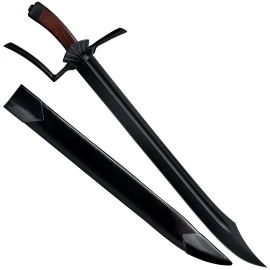
If you are looking for a sharp late-medieval Langes Messer that stands apart from more conventional designs, this model is immediately distinguished by its unusual blade profile. The Elmslie Type 3e Langes Messer combines a single-edged 65Mn spring-steel blade, two pronounced concave scallops along the spine, traditional full-tang knife construction with wooden grip scales and the characteristic protective Nagel. At approximately 943 g (2.08 lb), with its point of balance around 10 cm (3.9 in) ahead of the guard, it is a functional sharp weapon intended primarily for collecting, historical presentation, solo practice and controlled cutting on suitable soft targets. Further product information ...

Would you like to be notified as soon as the item is in stock?
You will receive a short e-mail as soon as we have it back in stock.
Martin Schwartz Langes Messer, Elmslie Type 3e
An unusual Elmslie Type 3e blade
The character of this long knife is defined by its 68.5 cm (27.0 in) single-edged blade. It measures approximately 36 mm (1.42 in) wide immediately below the guard and is still approximately 37 mm (1.46 in) wide at 10 cm (3.9 in) from the point. Unlike many sword blades, it therefore retains considerable width through the forward portion before developing into its long, acute tip.
The most striking feature is the pair of deep concave scallops cut into the forward part of the spine. Multiple scallops along the back of the blade are a defining visual feature of subtype 3e within the modern Elmslie typology of European single-edged weapons. It is a comparatively unusual and conspicuous form, particularly associated with messers and related late-medieval single-edged arms.
These scallops should not be interpreted as modern saw teeth. They form part of the deliberate outline of the blade rather than a serrated cutting edge. Comparable features on historical weapons may have combined aesthetic and structural considerations, but without a specific documented original it would be misleading to assign them a particular specialised combat function.
The blade is made from 65Mn spring steel. The manufacturer states a distal taper from approximately 5 mm (0.20 in) at the base to 3 mm (0.12 in) towards the point. Distal taper describes the reduction in blade thickness along its length and is an important part of controlling mass distribution and handling.
A fuller approximately 37 cm (14.6 in) long runs through the lower portion of the blade. A fuller is a structural feature used to distribute material and mass; it is not a so-called “blood groove”. The supplied measurement gives an edge thickness of approximately 0.4 mm (0.02 in), so the edge is classified as sharp. The point is sharp as well.
Knife-style full-tang hilt construction
The hilt construction is one of the main features distinguishing a messer from many single-edged swords with superficially similar blades. This model uses a flat tang extending through the full length of the grip. Wooden scales are fixed directly to its sides with three metal rivets of brass-like appearance.
This is fundamentally large-knife construction: instead of being completely enclosed within a separate grip, the flat tang itself forms the structural core of the handle and the scales are riveted to either side. This is one of the most recognisable construction features of historical messers.
The crossguard measures approximately 16.2 cm (6.4 in). Its arms are subtly profiled and finish in expanded terminals. On one side is the approximately 4.5 cm (1.8 in) Nagel, or protective nail, characteristic of many late-medieval messers. Its purpose is to provide additional protection for the back of the hand and knuckles, particularly against a blade sliding along the crossguard towards the fingers.
On the opposite side of the hilt, another prominent steel element projects above the base of the blade. Together these parts give the guard a robust, purposeful appearance. The bright ground steel provides a strong contrast with the warm brown wooden scales.
The wooden gripping area is approximately 11.5 cm (4.5 in) long and terminates in a substantial steel end fitting. According to the supplied specifications, the end assembly is peened. Its widened shape also helps prevent the hand slipping backwards during vigorous cutting movements.
Dark brown leather scabbard
A dark brown leather scabbard is included and complements the late-medieval character of the weapon particularly well. Visible cross-stitching runs along the widened forward section and the tip is protected by a dark chape.
Several small leather straps with decorative, historically styled metal fittings add visual interest to the otherwise restrained dark leather. The result is considerably more evocative of historical equipment than a modern transport sheath.
There is no integrated belt loop on the rear of the scabbard. If you intend to wear the messer as part of historical clothing, a suitable separate suspension or belt arrangement will therefore be required. The scabbard weighs approximately 313 g (0.69 lb).
The Langes Messer in the late Middle Ages
The Langes Messer – literally “long knife” – was a characteristic family of single-edged weapons in the German-speaking parts of Central Europe, particularly during the 15th and early 16th centuries. Its size and construction placed it somewhere between a large knife and a one-handed sword, and surviving and depicted examples display a wide variety of blade and hilt forms.
Messers appear in both civilian and martial contexts. It is therefore too simplistic to describe them exclusively as weapons of commoners or, conversely, as purely military arms. Historical forms range from restrained practical pieces to elaborately finished weapons, indicating use across a broader social spectrum.
A popular modern story claims that the knife-style hilt developed purely as a legal or guild loophole allowing cutlers to produce sword-sized weapons despite restrictions on sword manufacture. This is not sufficiently secure as a universal explanation for the weapon's development. What can be established with far greater confidence is the characteristic construction itself: a flat tang, riveted grip scales and, on many examples, a protective Nagel.
Johannes Lecküchner and the art of Messer fencing
The sophistication of the Langes Messer is especially clear from the fencing literature of the 15th century. The most important name is Johannes Lecküchner, a cleric and fencing master active in the German-speaking world during the second half of that century.
His extensive teachings present a highly developed system of cuts, thrusts, parries, blade engagements, locks, disarms and wrestling actions with the Messer. His substantial illustrated treatise completed in 1482 remains one of the principal sources used today in the reconstruction of historical Messer fencing.
This particular weapon is sharp, however, and is not a HEMA training sword. Historical techniques should only be explored with it as controlled solo movements with no training partner in range. Partner drills and sparring require a purpose-built blunt training weapon.
Elmslie Type 3e
The modern Elmslie typology was developed to provide a more systematic way of describing European single-edged arms, including falchions, messers and related forms. It considers blade shape together with the distinction between sword-like and knife-like hilt construction.
Subtype 3e is distinguished by multiple concave scallops along the back of the blade, most commonly two or three. Such blades are considerably less common than more conventional straight-backed messers and have an especially distinctive silhouette. The two clearly visible scallops on this model therefore correspond to the principal visual characteristic of the classification given by the manufacturer.
We nevertheless describe this product as a functional modern interpretation of a historical weapon type, rather than an exact reproduction of a specific surviving museum piece.
The name Martin Schwartz
We chose the model name as a reference to Martin Schwartz, a German mercenary commander of the second half of the 15th century. Originating from Augsburg, he took part in several important military enterprises of his age, including campaigns in the Burgundian-Habsburg sphere and, later, an expedition to England at the head of German mercenaries.
Schwartz was killed in 1487 at the Battle of Stoke Field, one of the final major engagements associated with the Wars of the Roses. His career therefore belongs to the same broad late-15th-century world in which the Langes Messer flourished and in which Lecküchner recorded his sophisticated fencing system.
There is no evidence that Martin Schwartz owned or carried this particular form of weapon. The name honours a historical figure whose lifetime suits the cultural setting of the design; it does not indicate a reproduction of his personal Messer.
Handling and cutting practice
The weapon weighs approximately 943 g (2.08 lb) and balances about 10 cm (3.9 in) ahead of the guard. Together with the relatively broad blade, this gives it a distinctly cut-oriented character without making it exceptionally heavy for a one-handed weapon.
This version is supplied sharpened, and the manufacturer presents the blade as a functional cutter. It can therefore be used for controlled cutting practice on suitable soft targets, such as dedicated cutting mats and similar materials designed for that purpose.
Do not strike metal, stone, concrete, bone, hard timber, trees or other unyielding objects. Such impacts can damage not only the fine cutting edge but also place unnecessary stress on the unusually profiled forward portion of the blade.
Technical specifications
| Weapon type | sharp Langes Messer / long knife |
|---|---|
| Typology | Elmslie Type 3e, according to the manufacturer |
| Historical inspiration | German-speaking Central Europe, primarily 15th to early 16th century |
| Blade material | 65Mn spring steel |
| Overall length | 85.5 cm (33.7 in) |
| Blade length | 68.5 cm (27.0 in) |
| Crossguard length | 16.2 cm (6.4 in) |
| Wooden grip length | 11.5 cm (4.5 in) |
| Nagel length | 4.5 cm (1.8 in) |
| Fuller length | 37 cm (14.6 in) |
| Distal taper | approx. 5 mm (0.20 in) → 3 mm (0.12 in) |
| Blade width below the guard | 36 mm (1.42 in) |
| Blade width 10 cm from the point | 37 mm (1.46 in) |
| Edge thickness | approx. 0.4 mm (0.02 in) – sharp |
| Blade point | sharp / acute |
| Point of balance | approx. 10 cm (3.9 in) ahead of the guard |
| Weapon weight | approx. 943 g (2.08 lb) |
| Scabbard weight | approx. 313 g (0.69 lb) |
| Grip construction | flat full tang, wooden scales, three rivets |
| End construction | peened |
| Hand protection | crossguard and side Nagel |
| Scabbard | dark brown leather with decorative metal fittings; no integrated rear belt loop |
| Intended use | collection, historical presentation, solo practice and controlled cutting on appropriate soft targets |
As the weapon receives manual finishing, the stated dimensions and weights should be regarded as approximate. Individual examples may vary slightly.
Safety
This Langes Messer has a sharp edge and an acute point. It is not intended for HEMA sparring, stage combat, LARP fighting or any other form of person-to-person contact. Incorrect handling of a sharp blade can cause severe or fatal injury.
The weapon should only be handled by responsible adults or under appropriate expert supervision. When drawing, practising solo movements or test cutting, maintain ample clear space and a substantial safety distance from all other people. Never handle or use the weapon whilst under the influence of alcohol or other intoxicating substances.
Before practical use, inspect the blade, edge, Nagel, crossguard, grip rivets and rear fitting. Do not use the weapon if any component is damaged or loose.
Care of the steel, wood and leather
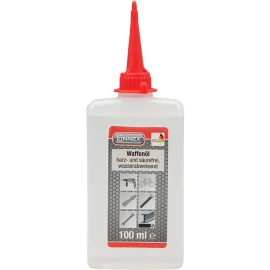
65Mn spring steel offers useful mechanical properties but is not stainless. After handling, remove fingerprints and moisture with a dry soft cloth and apply a thin protective film of suitable blade oil. After cutting practice, clean and dry the blade thoroughly before storage.
Protect the wooden grip scales from prolonged exposure to water and large changes in humidity. If required, they may be treated sparingly with a suitable wax or product intended for finished wood. Avoid aggressive treatments unless their compatibility with the existing finish is known.
Keep the leather scabbard dry and occasionally condition its exterior with an appropriate leather-care product. Do not store the sharp steel blade for prolonged periods in a damp scabbard. Always ensure the blade is clean and dry before sheathing it.
Recommended accessories
- a separate historical belt and appropriate Messer suspension, as the scabbard has no integrated rear belt loop,
- a suspension arrangement inspired by the second half of the 15th or early 16th century for historical presentation,
- blade oil or conservation wax suitable for carbon and spring steel,
- a soft cleaning cloth for regular maintenance,
- a secure display stand or wall mount for storage outside the scabbard,
- late-15th-century civilian or mercenary-style clothing for non-combat historical presentation.
Swordier – functional historical arms from Longquan
Swordier operates from Longquan in Zhejiang Province, China, a region with a long tradition of blade making and metalworking. The company focuses on functional swords and other historically inspired edged weapons, with blade geometry, steel choice, construction and practical handling forming important parts of its approach.
For this model Swordier uses 65Mn spring steel, full-tang construction and the unusual scalloped Type 3e blade profile. The brand is less about luxury positioning than offering an interesting balance of price, material, construction and practical utility. That makes this Langes Messer particularly appealing to collectors seeking a less commonplace late-medieval single-edged weapon in a fully functional sharpened configuration.
We are here for you!