 Čeština
 Deutsch


Záviš of Falkenstein Sharp Falchion with Engraved Guard


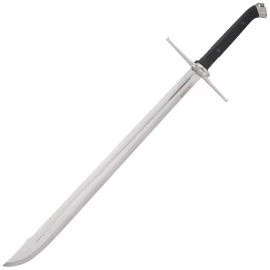
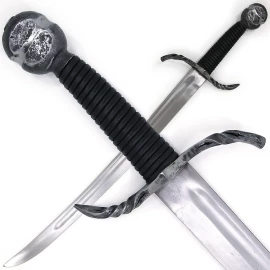
A broad cutting blade, pronounced clipped point and gracefully curved crossguard give this sharp falchion a distinctive appearance. This functional modern interpretation of a medieval single-edged sword combines a high-performance spring-steel blade, stated hardness of approximately 49–53 HRC and a pronounced 6 to 2 mm (0.24 to 0.08 in) distal taper with an ornamented guard and black leather-covered grip. It comes complete with a decorated wood-cored scabbard and belt. The model is named in honour of Záviš of Falkenstein, a major figure in 13th-century Bohemian history. Its sharpened blade is intended principally for collecting, historical presentation and controlled cutting practice on suitable soft targets. Further product information ...

 Delivery options
Záviš of Falkenstein Sharp Falchion with Engraved Guard
Broad blade with a distinctive clip point
The defining feature of this weapon is its approximately 66 cm (26.0 in) single-edged cutting blade. It measures around 40.6 mm (1.60 in) wide immediately below the guard and remains approximately 39.8 mm (1.57 in) wide even 10 cm (3.9 in) from the point. Unlike many double-edged swords that narrow substantially towards their tip, this blade retains considerable width along most of its working length.
The forward section terminates in a pronounced clip-point profile. The back of the blade angles down towards the point, producing a visually aggressive but functional geometry clearly different from the symmetrical point of a conventional double-edged arming sword.
A fuller approximately 46.5 cm (18.3 in) long runs through much of the blade. A fuller is not a “blood groove”; it is a structural feature that alters the blade's cross-section and distribution of material, allowing mass to be managed without simply making the entire blade thinner.
Spring steel and substantial distal taper
The blade is made from high-performance spring steel and is stated to have a hardness of approximately 49–53 HRC. The manufacturer also specifies a strong distal taper from about 6 mm to 2 mm (0.24 to 0.08 in).
Distal taper is the progressive reduction in blade thickness from the strong section near the guard towards the forward portion. This has an important effect on handling because sufficient material can be retained close to the hand for strength whilst unnecessary mass is removed farther along the blade.
The point of balance is approximately 7.5 cm (3.0 in) in front of the guard. Combined with the weapon's weight of around 1.07 kg (2.36 lb), this gives the falchion noticeable blade presence for decisive cutting actions without placing the balance point excessively far forward.
A sharpened blade for controlled cutting practice
The cutting edge measures approximately 0.4 mm (0.016 in) and therefore falls clearly within the sharp category. The point is also sharp and acute. This is not a blunt training falchion and must not be treated as a contact fencing weapon.
Experienced users may employ it for controlled cutting practice on suitable soft targets in an appropriately secured area. It is not designed to strike another steel weapon, armour, metal, stone, concrete or hard timber. Such impacts may damage the cutting edge and create dangerous rebounds or material failure.
Engraved crossguard and black leather grip
The crossguard measures approximately 20 cm (7.9 in) and its arms curve gently towards the blade. The upper surface carries ornamental engraving with scrolling and plant-like motifs, giving the hilt a more refined and representational appearance than a purely utilitarian military guard.
The grip is approximately 11 cm (4.3 in) long and covered in black leather. Its spirally defined surface provides useful tactile orientation and improves purchase in the hand.
A broad circular metal pommel approximately 5.6 cm (2.2 in) in diameter completes the hilt. Its plain polished form deliberately contrasts with the richly decorated guard. According to the supplied technical information, the pommel is peened.
Decorated scabbard and complete suspension
The falchion is supplied with a wood-cored scabbard covered in decorated black leather. Its embossed ornamental surface visually complements the engraved guard. The metal chape forms a pronounced pointed termination and incorporates an additional stylised decorative element.
The scabbard weighs approximately 467 g (1.03 lb). A suspension arrangement and black leather belt are also included. The belt is approximately 130 cm (51.2 in) long and 3 cm (1.18 in) wide, with a stated leather thickness of around 2.2 mm (0.09 in). This provides a complete carrying set for historical display and presentation.
The falchion in medieval Europe
Falchions form a distinctive group of European single-edged swords. They are documented by at least the 13th century and continued in a variety of forms through the later Middle Ages. Their common feature was the emphasis on a single cutting edge and efficient hewing action.
There was never one universal falchion blade shape. Some surviving and depicted examples have broad, almost cleaver-like profiles, while others are considerably slimmer. Curvature, point design and hilt configuration also varied. The term therefore describes a family of weapons rather than one rigid geometric pattern.
It is equally misleading to regard the falchion simply as a crude weapon of the lower classes. Surviving examples and period representations place single-edged swords in a variety of military and social contexts. By the 15th century, falchions are documented as infantry sidearms, while mounted use is also known.
This particular model is not an exact reproduction of one identified museum or archaeological specimen. It is more accurately described as a modern functional interpretation of a medieval falchion, combining a clip-point blade with a deliberately decorative hilt.
Why Záviš of Falkenstein?
The model is named in honour of Záviš of Falkenstein, c. 1250–1290, a Bohemian nobleman from the powerful Vítkovci family and one of the most prominent political figures in late 13th-century Bohemia.
Following the death of Přemysl Otakar II, Záviš gained considerable political influence and married the widowed Queen Kunigunda. His rise eventually brought him into conflict with King Wenceslaus II, and he was executed at Hluboká in 1290.
Falchions were already known in Europe during his lifetime, but there is no evidence that Záviš owned or used a weapon of this particular design. His name is therefore a historical tribute rather than a claim that this sword reproduces his personal weapon.
Technical specifications
| Weapon type | sharp one-handed falchion |
|---|---|
| Historical inspiration | European falchions of the High and Late Middle Ages |
| Overall length | 83.5 cm (32.9 in) |
| Blade length | 66 cm (26.0 in) |
| Grip length | 11 cm (4.3 in) |
| Crossguard length | 20 cm (7.9 in) |
| Pommel diameter | 5.6 cm (2.2 in) |
| Fuller length | 46.5 cm (18.3 in) |
| Blade width below guard | 40.6 mm (1.60 in) |
| Blade width 10 cm from point | 39.8 mm (1.57 in) |
| Distal taper | approx. 6 → 2 mm (0.24 → 0.08 in) |
| Edge thickness | approx. 0.4 mm (0.016 in) – sharp |
| Blade point | sharp / acute, clip-point profile |
| Point of balance | approx. 7.5 cm (3.0 in) ahead of guard |
| Falchion weight | approx. 1.07 kg (2.36 lb) |
| Scabbard weight | approx. 467 g (1.03 lb) |
| Blade material | high-performance spring steel |
| Blade hardness | approx. 49–53 HRC |
| Grip | black leather |
| Pommel | peened |
| Scabbard | wooden core, decorated black leather covering, metal chape |
| Included belt | 130 × 3 cm (51.2 × 1.18 in), leather approx. 2.2 mm (0.09 in) thick |
| Intended use | collecting, historical presentation and controlled cutting practice on suitable soft targets |
Because the product receives a degree of manual finishing, the stated dimensions, weights and other measurements should be treated as approximate. Individual examples may vary slightly.
Safe handling
This falchion has a sharp cutting edge and sharp point and is capable of causing extremely serious or fatal injury. It is not intended for contact HEMA, stage combat or any form of person-to-person fighting.
Handle and use the sharpened weapon only in an adequately large and secured space. Before cutting, ensure that no person, animal or unintended object is within or near the entire potential path of the blade. We recommend sharp weapons only for responsible adults familiar with safe handling practices.
Inspect the blade, guard, grip and pommel before each use. Do not continue practical use if any component is damaged or loose. Never handle or use the falchion under the influence of alcohol or other substances that impair judgement and coordination.
Care of the blade, leather and scabbard
Spring steel is not stainless. After handling, remove fingerprints, moisture and any target residue from the blade with a soft dry cloth. Apply a very thin protective film of suitable blade oil or conservation wax afterwards.
Keep the leather-covered grip, scabbard and belt dry. Treat them when necessary with a product intended for smooth natural leather. Avoid aggressive solvents and unsuitable cleaning chemicals that may damage the finish or colour.
Never sheath a wet blade or store the sword inside a damp scabbard. If the scabbard becomes wet, allow it to dry thoroughly. During long-term storage, inspect the blade periodically rather than relying on the scabbard alone for corrosion protection.
Recommended accessories
- blade oil or conservation wax suitable for carbon and spring steels,
- soft cleaning cloth,
- conditioner suitable for natural leather,
- secure sword stand or wall mount for display,
- protective gloves for careful maintenance and handling.
About Swordier
Swordier is associated with Longquan in Zhejiang Province, China, a region historically renowned for blade making and metalworking. The modern range includes both European and Asian edged weapons and combines historical inspiration with contemporary production methods.
On this falchion, the emphasis is on practical specifications such as the spring-steel blade, pronounced distal taper, sharpened edge and complete scabbard with belt. At the same time, the engraved crossguard and richly ornamented scabbard give the model a more decorative, representational character. The result is an interesting combination of functional construction, distinctive styling and attractive value for the price.
We are here for you!