 Čeština
 Deutsch


Late Medieval Chain Flail with Spiked Ball


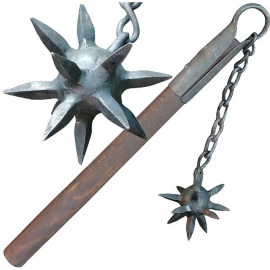
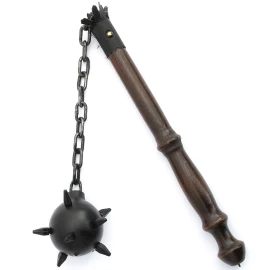
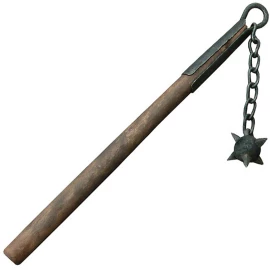
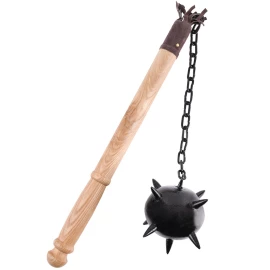
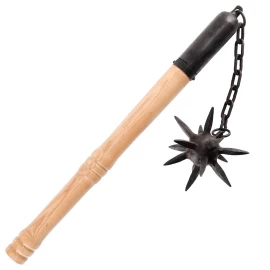
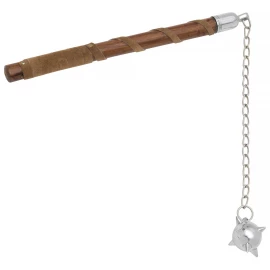
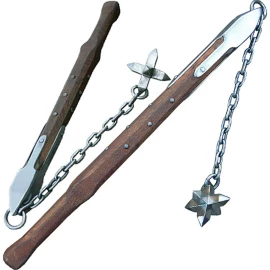
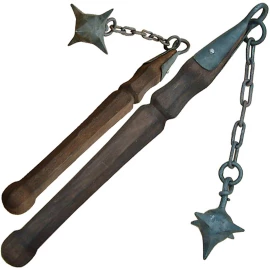
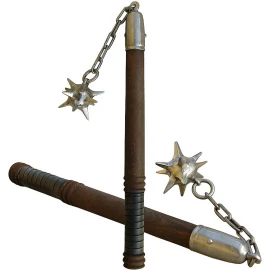
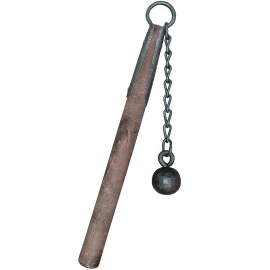
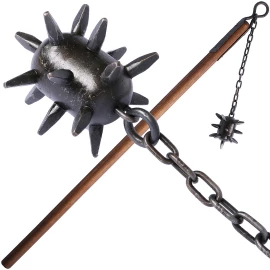
Add an imposing replica of a medieval chain flail with a spiked ball to your collection. Its long ash-wood shaft, dark steel socket, ten substantial chain links and heavy head with nine pyramid-shaped spikes create the dramatic outline familiar from historicist art, films and fantasy games. Weighing more than 1.5 kg / 3.36 lb overall, it has the solid presence expected from a serious display piece. We recommend it primarily for collections, armoury decoration, carefully controlled screen photography or a static presentation of late medieval and early modern weaponry. Further product information ...

 Delivery options
Late Medieval Chain Flail with Spiked Ball
Substantial Steel and Ash-Wood Construction
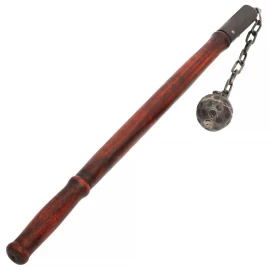
The replica is built around a long shaft made from natural ash wood. Its straight grain remains clearly visible, whilst the lower section is shaped into a broader grip. Profiled transitions help define the hand position and reduce accidental movement along the smooth timber.
A steel socket measuring approximately 6 cm / 2 3/8 in reinforces the upper end. A fixed eye at the end of this socket supports a chain formed from ten oval links. The metal sleeve also protects the transition between the steel fitting and wooden shaft.
The chain ends in a solid spiked steel ball measuring approximately 6 cm / 2 3/8 in across. It carries nine pyramid-shaped spikes and weighs approximately 870 g / 1.92 lb. The dark forge-style finish of the metal components contrasts with the pale natural ash.
Flail, Morning Star and Mace Terminology
This type of weapon is often marketed as a chain morning star. Flail is the more precise constructional term because the striking head is connected to the shaft by a flexible chain.
A conventional morning star usually has a spiked head mounted directly onto a rigid haft. Historical terminology was not entirely consistent, however, and modern names such as military flail, chain flail, chain morning star and spiked-ball flail frequently overlap.
Historical Inspiration and Surviving Evidence
Flexible striking weapons appear in European sources from the medieval and early modern periods. The best-documented European form is the long, two-handed military flail related to an agricultural threshing tool and adapted for warfare, particularly in Central Europe.
Shorter weapons with a metal ball suspended from a longer chain appear in artwork and museum collections, but their true frequency on European battlefields remains difficult to establish. Some surviving objects have cautious or very broad dates, whilst others were made during the 19th century in an earlier historical style.
We therefore describe this product as a historicist replica inspired by the late medieval period and the 16th century. It is not presented as an exact reconstruction of a particular archaeological find or as evidence that this exact form was a universally common battlefield weapon.
A Striking Collectable and Display Piece
- Collecting: an eye-catching addition to a medieval or early modern arms collection
- Interior display: suitable for an armoury, study, themed venue or historical exhibition
- Film and photography: for static or strictly controlled shots
- Theatre: only as an immobile prop without swinging the ball
- Education: for demonstrating the construction of a flexible striking weapon
- Fantasy costume display: only with the ball and chain completely immobilised and with the organiser’s approval
The flail is unsuitable for historical fencing, combat practice, stage fighting, HEMA, LARP combat, buhurt or contact reenactment. The heavy chained head can move unpredictably and may rebound towards the person holding the shaft.
Technical Specifications
| Specification | Details |
|---|---|
| Product type | Chain flail with one spiked ball |
| Historical inspiration | Late medieval period to the 16th century |
| Construction | Substantial historicist replica intended primarily for display |
| Shaft material | Ash wood |
| Ball, chain and socket material | Steel |
| Metal finish | Dark natural forge-style finish |
| Overall extended length | Approx. 98 cm / 38 1/2 in |
| Shaft length including upper socket | Approx. 64 cm / 25 1/4 in |
| Length of wooden shaft section | Approx. 61.1 cm / 24 1/16 in |
| Length of shaped grip | Approx. 14 cm / 5 1/2 in |
| Grip width | Approx. 3.5 cm / 1 3/8 in |
| Maximum width of central shaft | Approx. 4 cm / 1 1/2 in |
| Length of upper steel socket | Approx. 6 cm / 2 3/8 in |
| Chain length | Approx. 28 cm / 11 in |
| Number of chain links | 10 |
| Steel ball diameter | Approx. 6 cm / 2 3/8 in |
| Number of spikes | 9 |
| Ball weight | Approx. 870 g / 1.92 lb |
| Overall weight | Approx. 1524 g / 3.36 lb |
| Contents | 1 chain flail |
Size Guide
| Size | Shaft Length | Chain Length | Overall Extended Length |
|---|---|---|---|
| One size | Approx. 64 cm / 25 1/4 in | Approx. 28 cm / 11 in | Approx. 98 cm / 38 1/2 in |
All measurements are approximate. As the product includes worked metal and natural timber, individual examples may vary slightly in shape, grain, colour, surface marks, dimensions and weight.
Safe Unpacking and Display
- Unpack the flail on a clear floor or a large table free from breakable objects.
- Secure the spiked ball before releasing the shaft and chain from the packaging.
- Wear substantial work gloves and closed footwear when handling the product.
- Use display brackets rated for more than the full weight of the replica.
- Support the ball separately or immobilise it so that it cannot begin swinging.
- Do not mount the flail above a bed, chair, doorway or regularly used walkway.
- Pad and secure the ball, chain and wooden shaft separately during transport.
Care of the Steel and Ash Wood
- Wipe the metal components with a soft, dry cloth after handling, as fingerprints and perspiration encourage corrosion.
- Apply a very thin coat of protective oil to the ball, chain, eyes and steel socket.
- Work a small amount of oil into the moving chain joints, then remove all excess.
- Treat early surface corrosion carefully to avoid unnecessarily removing the dark finish.
- Occasionally condition the ash shaft with linseed oil or another treatment suitable for natural wood.
- Do not soak the timber or dry it beside a radiator, stove, open fire or in strong direct sunlight.
- Store the flail horizontally or with the ball fully supported in a dry, ventilated room.
- Regularly inspect the eyes, welds, chain links, socket and wooden shaft for damage.
Safety Information
This is a dangerous replica of an impact weapon, not a toy, training implement or safe LARP weapon. The heavy spiked ball can cause fatal or permanently disabling injuries even during a short uncontrolled movement.
- Do not swing, spin or test-strike with the flail.
- Never use it against people, animals, targets, armour or other objects.
- Do not use it for HEMA, LARP combat, stage fighting, buhurt or contact reenactment.
- Do not regard plate armour, mail armour or protective gloves as adequate protection.
- Never handle the flail with the chain hanging freely indoors or near another person.
- Store it locked away with the ball immobilised and beyond the reach of children.
- Stop handling the product if a link, weld, eye, socket or section of the wooden shaft becomes damaged.
- Observe all laws governing the ownership, transport, display and carrying of weapons in your location.
Recommended Accessories
- Heavy-duty wall-mounted weapon brackets for secure display
- Lockable display cabinet for a medieval or early modern arms collection
- Steel maintenance oil for the ball, chain and socket
- Linseed oil for natural wood to condition the ash shaft
- Full armour display stand for a static 15th–16th-century presentation
- Plate armour or breastplate displayed separately as part of the exhibition
- Rigid morning star or mace replica for comparing different impact-weapon constructions
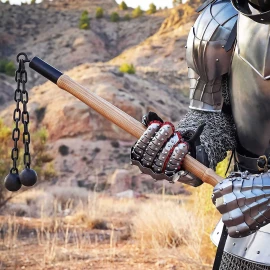
Armour, gauntlets, clothing, stands and any other accessories shown in the photographs are not included.
We are here for you!