Čeština
 Deutsch


Replacement armour straps
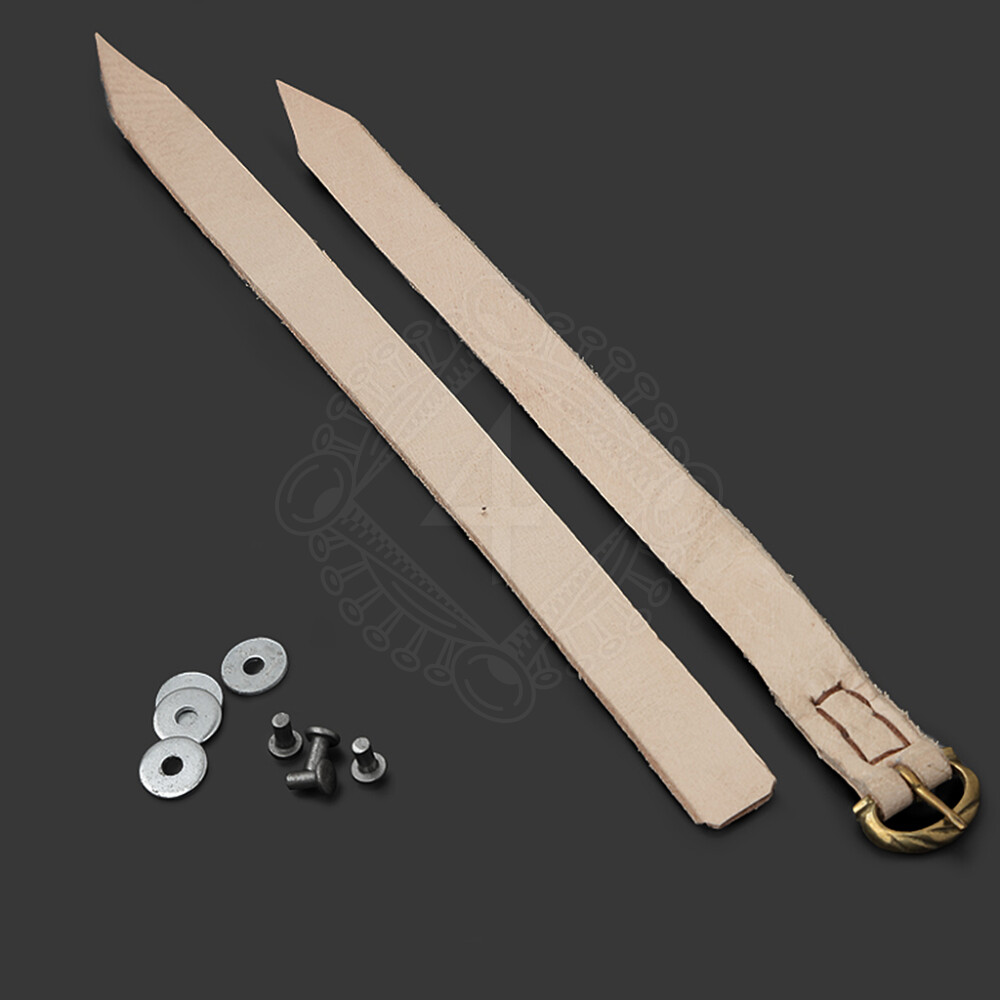

Replace worn fastenings and bring your armour back into usable condition. This replacement armour strap set from Marshal Historical includes a strap with a brass buckle, a separate plain strap, and iron rivets with washers. It is intended for repairing damaged leather attachments on complete armour or individual components. Natural cowhide has a restrained appearance that combines readily with historically styled equipment. Before fitting, compare the strap dimensions and rivet measurements with the original connection. The set is designed to be adapted to your particular repair rather than serving as an automatically compatible replacement for every fastening. Further product information ...

 Delivery options
Replacement armour straps with rivets and washers
Two straps and fastening hardware
Both straps are made from unfinished cowhide leather and have tapered ends. One carries a brass buckle; the other is a plain matching strap without a buckle. The image shows the plain strap without a prepared row of fastening holes. Their positions can be set according to the required fit.
The four iron rivets have domed heads. Four iron washers can support the connection according to the construction of the component being repaired. The untreated iron hardware may show light surface rust.
Contents and technical specifications
| Specification | Details |
|---|---|
| Strap with buckle | 1 piece |
| Plain strap without buckle | 1 piece |
| Iron washers | 4 pieces |
| Iron rivets | 4 pieces |
| Strap material | unfinished cowhide leather |
| Strap length | approx. 23–25 cm / 9.06–9.84 in |
| Strap width | approx. 15 mm / 0.59 in |
| Buckle material | brass |
| Buckle dimensions | width approx. 23 mm / 0.91 in; length approx. 16 mm / 0.63 in |
| Washer thickness | 1 mm / 0.039 in |
| Washer external diameter | approx. 13 mm / 0.51 in |
| Domed rivet head diameter | 9 mm / 0.35 in |
| Rivet shank diameter | 3.5 mm / 0.138 in |
| Rivet shank length | 7 mm / 0.276 in |
| Washer and rivet finish | untreated |
| Manufacturer | Marshal Historical |
Preparing to replace a strap
Before removing the old strap, mark its position and check the required fastening length. Inspect the existing holes in the armour. Make new leather holes with a suitable punch, leaving sufficient material around each hole.
The shank length must suit the combined thickness of the joined layers and allow proper riveting. Use suitable riveting tools and a firm support. If you lack riveting experience, we recommend having a craftsperson fit the replacement. The completed joint must hold without play and have no sharp projections facing the wearer.
Natural appearance and historical context
The leather may have minor surface blemishes and uneven texture. Flexibility, surface roughness and colour can vary between pieces. These natural differences are part of the material’s character. Nevertheless, inspect each strap before fitting, particularly where you intend to make holes.
Leather straps and buckles allowed historical armour components to be adjusted and fastened. This set is a practical replacement part rather than a documented copy of a particular find. For reconstructions of 14th–16th-century plate equipment, match the position and design of the connections to your chosen original.
Care and safety
Do not soak the leather; allow it to dry naturally away from heaters. Test a suitable leather care product on an inconspicuous area first, as it may alter the colour. Keep iron components dry and gently remove any light surface rust before fitting.
Wear eye protection when riveting. Check the repair’s strength before wearing the armour. Replacing a strap alone does not establish the armour’s suitability for contact combat.
Recommended accessories
We recommend a leather punch, suitable riveting tools and leather care products. For 14th–16th-century equipment, match the buckle and attachment method to the remaining armour components.
We are here for you!