Čeština
 Deutsch


Warwick Gothic Type XIV Arming Sword


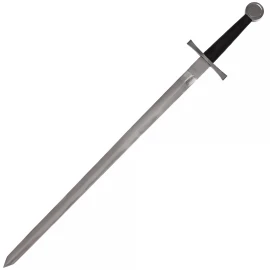
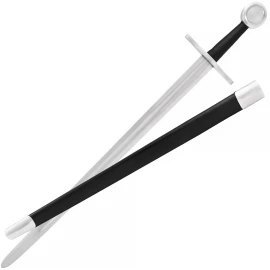
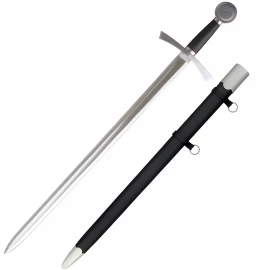
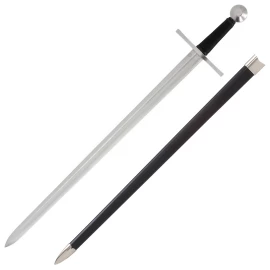
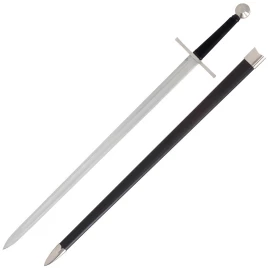
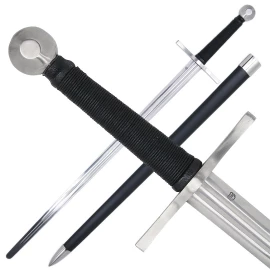
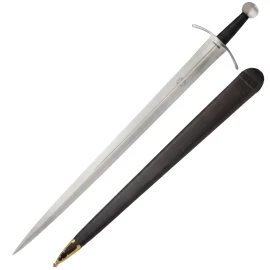
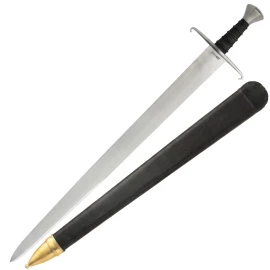
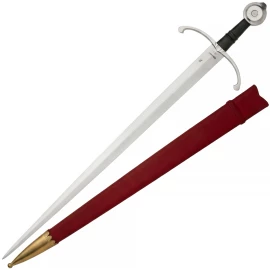
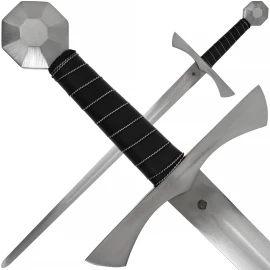
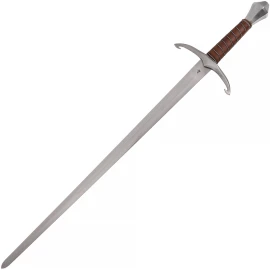
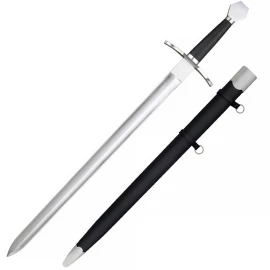
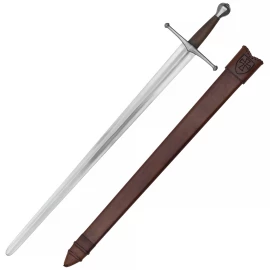
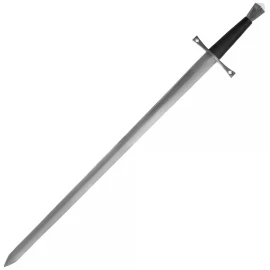
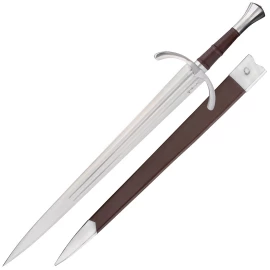
The Warwick is a sharp European arming sword with an Oakeshott Type XIV-inspired blade, combining an exceptionally broad blade base, strong profile taper and shorter fuller with a hilt styled after later medieval forms. The spring-steel blade is almost 70 mm (2.75 in) wide below the guard, has an edge approximately 0.5 mm (0.02 in) thick and a stated hardness of about 49–53 HRC. A black scabbard and belt are included. This is a functional sharp weapon intended principally for collecting, historical display, experienced solo practice and controlled test cutting on appropriate soft targets. Further product information ...

 Delivery options
Warwick Gothic Type XIV Arming Sword
A broad Type XIV blade with a later medieval hilt
The blade immediately defines the character of this sword. At the guard it measures approximately 69.8 mm (2.75 in) wide, before tapering strongly and continuously towards the point. At 10 cm (3.9 in) from the tip, its width has reduced to approximately 24 mm (0.94 in). This pronounced profile taper is one of the defining characteristics associated with swords classified by Ewart Oakeshott as Type XIV.
A fuller approximately 43 cm (16.9 in) long runs along the lower part of the blade. A fuller is a structural feature used to distribute material and mass efficiently; it is not a so-called “blood groove”. On this sword it ends around the middle section, after which the blade continues towards the acute point in a narrower and comparatively rigid profile.
The supplied measurement gives an edge thickness of approximately 0.5 mm (0.02 in), which places it in the sharp category under our classification. The point is also acute and clearly formed for effective thrusting. The sword must therefore never be used for person-to-person contact or struck against another steel weapon.
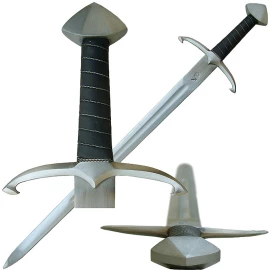
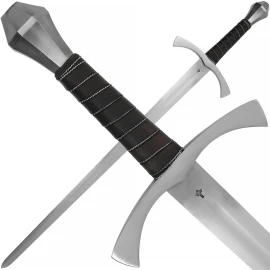
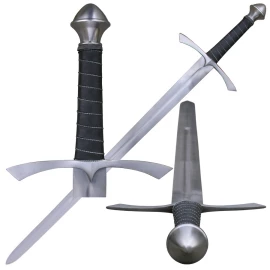
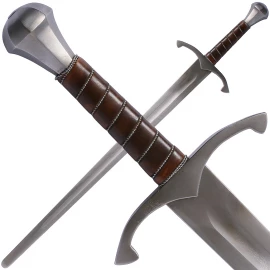
The crossguard is approximately 20 cm (7.9 in) long. Its quillons sweep towards the blade and terminate in small curled ends, giving the hilt a distinctly late-medieval appearance. Around the centre of the guard, immediately ahead of the grip, the steel forms a neatly faceted block with crisp ground surfaces.
The approximately 11 cm (4.3 in) grip is covered in black synthetic leather. Its subtly shaped surface helps locate the hand and provides a secure one-handed hold. A prominent steel pommel completes the hilt, with a broad, faceted upper section. Its shape recalls certain later-medieval expanded pommel forms, although we do not force it into a precise Oakeshott pommel subtype without stronger documentation.
The tang is peened over the pommel. Peening is one of the traditional mechanical methods used to secure a European sword hilt, with the end of the tang spread over the pommel to hold the assembly under compression.
Oakeshott Type XIV – a sword of about 1275–1340
Oakeshott Type XIV is one of the more distinctive families of medieval European one-handed swords. Its principal period of popularity lies roughly between the last quarter of the 13th century and the opening decades of the 14th century, approximately 1275–1340.
Typical examples have a comparatively short one-handed hilt and a blade that is very broad at the base but narrows strongly to an effective point. This gave the form an interesting cut-and-thrust character. The broad lower blade retained substantial cutting ability, whilst the strongly tapering point offered better thrusting potential than many earlier sword forms with more nearly parallel edges.
This development belongs to a period when European defensive equipment was becoming increasingly complex. Mail armour remained fundamental, but it was supplemented by padded garments, reinforced leather and early plate elements. A more acute sword point allowed a fighter to target gaps and less well protected areas with greater precision. It would be misleading, however, to describe the type as a weapon designed simply to punch through solid plate armour.
There is an important distinction with this particular model. It is presented as a Type XIV blade fitted with a 15th-century-inspired hilt. It should therefore not be described as an exact reproduction of a conventional sword from around 1300. Instead, it is a functional, historically inspired interpretation combining elements associated with different phases of the medieval period.
The name Warwick naturally evokes later medieval England, but the classic Type XIV blade belongs primarily to a period more than a century earlier than the Wars of the Roses. This distinction matters particularly if you intend to use the sword for historical interpretation or reenactment.
The arming sword, shield and buckler
Historical Type XIV swords were one-handed weapons. On the battlefield they could be used in conjunction with a shield, whilst in fencing and civilian contexts the combination of sword and small buckler is especially relevant.
The oldest surviving European fencing treatise, now known as Royal Armouries MS I.33, dates from around the same broad period and deals specifically with sword-and-buckler fencing. This does not mean that the Warwick is a reconstruction of an I.33 sword. Its deliberately later-styled hilt prevents such a precise association. The manuscript nevertheless provides useful context for understanding how a broad one-handed sword could be used alongside a compact defensive shield.
Handling and practical use
According to the supplied measurements, the sword weighs approximately 932 g (2.05 lb) and balances about 13 cm (5.1 in) ahead of the crossguard. Despite its unusually broad blade, the overall mass is therefore relatively moderate, while the forward balance gives the blade a noticeable presence during a cut.
The stated blade flex is approximately 16 kg (35.3 lb). This indicates a comparatively stiff blade. It must not be interpreted as making the sword suitable for HEMA sparring, however, because both edge and point are sharp.
The Warwick is appropriate for collecting, historical display, careful solo handling by an experienced user and controlled test cutting on suitable soft targets. Appropriate targets may include free-standing PET bottles, dedicated cutting mats or similarly forgiving materials.
Do not use the sword on timber, branches, bone, steel, stone, concrete or other hard and unyielding targets. Poor alignment against an unsuitable target can damage the edge, bend the blade or place excessive stress on the hilt.
Scabbard and belt
The set includes a black-finished scabbard with a metal chape and a separate suspension belt. The scabbard weighs approximately 285 g (0.63 lb). The included belt is approximately 130 cm (51.2 in) long, 3 cm (1.18 in) wide and made from leather about 2.2 mm (0.09 in) thick.
The black scabbard visually matches the black grip and gives the complete set a restrained, cohesive appearance. The scabbard is useful for transport and short-term storage of the sharp blade. We do not recommend storing a carbon or spring-steel blade in a scabbard for long periods if moisture may be retained inside.
Technical specifications
| Weapon type | sharp European arming sword |
|---|---|
| Blade typology | Oakeshott Type XIV |
| Historical inspiration | Type XIV blade with a 15th-century-inspired hilt |
| Blade material | spring steel |
| Blade hardness | approx. 49–53 HRC |
| Overall length | 92 cm (36.2 in) |
| Blade length | 72.2 cm (28.4 in) |
| Crossguard length | 20 cm (7.9 in) |
| Grip length | 11 cm (4.3 in) |
| Fuller length | 43 cm (16.9 in) |
| Blade width below the guard | 69.8 mm (2.75 in) |
| Blade width 10 cm from the point | 24 mm (0.94 in) |
| Edge thickness | approx. 0.5 mm (0.02 in) – sharp |
| Blade point | sharp / acute |
| Point of balance | approx. 13 cm (5.1 in) ahead of the guard |
| Blade flex | approx. 16 kg (35.3 lb) |
| Sword weight | approx. 932 g (2.05 lb) |
| Scabbard weight | approx. 285 g (0.63 lb) |
| Grip covering | synthetic leather |
| Pommel construction | peened |
| Included belt | approx. 130 × 3 cm (51.2 × 1.18 in), leather thickness approx. 2.2 mm (0.09 in) |
| Intended use | collection, historical display, solo practice and test cutting on suitable soft targets |
As the sword receives a degree of manual finishing, the stated measurements, weights and other measured values should be regarded as approximate. Individual examples may vary slightly.
Safety
This sword has a sharp edge and an acute point and is not intended for contact fencing. Do not use it for HEMA sparring, stage combat, LARP fighting or any exercise in which another person is within the active range of the blade. A sharp steel sword can cause severe or fatal injury.
Only handle the sword in a clear, controlled area away from bystanders, children and animals. Carry it in its scabbard. Before any practical use, inspect the blade, edge, hilt and peened assembly for damage or looseness. Never handle or use a sharp sword whilst under the influence of alcohol or other intoxicating substances.
Care and maintenance
Spring steel is not stainless. After handling, wipe fingerprints and moisture from the blade with a soft cloth and apply a very thin layer of suitable weapon oil or conservation wax. After test cutting, clean and dry the blade thoroughly before storage.
The guard and pommel should receive similar protection. Clean the synthetic grip covering only with a slightly damp cloth and avoid aggressive conditioners designed specifically for natural leather unless the product is confirmed to be compatible with synthetic material.
Recommended accessories
- a sword stand or wall mount for secure display,
- blade oil or conservation wax suitable for carbon and spring steel,
- a soft cleaning cloth for fingerprints and moisture,
- a late-13th- to early-14th-century-style buckler for non-contact historical display,
- period-appropriate clothing and belt equipment selected for the era you wish to portray.
Swordier – functional swords from Longquan
Swordier operates from Longquan in Zhejiang Province, China, a historically renowned centre of blade making and metalworking. The company focuses on functional swords and modern interpretations of historical weapons, with particular attention to blade steels, geometry, balance and practical handling.
The Warwick demonstrates that approach clearly. Its very broad Type XIV-style blade is combined with a distinctly later medieval-looking hilt, creating not a strict museum reproduction but a functional historical interpretation with its own visual identity. For collectors looking for a sharp one-handed sword suitable for display and controlled cutting practice, it offers an interesting combination of material, geometry and value.
We are here for you!