Čeština
 Deutsch


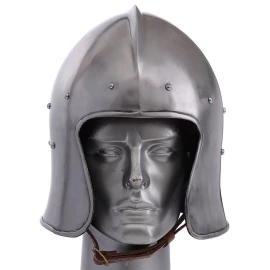
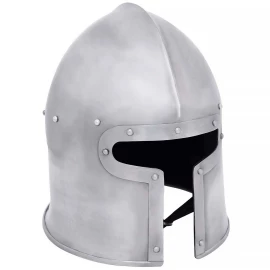
Italian Knightly Barbute Helmet Verona, 15th Century


Looking for the perfect blend of Italian elegance and practical protection for your historical adventures? Hand-hammered from steel, this barbute helmet transports you straight to the 15th-century Renaissance era of condottieri! You will appreciate its graceful lines inspired by Northern Italian originals, decorative brass rivets encircling the skull, and an open T-shaped face opening for enhanced visibility. Inside, an adjustable padded cotton canvas liner and genuine leather chin strap ensure a comfortable, secure fit. We recommend this helmet to you for re-enactment, LARP, historical festivals, and display! Further product information ...

 Delivery options
Italian Knightly Barbute Helmet Verona, 15th Century
Historical Origin and Combat Use
The barbute (or barbuta) helmet represents one of the peaks of 15th-century Italian armor design. Originating in Northern Italy as a visorless alternative to the sallet or bascinet, armorers drew visual inspiration from classical Greek Corinthian helmets. The characteristic T-shaped or Y-shaped facial opening provided soldiers with superior peripheral vision and airflow without needing a movable visor, while extended cheek guards protected the jaw and throat. This style was widely favored by Italian mercenary captains (condottieri), nobles, and heavy infantrymen. A remarkably similar 15th-century barbute original is preserved in the Metropolitan Museum of Art in New York.
Significance of the Name Verona
This helmet bears the name Verona in honor of one of Northern Italy's most prominent cities and a key hub of Renaissance warfare and armor trade. Situated along strategic military routes by the Adige River, 15th-century Verona was governed by the Venetian Republic and witnessed numerous mercenary campaigns. Naming this helmet Verona directly commemorates the Northern Italian birthplace of the barbute style and celebrates the regional armor craft.
Materials and Craftsmanship
Hand-crafted from 1.2 mm (18-gauge) steel sheet, the helmet skull is reinforced along the crown with a subtle low ridge to deflect downward strikes. Decorative brass rivets with detailed heads encircle the forehead and sides, while steel rivets line the lower rim for interior attachment. The interior comes equipped with an adjustable padded cotton canvas lining and a leather chin strap with a metal buckle.
Technical Specifications
| Parameter | Specification |
|---|---|
| Overall height | 31 cm / 12.20 in |
| Skull material | 1.2 mm (18-gauge) steel sheet |
| Sizing | Fits head circumference up to approx. 60 cm / 23.62 in |
| Decoration | Brass rivets on skull, steel rivets along edges |
| Interior lining | Adjustable padded cotton canvas |
| Retention system | Leather chin strap with buckle |
| Weight | approx. 1510 g / 3.33 lbs (1.51 kg) |
Care & Safety Guidelines
Keep exterior steel surfaces clean and dry. After handling or outdoor exposure, wipe the metal clean and apply a thin layer of protective mineral oil (such as Ballistol) to prevent rust. Brass rivets can be polished occasionally with metal polish. Allow the interior cotton liner to air-dry thoroughly after use. Condition the leather chin strap with leather balm.
Safety Warning: Crafted from 1.2 mm (18-gauge) steel sheet, this helmet is NOT protective armor intended for high-impact combat such as buhurt, Battle of the Nations, or HEMA sparring! The steel gauge is not engineered to withstand heavy strikes from blunt steel weapons. This item is designed primarily for re-enactment, Renaissance fairs, LARP, theater, cosplay, and historical display.
Recommended 15th Century Accessories
To ensure maximum wearing comfort and complete your 15th-century Italian warrior kit, we recommend pairing this barbute with:
- A padded cotton arming cap to wear under the helm for cushioning
- A maille coif made of riveted rings for neck protection
- A 15th-century quilted gambeson or arming doublet
- A steel cuirass or Milanese breastplate
- A 15th-century Italian arming sword or dagger
We are here for you!