Čeština
 Deutsch


Toledo armet with collar and ostrich feathers


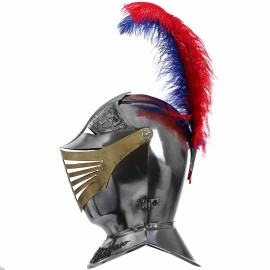
The decorative Toledo armet commands attention with its enclosed silhouette, movable visor and striking black and yellow ostrich feathers. Galvanised iron sheet gives it a distinctive metallic appearance, while the shaped collar completes a design inspired by European plate armour of the 16th century. Although the helmet is made in a wearable adult size, it is strictly a decorative piece and is not intended for practical wear or use as protective armour. Ostrich feathers and a display stand are included, allowing you to present it straight away in a collection, study or historically themed interior. Further product information ...

Would you like to be notified as soon as the item is in stock?
You will receive a short e-mail as soon as we have it back in stock.
Toledo armet with collar and ostrich feathers
Enclosed helmet with a movable visor
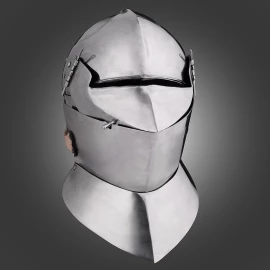
The helmet has an enclosed skull with a pronounced central ridge. Its hinged visor covers the face and incorporates narrow vision openings together with several horizontal ventilation slots. The articulated side sections have metal fastenings, allowing the helmet to be opened. Around the lower edge, the construction widens into a substantial collar surrounding the neck area.
The most conspicuous details are the long black and yellow ostrich feathers mounted towards the upper rear of the helmet. Measuring approximately 16.54 in / 420 mm in length, they give the piece a particularly imposing and ceremonial appearance.
The armet in the 16th century
The armet had appeared in Europe by the 15th century and became an important form of enclosed helmet for armoured cavalry. Its characteristic construction closely enclosed the head and face and often incorporated a movable visor and opening side sections. During the 16th century, enclosed helmets continued to develop both technically and stylistically and formed part of complete plate armour used in warfare, tournaments and prestigious displays.
This model follows a Spanish-inspired helmet form of the 16th century. Feathers and other conspicuous embellishments on historical armour could serve a representational as well as decorative purpose. Elaborately presented armour was capable of expressing status, affiliation and the personal taste of its owner.
Why the name Toledo
Toledo is a Spanish city renowned for its long tradition of metalworking and edged-weapon manufacture. The name is also appropriate for this Spanish-styled helmet because the decorative products made by Art Gladius, including this model, are manufactured in Toledo.
Technical specifications
| Specification | Value |
|---|---|
| Type | decorative armet with collar |
| Historical inspiration | Spanish helmet form, 16th century |
| Material | galvanised iron sheet |
| Sheet thickness | approx. 0.035 in / 0.9 mm |
| Overall height | approx. 14.96 in / 380 mm |
| Diameter with visor open | approx. 7.68 in / 195 mm |
| Diameter around neck | approx. 5.31 in / 135 mm |
| Feather length | approx. 16.54 in / 420 mm |
| Weight | approx. 4.35 lb / 1,972 g |
| Visor | hinged and movable |
| Opening | side fastenings |
| Size | wearable adult size |
| Included | ostrich feathers and display stand |
| Stand height | approx. 13.58 in / 345 mm |
| Intended use | decorative use only |
| Manufacturer | Art Gladius |
| Made in | Toledo, Spain |
All stated dimensions and the weight are approximate and may vary slightly between individual pieces.
Use, care and safety
Although this helmet is produced in an adult wearable size, it is strictly a decorative object and unsuitable for practical use. Do not use it as protective armour for HEMA, stage combat, reenactment fighting, contact LARP, buhurt or Battle of the Nations. It is not intended for ordinary wear on the head either. Moving metal components and edges may cause injury if handled carelessly.
For display, use the supplied stand and place it on a stable, level surface. Wipe the metal components with a soft, dry cloth and protect them from prolonged exposure to moisture. Dust the feathers very gently, avoid crushing them and do not place other objects on them during storage. Aggressive cleaners and abrasives may damage the surface finish.
What to display with the armet
For a decorative ensemble inspired by the 16th century, you can combine the armet with a reproduction cuirass, plate pauldrons, gauntlets or a decorative Renaissance sword. A full armour stand and other display pieces inspired by European knightly and cavalry equipment of the 16th century will also complement it well.
We are here for you!