
 Čeština
 Deutsch


How to Choose the Right Japanese Training Sword [Practical Tips]
 Samurai swords
![How to Choose the Right Japanese Training Sword [Practical Tips]](https://www.outfit4events.cz/images/palette/shared/www/multimedia/treninkovy-mec-01.1443294657.1766060499.jpeg.webp)
Bokken, Shinken, Iaito – Japanese training swords come in many forms, and each serves a different purpose. Choosing the right one depends on your training style and your current skill level. The wrong sword can be more than just uncomfortable, it can be very dangerous. In this guide, you’ll learn what types of Japanese training swords exist, what makes them different, and how to pick the right one for your training.
Contents
- What Are Japanese Training Swords Used For?
- How Do Training Swords Differ – and Does It Matter?
- 1. Wooden Swords – Bokken
- 2. Bamboo Swords – Shinai
- 3. Metal Replicas – Iaitō, Mogitō, and Habiki
- 4. Soft swords – Gomu-tō / soft Bokken
- 5. Sharp swords – Shinken
- How to choose the right training sword – A practical guide
- Ready to take your Japanese sword training to the next level? Outfit4Events is here to help!
What Are Japanese Training Swords Used For?
Training swords are ideal for beginners. They allow you to practice proper technique without unnecessary risk of injury.
Traditional sharpened swords are usually handled by expert practitioners only, while training swords give beginners a safe and accessible way to learn the fundamentals.
How Do Training Swords Differ – and Does It Matter?
Today’s range of Japanese training swords is surprisingly broad. You’ll find everything from wooden swords and bamboo models to steel replicas that closely resemble real katanas.
Each type of sword plays a specific role in various martial arts disciplines such as Kendō,Kenjutsu, Iaidō, or Aikido.
So what kinds of Japanese training swords are out there, and which one should you choose for your (first) training session?
1. Wooden Swords – Bokken
Bokken are classic Japanese training swords made of wood, and they’re perfect for mastering the basics of Aikido, Kenjutsu, and Iaido.
A classic bokken is ideal for beginners who need to get used to the length, weight, and balance of a sword. Bokken swords are also available with an optional scabbard (Saya), which is especially helpful for practicing drawing techniques.
There are several types of Bokken, each designed for a specific purpose:
Suburitō – Designed to build strength
This long, heavier wooden training sword has a broader blade and greater weight. It’s commonly used for Suburi practice, focusing on basic swings that improve power, stamina, and overall stability.
Daishō set – The traditional two-sword set
This training set includes two wooden swords: a long katana-style sword (Daitō) and a shorter wakizashi (Shōtō).
This combination lets you alternate between different Japanese swords, mirroring the traditional Samurai gear.
Bokken Shōtō
This short wooden sword is designed for practicing close-range techniques. It’s used in Kenjutsu and often paired with longer training swords.
Tanren Bokken – For physical training
Heavier than a standard Bokken, this wooden sword is used in Aikido and Kenjutsu to develop strength and endurance. It targets the core while improving arm, wrist, and grip power.
Ideal for advanced students who want to push beyond basic technique and focus on physical development.
Koryū Bokken – Shaped by tradition
Traditional Japanese martial arts schools ( koryū) developed Bokken in various forms, differing in width, curvature, and overall profile.
These swords are mainly used for practicing traditional techniques unique to each school.
How to choose the right wooden training sword (Bokken):
When choosing a bokken, consider both your experience level and your training goals:
- Basic technique practice – classic Bokken
- Strength and endurance training – Suburitō or Tanren Bokken
- Close-combat training – Bokken Shōtō
- Traditional kata practice – Koryū Bokken
DID YOU KNOW... There are wooden training swords designed for children. Inspiring a child or younger sibling to explore Japanese culture and ancient martial traditions early on might spark a lifelong passion for swordsmanship!
2. Bamboo Swords – Shinai
A Shinai is made of four slats of bamboo, held together by leather fittings and string.
Thanks to its flexible design, it absorbs impact effectively and is ideal for safe contact training and Kendo sparring.
Shinai come in different sizes and styles:
- Daitō – long version (for most adult practitioners)
- Chūtō – mid-length option
- Shoto – shorter version, comparable to a wakizashi
Fukurō-Shinai – For safer training
A Fukurō-Shinai is partially wrapped in a leather cover, making it gentler on impact. It’s a great choice for training without protective gear or for those who prefer less intense training.
Shinai in practice
The Shinai is the fundamental training weapon in Kendo. It allows fast movements, full-contact training, and better control over strike impact.
How to choose the right Shinai based on the wielder’s height
The most common Shinai sizes by height are shown in the table below:
| Height | Shinai size |
|---|---|
| up to 160 cm | 36 or 37 |
| 160–175 cm | 38 |
| 175 cm and above | 39 |
Things to know when choosing a Shinai:
- Shinai sizes (37, 38, 39, etc.) do not represent standard units of measurement. They are conventional Kendo size categories that refer to adult Shinai categories that meet officially defined limits for length and weight.
- The correct Shinai size is determined by official rules, which also take the wielder’s age and gender into account. Height is a helpful extra reference when deciding between two similar sizes.
3. Metal Replicas – Iaitō, Mogitō, and Habiki
![How to Choose the Right Japanese Training Sword [Practical Tips]](https://www.outfit4events.cz/images/palette/shared/www/multimedia/treninkovy-mec-03.3068510588.1766060499.jpeg.webp)
Iaitō – Unsharpened training katana
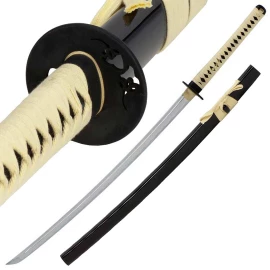
The Iaitō is a replica of a traditional Japanese katana. It retains the design and weight of a real sword but has a blunt blade. It’s used for practicing drawing and cutting techniques that cannot be safely performed with wooden swords.
Mogitō – Demonstration replica
Mogitō is the standard model for teaching and demonstrations of techniques. It imitates the shape of a real katana, but has a blunt blade, which makes it safer and more affordable.
Habiki – Blunt-edged training sword
Habiki closely mimics the weight and balance of a real Japanese sword but has a blunt edge. It’s ideal for training precise kata techniques with a partner (without full contact) or for solo training.
4. Soft swords – Gomu-tō / soft Bokken
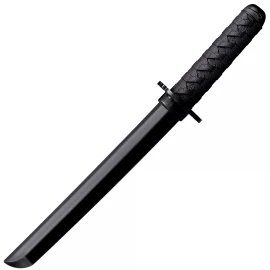
Plastic training swords with a soft foam or rubber surface are perfect for beginners or children who don’t worry too much about safety. They’re commonly used for contact drills, sparring, and teaching younger swordsmen.
![How to Choose the Right Japanese Training Sword [Practical Tips]](https://www.outfit4events.cz/images/palette/shared/www/multimedia/treninkovy-mec-02.3068510588.1766060499.jpeg.webp)
5. Sharp swords – Shinken
Shinken is a sharpened Japanese sword and is not intended for regular training. It is mainly used for tameshigiri (test cutting).
Training with a Shinken must always be supervised by an authorized master. It is intended only for experienced practitioners.
How to choose the right training sword – A practical guide
When choosing a Japanese training sword, consider three key criteria:
1. Discipline
- Kendo: Shinai
- Aikido: Bokken
- Kenjutsu: Bokken, Koryū Bokken, Habiki, Fukurō-Shinai
- Iaido: Iaitō, Bokken with scabbard
2. Experience Level
- Beginner: Bokken or soft Bokken
- Intermediate/Advanced: quality Bokken, Shinai, Iaitō
- Master: Habiki or Shinken
3. Purpose
- Sparring: Shinai, Fukurō-Shinai
- Kata: Iaitō, Bokken
- Strength training: Suburitō, Tanren-Bokken
- Demonstration of techniques: Mogitō or other metal replicas
DID YOU KNOW... Katanas are admired by fans of historical weapons worldwide for their craftsmanship? Every part of the sword is carefully designed, making it a true work of art. Read more about the different parts of a katana and discover why it is still considered a masterpiece today.
Ready to take your Japanese sword training to the next level? Outfit4Events is here to help!
Víš, co praví známé pořekadlo: cvičení dělá mistra. Máš už první nácviky techniky za sebou a chceš své šermířské dovednosti posunout na další úroveň?
We all know the saying: Practice makes perfect. If you’ve already started learning the basics and want to improve your swordsmanship skills, explore our range of
Japanese training swords. Enjoy
safe and effective training, and move one step closer to your goal!

 Share
Share
 Share
Share
 Tweet
Tweet
Comments