 Čeština
 Deutsch


Dagger, Spain 13th - 14th century


Would you like to be notified as soon as the item is in stock?
You will receive a short e-mail as soon as we have it back in stock.
Burgos Medieval Spanish Dagger with Sheath, 13th–14th Century
Slender Blade and Distinctive H-Shaped Hilt
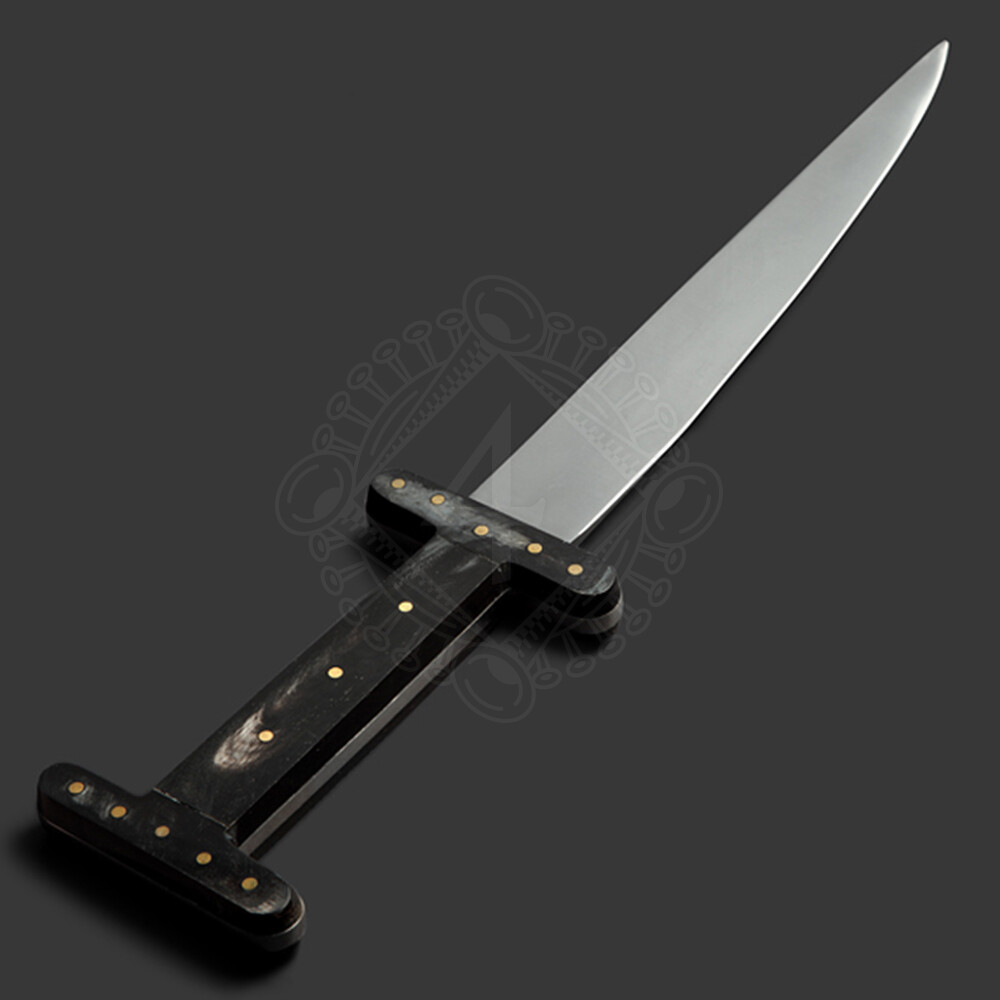
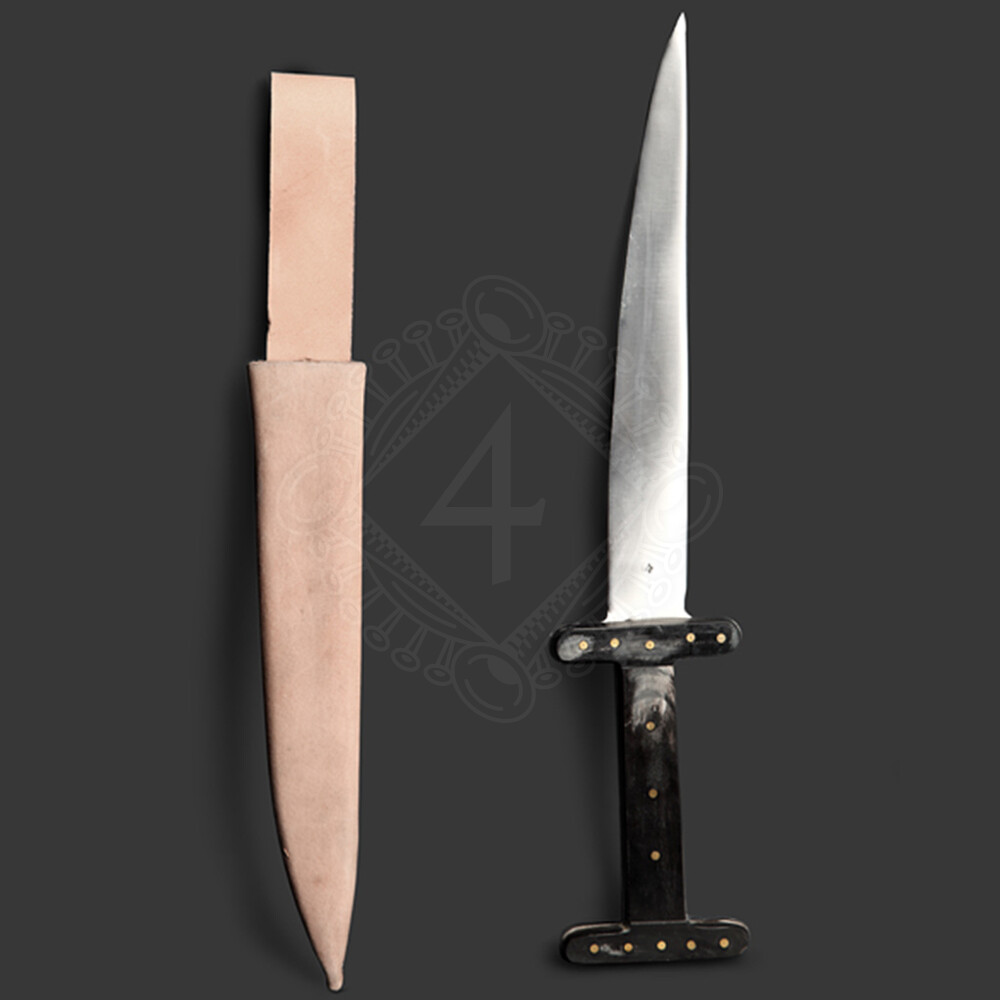
The dagger's most recognisable feature is its hilt with a transverse crossguard and similarly shaped pommel. Both elements have the form of short bars with rounded ends. Together with the straight grip, they produce the characteristic H-shaped silhouette reminiscent of historical baselard daggers.
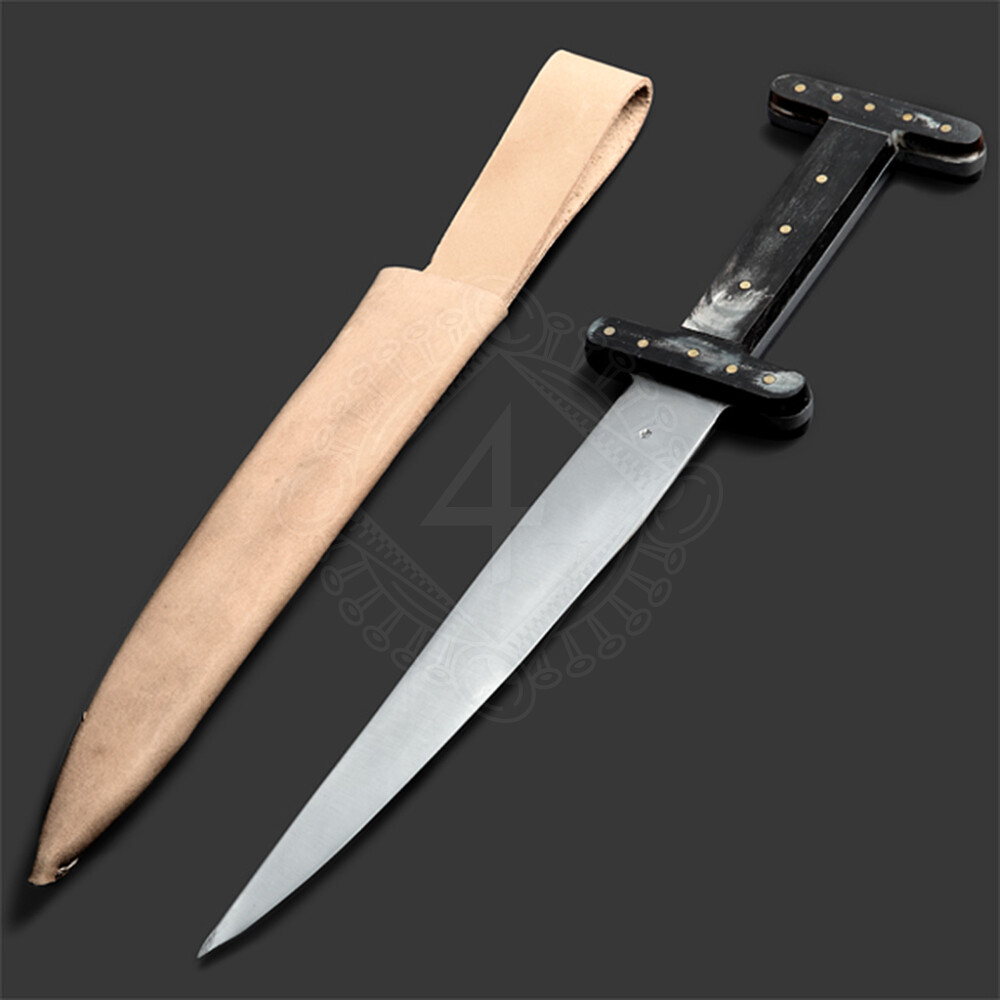
The black grip scales are secured with small golden-coloured rivets, whose heads form a regular decorative pattern. Similar rivets also decorate both transverse elements of the hilt. The dark finish contrasts attractively with the bright steel blade.
The straight, single-edged blade gradually tapers towards a sharp point. Its smooth metallic surface has a satin sheen. The blade measures approximately 227 mm (8.94 inches) long, with a maximum width of 30.1 mm (1.19 inches) and a thickness of 5.1 mm (0.20 inches) near the hilt.
The dagger comes with a simple sheath made from pale natural leather, shaped to follow the blade's narrowing profile. An extended leather strip at the top forms a loop. The sheath provides a convenient means of covering the blade and helps reduce the risk of accidental contact with its cutting edge.
Historical Background: Daggers with H-Shaped Hilts
Daggers were important personal weapons in medieval Europe and formed part of both military and civilian equipment. During the 13th and 14th centuries, various forms of short-bladed weapons were used, with their designs evolving according to requirements for carrying, gripping and handling.
The hilt of this dagger bears a strong resemblance to the historical baselard type. Baselards are distinguished by their transverse crossguards and similarly shaped pommels, with a straight grip between them. They are particularly well documented from the 14th century onwards and became widespread across several European regions during the Late Middle Ages.
The name baselard is commonly associated with the Swiss city of Basel. However, similar daggers were not confined to Switzerland. During the 14th and 15th centuries, they appeared in various parts of Europe as personal weapons and accessories worn with men's clothing.
Interestingly, some historical baselards featured such pronounced pommels and crossguards that their hilts appeared almost ornamental. Besides their practical function, these daggers could also serve as fashionable accessories and symbols of social standing.
This dagger has design features resembling a baselard, but it is not a documented exact reproduction of a particular historical original. The description “Spanish” comes from the original product designation. Neither a specific Spanish archaeological prototype nor an exact place of manufacture has been established.
Why Is the Dagger Called Burgos?
The name Burgos refers to the historic city in northern Spain, which was an important centre of the medieval Kingdom of Castile. Burgos played a significant role in trade, administration and culture and stood on one of the principal pilgrimage routes to Santiago de Compostela.
The name evokes medieval Spain and its knightly traditions. It does not imply that this particular dagger was historically manufactured in Burgos.
Decorative Use and Proper Handling
This dagger is primarily intended as a collector's item and decorative display piece. You can exhibit it alongside other reproductions of medieval weapons or use it as a securely positioned exhibit in a static historical presentation.
Although its construction and materials may outwardly resemble those used for stage-combat weapons, the manufacturer does not provide the necessary servicing or confirmation of suitability for practical use.
The dagger has a sharp blade and is unsuitable for historical fencing, contact combat, staged fights, cutting tests or thrusting exercises.
Always handle it by the grip, keeping the edge and point directed away from yourself and other people. After handling, carefully return it to its sheath and store it in a secure location.
Technical Specifications
| Feature | Specification |
|---|---|
| Product type | Decorative medieval dagger reproduction |
| Model | Burgos |
| Historical inspiration | 13th–14th-century European daggers, baselard-like hilt |
| Overall length | Approx. 361 mm (14.21 inches) |
| Blade length | Approx. 227 mm (8.94 inches) |
| Maximum blade width | Approx. 30.1 mm (1.19 inches) |
| Blade thickness at the hilt | Approx. 5.1 mm (0.20 inches) |
| Blade cross-section 5 cm (1.97 inches) from the tip | Approx. 19.5 × 4.7 mm (0.77 × 0.19 inches) |
| Cutting edge thickness | Approx. 0.6 mm (0.024 inches) |
| Grip length between crosspieces | Approx. 102 mm (4.02 inches) |
| Front crossguard length | Approx. 76 mm (2.99 inches) |
| Rear crosspiece length | Approx. 72 mm (2.83 inches) |
| Grip cross-section at the centre | Approx. 18.9 × 25.9 mm (0.74 × 1.02 inches), thickness × width |
| Dagger weight | Approx. 426 g (15.03 oz) |
| Blade | Steel, sharp |
| Grip colour | Black with golden-coloured rivets |
| Sheath | Pale natural leather |
| Intended use | Decoration and collecting, not practical fencing |
| Package contents | 1 dagger and 1 leather sheath |
| Manufacturer | Marshal Historical |
All measurements and weight figures are approximate and may vary slightly between individual items.
Caring for the Dagger and Leather Sheath
- Steel blade: Wipe it with a soft, dry cloth after handling and regularly apply a thin layer of suitable protective oil to help prevent corrosion.
- Hilt: Clean gently with a dry cloth. Avoid prolonged exposure to moisture and aggressive cleaning products.
- Leather sheath: Keep it dry and treat it with a suitable leather care product when necessary. Test the product on an inconspicuous area first.
- Storage: For long-term storage, we recommend keeping the blade outside the leather sheath, as leather can retain moisture and encourage corrosion.
Safety Information
Warning! This dagger has a sharp cutting edge and a pointed tip. Careless handling may result in serious or fatal injury. It is a decorative reproduction and is not intended for practical use as a weapon.
Never use it for contact fencing, thrusting exercises against people or other combat activities. It is also unsuitable for staged fighting. Maintain sufficient distance from other people during demonstrations or photography.
Keep the dagger out of the reach of children and unauthorised persons. The sheath helps reduce accidental contact with the blade but does not replace secure storage.
Recommended Accessories
For an attractive display, we recommend a wooden historical weapon stand or a suitable wall mount. You can complement your collection with a medieval leather belt, coin pouch, other European dagger types or sword reproductions inspired by the 13th and 14th centuries. A tunic, period doublet and leather footwear would also complement a 14th-century knight's or townsperson's costume.
We are here for you!