 Čeština
 Deutsch


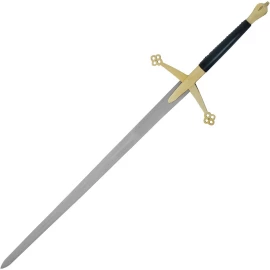
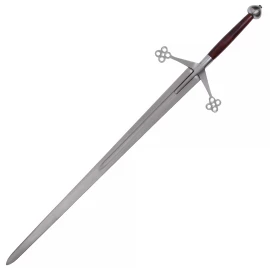
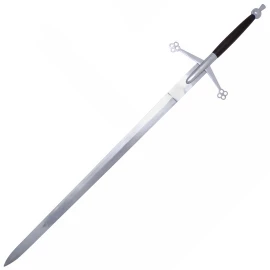
Scottish Claymore Sword with antique finish
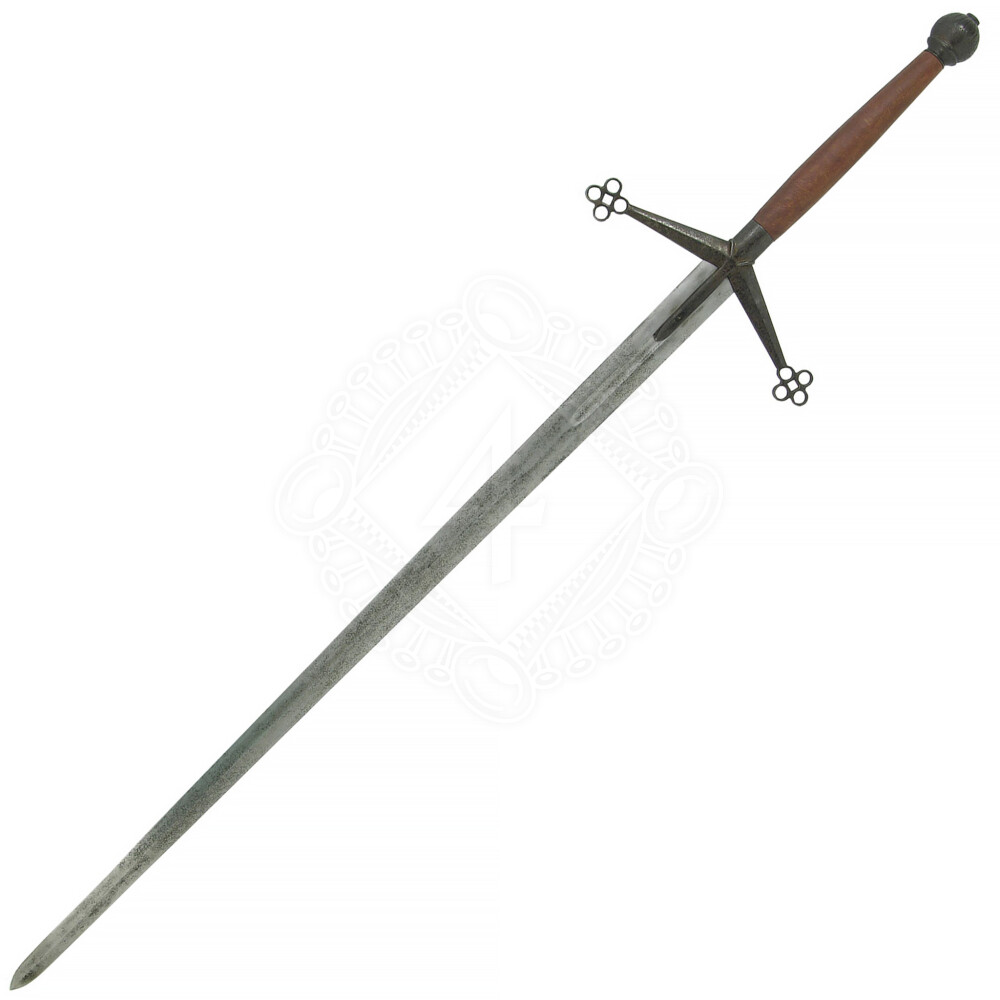

Mainstay of the Highland warriors of the late 15th and 16th centuries, the Claymore had a uniquely styled hilt that sets it apart from other great swords of the period. Typically of hand-and-a-half length, this versatile weapon could deliver great sweeping slashes or powerful thrusts. Further product information ...
Would you like to be notified as soon as the item is in stock?
You will receive a short e-mail as soon as we have it back in stock.
Scottish Claymore Sword with antique finish
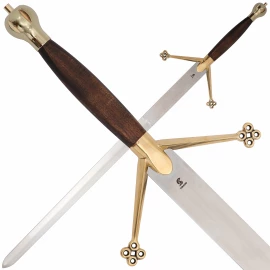
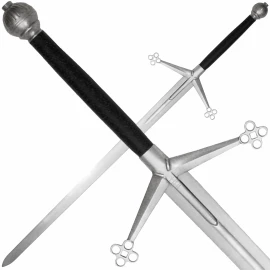
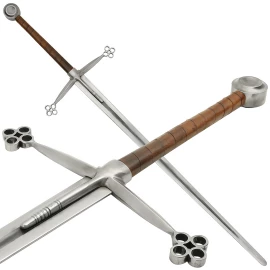
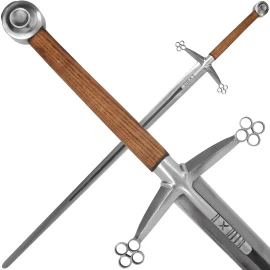
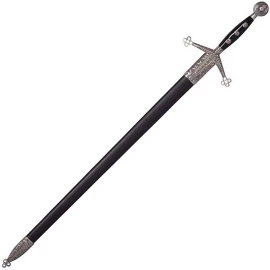
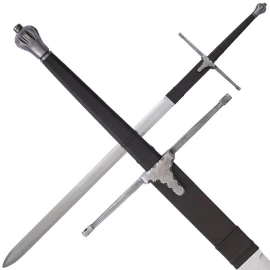
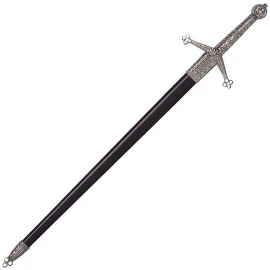
Replicated from a surviving museum piece the Hanwei Claymore is classic in its design, with distinctive sloping quillons terminating in quatrefoils and a high-collared quillon block with langets following the blade fuller. The leather-covered grip is topped by a globate pommel. Originally carried slung on the back, the Claymore matches perfectly with a back scabbard (e.g. item no. 0101050600).
This is is the antique-finish version of the Claymore sword. It is also available (SH2060/0165192060) in a 'normal' plain version.
Key Features:
- Authentic styling
- Fully functional
- Great balance
Specifications:
- Overall: approx. 139cm
- Blade Length: approx. 104cm
- Handle Length: approx. 35cm
- Blade material: spring steel 60CrMnA
- Hardness 48 - 52 HRC
- Weight: approx. 2210 g
- Point of Balance: approx. 18cm
- Point of Harmonics: approx. 79cm
- Width at Guard: approx. 4.50cm
- Width at Tip: approx. 3.25cm
- Thickness at Guard: approx. 0.60cm
- Thickness at Tip: approx. 0.40cm
Specs may slightly vary from piece to piece.
A Stage Combat Suitability Review: The Hanwei Scottish Claymore (HN-SH2060)
The Scottish Claymore Sword with an Antique Finish (Article number HN-SH2060) by Hanwei, in its as-delivered condition, is not suitable for stage combat or reenactment. This assessment is based on several key factors, primarily its sharpened blade and the lack of a specific classification for contact-based fighting.
Analysis of Product Specifications
The Claymore, designed by Paul Chen and manufactured by Hanwei, is consistently described by retailers and reviewers as "fully functional." This indicates that it is not a decorative-only stainless steel piece, but a live weapon designed and constructed for cutting tests (tameshigiri). Its solid construction, featuring a peened pommel, reinforces this intended purpose.
However, the decisive characteristics for evaluating its suitability for stage combat are as follows:
-
Sharp Blade: All sources confirm that the sword is delivered with a sharpened edge. Retailers across the UK and Europe explicitly point out its "sharp cutting edges." A sword suitable for stage combat or reenactment must have a blunt striking edge of at least 2-3 mm and a rounded (rebated) tip to minimize the risk of injury to participants. This sword does not meet that standard.
-
Lack of a "Battle-Ready" Classification: Neither the manufacturer, Hanwei, nor its distributors classify this specific model as "battle-ready" in the context of reenactment. Hanwei produces separate "Practical" lines (e.g., the "Practical Hand-and-a-Half Sword"), whose blades are explicitly designed for stage combat (unsharpened and made from resilient steel). The Claymore HN-SH2060 is not part of this series.
-
Blade Material and Hardness: There is conflicting information regarding the blade steel used. Some US sources cite "1566 carbon steel," while several European retailers list "60CrMnA spring steel" with a Rockwell hardness of 48-52 HRC. Spring steel at this hardness is generally well-suited for blades that must withstand impact. However, suitability for stage combat depends not only on the material but also on the blade geometry and heat treatment. Without a clear manufacturer's declaration of its fitness for blade-on-blade contact, a significant risk remains.
Can It Be Modified for Stage Combat?
Theoretically, the blade could be blunted by an experienced professional. However, this course of action is strongly discouraged for safety reasons. The blade was designed and heat-treated to be a sharp sword, prioritizing edge retention, not the repeated, high-impact stress of striking other blades. Improper modification or an unsuitable blade can lead to edge chipping or, in the worst-case scenario, catastrophic blade failure.
Final Verdict
The Hanwei/Paul Chen Scottish Claymore (HN-SH2060) is a high-quality, functional, sharp sword intended for collectors and cutting practice. For use in European or UK stage combat, HEMA sparring, or reenactment where blades make contact, it is entirely unsuitable and dangerous in its original form.
We are here for you!