 Čeština
 Deutsch


Sutor HEMA Feder for German Longsword Training


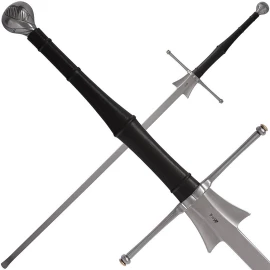
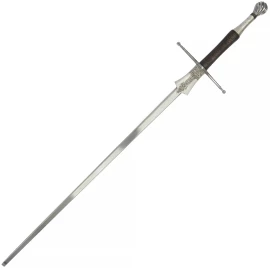
This professional HEMA feder made from 5160 spring steel is a modern functional interpretation of the historical training longsword, designed for technical practice and controlled steel sparring. It measures 134.5 cm (53.0 in) overall, weighs approximately 1.339 kg (2.95 lb), balances around 6 cm (2.4 in) ahead of the guard and has a manufacturer-stated flex of about 10 kg (22 lb). Distinctive features include an engraved floral schilt, a pale grey textured grip and a rolled safety tip. The model name honours Jakob Sutor von Baden, whose fencing book was printed in Frankfurt am Main in 1612. Further product information ...

 Delivery options
Sutor HEMA Feder for German Longsword Training
A modern HEMA feder construction
This type of specialised training longsword is commonly known in modern Historical European Martial Arts as a feder, Fechtfeder or federschwert. The present model is not an exact reproduction of a particular surviving antique. Instead, it is a functional modern training sword based on the general construction principle associated with historical fencing feders: a long, comparatively narrow working blade combined with a strongly widened section immediately in front of the crossguard, generally called the schilt.
The blade is made from 5160 spring steel. This chromium-bearing spring steel is widely valued in mechanically demanding applications for its useful combination of toughness and elasticity. The supplied specifications give a hardness of approximately 49–53 HRC and a flex rating of about 10 kg (22 lb). A flex figure describes resistance during a bending test; it should not be treated as a stand-alone safety certification.
The blade has a documented distal taper from approximately 4.8 mm (0.19 in) at the base to 3.8 mm (0.15 in) towards the tip. Distal taper is the gradual reduction in blade thickness from hilt to point and plays an important role in mass distribution and bending behaviour. The striking edge is approximately 3.3 mm (0.13 in) thick, placing it clearly in the blunt training category.
At the end of the blade, the steel is visibly folded back to form a rolled safety tip. This produces a broader contact area than an acute point and reduces the risk of penetrating protective clothing during controlled thrusting. It does not, however, make an otherwise substantial steel longsword inherently safe without proper protective equipment and controlled fencing practice.
Schilt, crossguard and two-handed grip
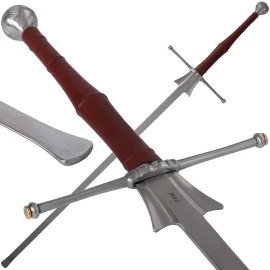
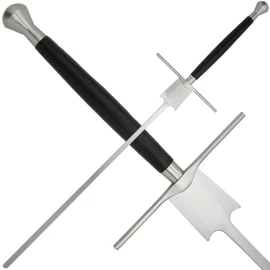
The most visually distinctive feature is the expanded schilt at the base of the blade. At its widest point it measures approximately 96.9 mm (3.81 in). Its pronounced lateral profile creates the familiar feder silhouette, whilst the flat surfaces are embellished with a fine floral engraving. The decoration gives the otherwise restrained grey weapon a more individual appearance without turning it into a purely ornamental piece.
On a modern HEMA feder, the schilt contributes to protection close to the hands and helps place mass near the hilt, where it can compensate for the otherwise narrow blade. Historical training swords varied considerably, however, so the schilt should not be assigned one single universal historical function.
The straight crossguard is approximately 25 cm (9.8 in) long. Its terminals are slightly widened and rounded, avoiding unnecessarily sharp corners on a sparring weapon. The grip measures approximately 22 cm (8.7 in), giving adequate space for two-handed control even when wearing substantial HEMA gloves.
The photographs show a pale grey to silver-coloured, finely textured grip covering. Its exact material is not specified in the supplied technical data, so we do not identify it solely from appearance.
The hilt terminates in a metal pommel of teardrop or pear-like form. The tang is peened at the pommel. Together with the long grip, the pommel brings the balance of the 101 cm (39.8 in) blade back towards the hands.
Handling and use in HEMA
At 134.5 cm (53.0 in) overall and approximately 1.339 kg (2.95 lb), this model falls within the general handling range expected of modern longsword training feders. Its point of balance is about 6 cm (2.4 in) ahead of the crossguard, giving the blade enough presence for engagement in the bind whilst retaining the agility needed for changes of line, parries and repeated technical drills.
The sword is intended for HEMA drilling, partner work and contact sparring when used with suitable protective equipment. Its format is particularly appropriate for practising material from the German longsword tradition, including binding actions, winding, parries, cuts and controlled thrusts.
This should not be confused with automatic tournament approval. Individual competitions set their own limits for overall length, weight, blade flex, edge geometry and tip design. Always check the current rules of the relevant event before entering with a particular training weapon.
The historical Fechtfeder and German fencing culture
Purpose-built training swords with comparatively narrow blades and widened sections close to the guard are particularly associated with the German fencing culture of the 16th century. Similar forms appear in Early Modern fencing imagery and belong to the wider environment of the Fechtschule, where fencing was taught, practised and publicly demonstrated with a variety of weapons.
This culture included well-known fencing brotherhoods and societies such as the Marxbrüder and, later, the Federfechter. Their rivalry formed an important part of organised fencing in the Holy Roman Empire. Historical terminology was not completely uniform, however, and the modern word “federschwert” should not simply be projected onto every historical training sword.
Modern HEMA has adopted the central principle of the historical Fechtfeder and adapted it to contemporary partner training. Modern feders therefore tend to combine historically inspired proportions with blunt edges, controlled blade flexibility and broadened or rolled safety tips.
Jakob Sutor von Baden and the fencing book of 1612
The model name honours Jakob, also written Jacob, Sutor von Baden. His name is associated with the New Künstliches Fechtbuch, printed in Frankfurt am Main by Wilhelm Hoffman in 1612.
The book contains material on the longsword, dusack, early forms of rapier fencing, polearms and other weapons. A substantial part of its teaching draws upon Joachim Meyer's much larger 1570 fencing treatise, condensing and reorganising earlier material for a new readership at the beginning of the 17th century.
This makes Sutor especially interesting to present-day HEMA practitioners. His publication stands near the later end of the printed German longsword tradition and also reflects a period in which European fencing was changing. This feder is not a reproduction of a personal weapon owned by Jakob Sutor. His name is used as a tribute to the fencing tradition preserved in his book.
Technical specifications
| Weapon type | HEMA feder / training longsword |
|---|---|
| Intended use | HEMA technical practice and contact sparring with appropriate protective equipment |
| Blade material | 5160 spring steel |
| Hardness | approx. 49–53 HRC |
| Overall length | 134.5 cm (53.0 in) |
| Blade length | 101 cm (39.8 in) |
| Grip length | 22 cm (8.7 in) |
| Crossguard length | 25 cm (9.8 in) |
| Ricasso / schilt section | approx. 9 cm (3.5 in) |
| Blade width below the guard | 45.8 mm (1.80 in) |
| Maximum schilt width | approx. 96.9 mm (3.81 in) |
| Blade width 10 cm from the tip | 13.64 mm (0.54 in) |
| Striking edge thickness | approx. 3.3 mm (0.13 in) – blunt |
| Distal taper | approx. 4.8 mm → 3.8 mm (0.19 → 0.15 in) |
| Blade tip | blunt, rolled safety tip |
| Safety-tip dimensions | approx. 12.6 × 8.9 mm (0.50 × 0.35 in) |
| Manufacturer-stated flex | approx. 10 kg (22 lb) |
| Point of balance | approx. 6 cm (2.4 in) ahead of the guard |
| Weight | approx. 1.339 kg (2.95 lb) |
| Pommel construction | peened |
Because the sword receives a degree of manual finishing, the stated measurements, weight and other measured values should be regarded as approximate. Individual examples may vary slightly.
Safety in HEMA sparring
Blunt edges and a rolled point do not prevent a steel feder from causing serious injury. Partner work should therefore be performed only with protective equipment appropriate to steel longsword fencing: a suitable fencing mask, rigid back-of-head protection, gorget, padded HEMA jacket, heavy longsword gloves and protection for the forearms, elbows, knees and shins. Depending on the intensity and ruleset, chest and groin protection may also be appropriate.
Before every session, inspect the rolled tip, edges, schilt, crossguard and pommel. Steel-on-steel contact can create burrs or sharp projections along the otherwise blunt edge. If these occur, stop using the sword for contact work until the damaged area has been smoothed safely. Sparring intensity should always match the experience of both partners and the rules of the club. Never fence with a steel weapon whilst under the influence of alcohol or other intoxicating substances.
Care and maintenance
5160 spring steel is not stainless. After training, wipe the blade, schilt, guard and pommel dry, removing perspiration and fingerprints. Apply a very thin film of suitable weapon oil or conservation wax to exposed steel surfaces.
Inspect the edges regularly after intensive sparring. Minor burrs created by blade contact should be dressed carefully with a fine file or another appropriate abrasive so that no sharp hooks remain to catch gloves, masks or protective clothing. Do not strike trees, stone, concrete, metal posts or other hard immovable objects with the feder.
Recommended accessories
- HEMA fencing mask with robust back-of-head protection,
- gorget and padded HEMA jacket,
- heavy gloves suitable for steel longsword sparring,
- forearm, elbow, knee and shin protection,
- padded transport bag for a full-length longsword,
- blade oil, cleaning cloth and fine file for routine edge maintenance.
Swordier – functional training swords from Longquan
Swordier operates from Longquan in Zhejiang Province, China, a city with a long-standing association with blade making and metalworking. Alongside Asian swords, the company also produces European-inspired functional weapons and specialised HEMA training models.
The SWHZ range focuses on practical construction, heat treatment, blade flexibility, handling and durability. This particular feder combines 5160 spring steel, a pronounced schilt, a rolled safety tip and proportions suited to contemporary HEMA practice. For fencers looking for a functional training weapon with an attractive balance of material, construction and price, it represents a technically interesting option.
We are here for you!