
 Čeština
 Deutsch


Early Scottish Highland Dirk with Carved Wooden Grip and Sheath - Outlet
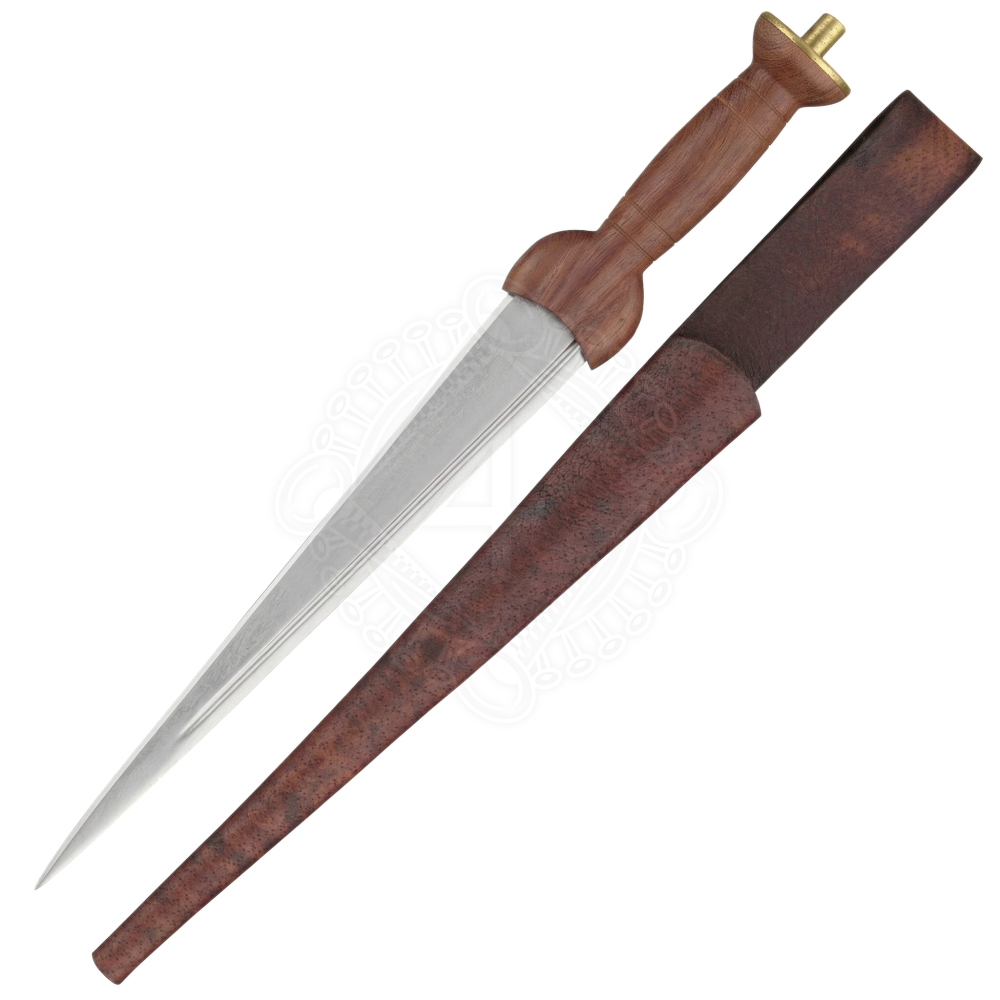

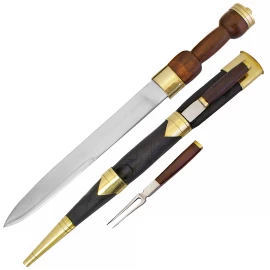
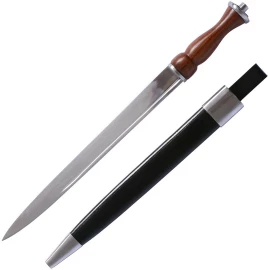
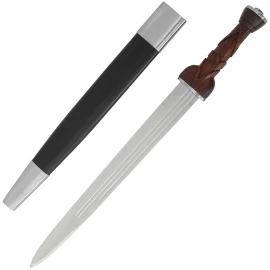
Are you looking for an authentic accessory for your Scottish Highland costume or a striking backup weapon for your historical camp? We present to you an early Scottish dirk, precisely inspired by originals from around 1700. This fascinating dagger represents the evolutionary missing link between the medieval bollock dagger and the later, heavily ornamented ceremonial dirks of the Scottish Highlanders. Its wedge-shaped blade and hand-carved hardwood handle make it a perfect piece for collectors, reenactors, and Scottish history enthusiasts alike. Immerse yourself in the rugged world of the Highlands and complete your gear with this unique piece that breathes the spirit of the Jacobite risings! Further product information ...

 Delivery options
Early Scottish Highland Dirk with Carved Wooden Grip and Sheath
Historical Context and Purpose of the Scottish Dirk
The Scottish dirk (Scottish Gaelic: biodag) was the traditional personal sidearm of the Scottish Highlanders. The model we present to you here dates from the early 18th century. During this period, the weapon still retained strong features of its predecessor, the European bollock dagger, which is particularly evident in the characteristic shape of the lower hilt section. While in the later Romantic period of the 19th century the dirk became more of a richly decorated piece of jewellery and a ceremonial badge of the kilt wearer, in 1700 it was a deadly, practical everyday weapon. Highlanders used it for camp chores, hunting, and most importantly in close quarters combat, often to devastating effect when combined with a basket-hilted broadsword and a small round shield (targe).
Construction and Technical Specifications
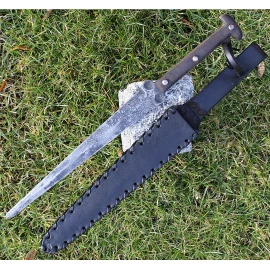
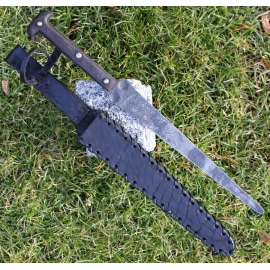
The weapon boasts a massive, wedge-shaped blade. Adjacent to the blade is a hand-carved solid wood grip, which is crowned by an elegant and robust pommel made of solid brass. We supply the dagger inclusive of a precisely fitting, simple sheath made of genuine leather, which reliably protects the weapon.
| Overall Length | approx. 50.8 cm (20 inches) |
| Blade Length | approx. 34.3 cm (13.5 inches) |
| Dagger Weight | approx. 435 g (15.3 oz) |
| Blade Profile | Wedge-shaped, single-edged, with a diamond cross-section |
| Grip Material | Hardwood (specified originally as ebony, but visually finished in medium brown tones) |
| Fittings Material | Solid brass |
| Accessories | Matching leather sheath is included in the delivery |
Safety Warnings and Practical Use
This dirk is fitted with a sharp edge and a pointed tip. For safety reasons, we must strongly warn you that this product is completely unsuitable for practical use in contact combat (stage fighting), for HEMA, SCA, or LARP battles. It is not intended for person-to-person combat, not even for practice. It serves primarily as a high-quality decorative and collector's item, or as an authentic-looking prop for a historical costume (always bearing in mind local laws regarding the carrying of sharp weapons in public). Striking the blade against hard targets or other weapons could damage the dagger and cause injury to you or bystanders.
How to Properly Care for Your Dirk
To ensure that your dagger serves you well and brings you joy for many years, regular maintenance is essential. We recommend cleaning the steel blade after every touch with bare hands or after use in a damp environment, and lightly coating it with a preserving gun oil. This prevents the formation of surface rust. You can occasionally treat the wooden handle with beeswax or linseed oil to stop the wood from drying out. Keep the leather sheath supple by using special leather balms. Never store the dagger in its leather sheath in a damp environment for an extended period, as the leather can draw in moisture and cause the blade to corrode.
To achieve the ultimate look of a Scottish warrior, we recommend acquiring a traditional Scottish targe shield and a genuine leather belt with a historical buckle to accompany this wonderful piece.
We are here for you!





.3773623034.1696456237.png.webp)

.3773623034.1696456268.png.webp)
.3773623034.1696456247.png.webp)