Čeština
 Deutsch


Oseberg Viking Campfire Tripod for Cauldrons, 9th Century


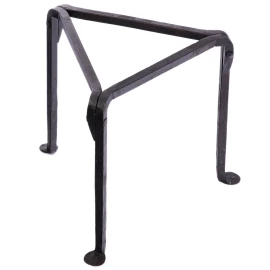
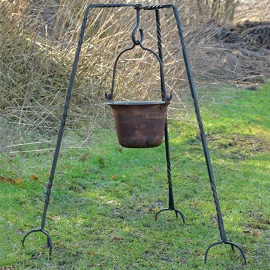
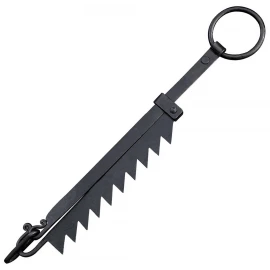
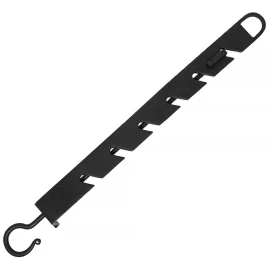
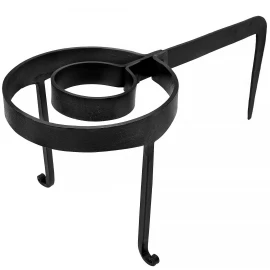
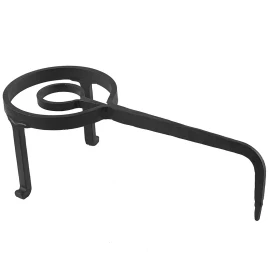
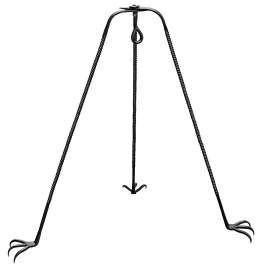
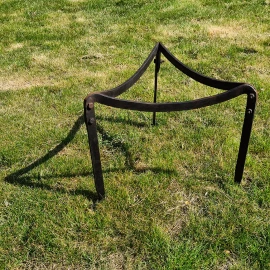
Viking enthusiast, give your camp kitchen a convincing historical centrepiece with this folding cooking tripod inspired by the Oseberg find. Its design reflects portable cooking equipment associated with 9th-century Scandinavia. Three long steel legs form a stable support over the fire, whilst the top suspension point accepts a suitable hook or cauldron chain. Available in Medium and Large sizes, the tripod can be matched to different camp layouts and cookware. We recommend this Viking cooking tripod for living history, reenactment, LARP, historical camps and traditional outdoor cooking over an open fire. Further product information ...

 Delivery options
The following variants are currently available:
Oseberg Viking Campfire Tripod for Cauldrons, 9th Century
A Robust Tripod for a Historical Camp Kitchen
The construction is deliberately simple, practical and easy to transport. The three long legs are made from hand-worked mild steel and meet at the top in a folding arrangement. They can be brought together for transport and spread out again to form a stable triangular stance at camp. A black protective surface finish helps shield the steel from moisture whilst providing a subdued appearance suitable for historical equipment.
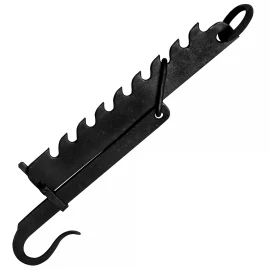
The legs are made from approximately 12 × 12 mm / 0.47 × 0.47 in square stock. Each lower end divides into two short points, helping the tripod settle securely on natural ground. At the apex is a hanging element approximately 17 cm / 6 3/4 in long. For convenient control of cooking height, we recommend suspending a suitable iron cauldron chain with hooks between this top hook and your cooking vessel.
The Oseberg Ship-Burial Connection
The historical inspiration comes from the famous Oseberg ship burial in Vestfold, Norway, one of the most remarkable archaeological assemblages of the Viking Age. The burial belongs to the 9th century and contained two women accompanied by an exceptionally rich collection of grave goods. Alongside vehicles, sledges, textiles, furniture and numerous other objects was a substantial selection of household and cooking equipment.
The assemblage included vessels and implements used in food preparation, together with a portable three-legged cooking support. That practical principle provides the historical basis for this Oseberg-style campfire tripod. A portable stand was particularly useful when cooking away from a permanent hearth equipped with a built-in suspension system.
A three-legged support also offers a practical mechanical advantage: three contact points can remain stable on ground that is not perfectly even. Simple cooking stands of this general principle should therefore not be considered uniquely Scandinavian, but the Oseberg material provides a particularly evocative example of Viking Age cooking equipment from the 9th century.
How to Set Up the Campfire Tripod
Choose firm ground where an open fire is both permitted and safe. Clear dry grass, leaves and other readily combustible material from the immediate area. Always erect the tripod before lighting the fire. Spread all three legs evenly so that the top suspension point sits approximately above the centre of the intended hearth.
On softer natural ground, allow the divided feet to settle gently into the surface. On stone or other hard ground, check particularly carefully that none of the legs can slide once the tripod is loaded. The suspended cauldron should remain approximately centred between all three legs rather than pulling the structure heavily towards one side.
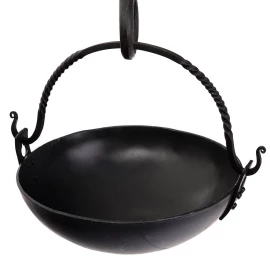
Hang a suitable cauldron chain from the upper hook and attach cookware with a strong bail handle. Different links in the chain can then be used to alter the distance between the vessel and the heat. Only use pots, cauldrons, chains and hooks specifically suitable for cooking over an open fire.
Technical Specifications
| Specification | Details |
|---|---|
| Product type | Folding campfire tripod, cooking tripod, cauldron tripod |
| Historical inspiration | Oseberg, Scandinavia, Viking Age |
| Date of historical inspiration | 9th century |
| Leg material | Hand-worked mild steel |
| Leg stock | Approx. 12 × 12 mm / 0.47 × 0.47 in |
| Suspension material | Mild steel |
| Suspension round-stock diameter | Approx. 15 mm / 0.59 in |
| Upper suspension length | Approx. 17 cm / 6 3/4 in |
| Finish | Black protective surface finish |
| Construction | Three folding legs with top suspension point |
| Feet | Divided ends for improved stability on natural ground |
| Intended purpose | Suspending suitable cookware over an outdoor fire |
| Suitable for | Living history, reenactment, LARP, historical camp kitchens and camping |
| Cauldron and suspension chain | Not included |
Size Chart
| Size | Leg Length | Approximate Height When Erected | Weight |
|---|---|---|---|
| Medium | Approx. 120 cm / 47 1/4 in | Approx. 94 cm / 37 in | Approx. 4,550 g / 10.0 lb |
| Large | Approx. 150 cm / 59 in | Approx. 114 cm / 44 7/8 in | Approx. 5,050 g / 11.1 lb |
The actual standing height can vary slightly according to how widely the legs are spread and the nature of the ground beneath them.
Open-Fire Cooking Safety
- Fully erect the tripod and check its stability before lighting the fire.
- Use it outdoors or only in an area specifically intended for open-fire cooking.
- Never use an open campfire inside an ordinary enclosed tent or other poorly ventilated space.
- Keep the suspended cauldron approximately centred between the three legs.
- No maximum load rating has been supplied, so do not subject the tripod to unnecessarily heavy loads.
- Never use the tripod to suspend people, heavy equipment or loads unrelated to camp cooking.
- Never leave an open fire or suspended cooking vessel unattended.
- The steel can become extremely hot through flame and radiant heat. Wear suitable protective gloves and allow the tripod to cool completely before folding it.
- Do not move or reposition the tripod whilst a hot or filled cauldron is suspended from it.
- Always observe local fire regulations and seasonal restrictions on open fires.
Care and Maintenance
After cooking, allow the tripod to cool completely before handling it. Remove soot, ash and food deposits, and dry the steel thoroughly if it has become wet. Before long-term storage, a very light coating of suitable protective oil can be applied to clean, dry metal; wipe away any excess before the next use. Pay particular attention to areas where the black finish has been scratched through normal handling.
Store the tripod in a dry place and avoid leaving it permanently outdoors in rain or on wet ground. Minor surface rust can develop where the protective finish has worn away. Remove it promptly and protect the cleaned area with a light coating of oil to help maintain the tripod for many seasons.
Recommended Accessories
For a 9th–10th-century Viking camp kitchen, we recommend pairing the tripod with an iron suspension chain and hooks, a cauldron with a sturdy bail handle, an iron frying pan, wooden ladle, chopping board and simple historical tableware. A fire striker and flint, wooden or ceramic vessels and leather provision bags also complement a living-history camp. The cauldron, suspension chain, fire pit, cookware, weapons and other equipment shown in the photographs are not included.
We are here for you!