Čeština
 Deutsch


Richmond Confederate D-Guard Bowie Knife with Leather Sheath
3x


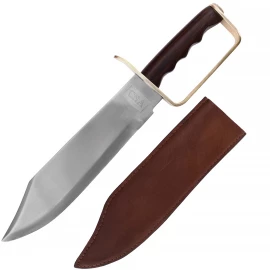
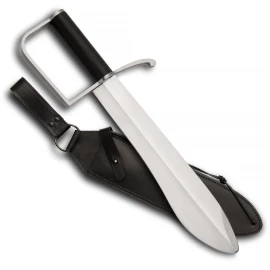
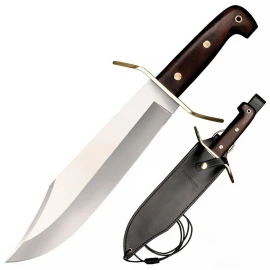
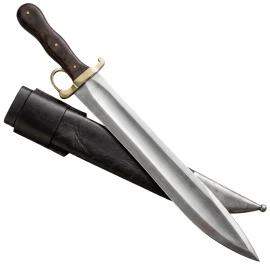
This massive D-guard Bowie knife recalls the large fighting and camp knives associated with Confederate soldiers during the American Civil War. Its long AISI 1060 high-carbon steel blade measures approximately 17.56 in (446 mm), while the shaped wooden grip is surrounded by a prominent steel knuckle bow. At approximately 22.4 in (569 mm) overall, the knife has an imposing presence somewhere between a large Bowie, short sabre and machete. It comes complete with a black leather sheath with metal fittings, making it an attractive piece for collecting, historical display and American Civil War reenactment. Further product information ...

 Delivery options
Richmond Confederate D-Guard Bowie Knife with Leather Sheath
A Large D-Guard Bowie of the American Civil War
This knife is inspired by the exceptionally robust American D-guard Bowie knives associated particularly with the American Civil War of 1861–1865. They were not a single standardised military pattern. The term Bowie covered a broad family of long knives made by individual cutlers, workshops and, in some instances, specifically for particular users.
Large examples with a knuckle-bow guard were valued for their versatility. A soldier could use such a knife around camp for chopping small branches, splitting and shaping wood, preparing improvised shelter and performing other everyday chores. At the same time, it could serve as a back-up edged weapon when a rifle, sabre or other principal weapon was unavailable or impractical.
Long AISI 1060 High-Carbon Steel Blade
The dominant feature is the approximately 17.56 in (446 mm) blade made from AISI 1060 high-carbon steel. At its base it measures about 1.61 in (41 mm) wide and 0.17 in (4.4 mm) thick. It tapers markedly towards the point, while the gently curved profile gives the weapon a distinctive appearance somewhere between a large Bowie knife, hanger and light machete.
According to the supplied specifications, the blade is hand-forged. Its edge is approximately 0.008 in (0.2 mm) thick, so it must not be regarded as a safely blunt reenactment weapon. Treat it as a functional edged weapon and prevent any uncontrolled contact with people.
Protective D-Shaped Knuckle Guard
The most distinctive feature of the hilt is its steel D-shaped knuckle guard. A broad bow extends from the forward guard around the knuckles to the end of the grip, giving the hand substantial coverage. The guard measures approximately 4.09 × 4.80 in (104 × 122 mm).
The grip is made from dark-stained wood with a clearly visible natural grain. Its gently waisted profile and simple finish suit the utilitarian character of American fighting and camp knives of the 19th century. The contrast between the dark timber and bright steel also gives the knife a restrained but attractive appearance.
Black Leather Sheath with Metal Fittings
The knife is supplied with a black leather sheath fitted with metal reinforcement at the throat and tip. These fittings protect the areas most exposed to wear while visually complementing the steel hilt. Only place the knife in its sheath when the blade is clean and dry. Moisture retained by leather can encourage corrosion on high-carbon steel.
How Bowie Knives Were Used
During the first half of the 19th century, the Bowie knife became an American byword for a large general-purpose and fighting knife. Its name is associated with James Bowie, who became famous in part through the violent encounter known as the Sandbar Fight in 1827. The precise designer and maker of the original Bowie knife remain disputed, however, and numerous legends grew around its development.
By the American Civil War, Bowie knives were already widely familiar. Some Confederate soldiers carried exceptionally large examples, including versions with D-shaped knuckle guards. As the war progressed, firearms naturally dominated battlefield combat, but a substantial knife could still remain useful as a camp tool and emergency sidearm.
Why the Name Richmond?
Richmond, Virginia served as the capital of the Confederate States of America for most of the American Civil War. It was a major political, military and industrial centre of the Confederacy. Richmond therefore provides a fitting historical name for a Bowie knife inspired by the equipment associated with Southern soldiers of the 1860s.
Technical Specifications
| Specification | Value |
|---|---|
| Type | D-guard Bowie knife |
| Historical period | American Civil War, 1861–1865 |
| Overall length | approx. 22.4 in (569 mm) |
| Blade length | approx. 17.56 in (446 mm) |
| Grip length | approx. 4.13 in (105 mm) |
| Blade material | AISI 1060 high-carbon steel |
| Blade thickness at base | approx. 0.17 in (4.4 mm) |
| Blade width at base | approx. 1.61 in (41 mm) |
| Edge thickness | approx. 0.008 in (0.2 mm) |
| D-guard dimensions | approx. 4.09 × 4.80 in (104 × 122 mm) |
| Grip material | Wood |
| Guard material | Steel |
| Knife weight | approx. 1 lb 3.6 oz (556 g) |
| Weight including sheath | approx. 1 lb 9.9 oz (734 g) |
| Sheath | Black leather with metal fittings; included |
| Manufacturer | Windlass Steelcrafts® |
The stated dimensions, weights and other technical values may vary slightly from one piece to another.
Care and Safe Handling
- After use, wipe the blade with a clean, dry cloth to remove moisture, dirt and fingerprints.
- Regularly protect the high-carbon steel with a thin coating of suitable blade or gun oil, as this steel is not stainless.
- Never put a damp or dirty blade into the leather sheath. Leather can retain moisture and encourage corrosion.
- For long-term storage, keep the knife in a dry environment and inspect the blade periodically.
- Protect the wooden grip from prolonged exposure to water, high humidity and extreme changes in temperature.
- The edge is approximately 0.008 in (0.2 mm) thick, so this is not a safely blunt prop.
- Do not use the knife for contact historical fencing or choreographed person-to-person combat.
- Never direct the blade towards people or animals and always maintain a safe working distance when handling it.
- Do not strike stone, metal, concrete or other very hard materials, as doing so may damage the edge or point.
Recommended Accessories
- Confederate military belt – suitable for an American Civil War soldier impression of the 1860s.
- Confederate belt buckle – a characteristic accessory for Southern military equipment of the 19th century.
- Confederate uniform – suitable for American Civil War reenactment of 1861–1865.
- Leather haversack or cartridge pouch – a practical accessory for mid-19th-century military impressions.
- Confederate cavalry sabre – suitable for completing a display of Southern military equipment from the 1860s.
We are here for you!