Čeština
 Deutsch


Medieval Hanging Steel Frying Pan


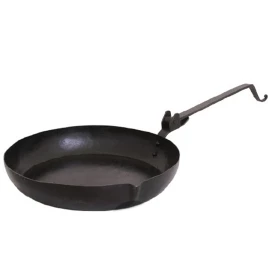
Fancy cooking a hearty meal over a crackling fire at your next medieval camp? This hand-forged hanging steel frying pan brings the atmosphere of a historical camp kitchen straight to your hearth. Measuring approximately 28 cm (11 in) in diameter, it offers plenty of room for frying meat, vegetables, eggs or flatbreads. Its tall, arched steel handle features a sturdy hook, allowing you to suspend the pan from a cooking tripod above the flames. Perfect for historical reenactment, LARP, medieval camps and rustic outdoor cooking, it can also be placed on a suitable stable support over the fire. Further product information ...

 Delivery options
Medieval Hanging Steel Frying Pan for Open-Fire Cooking
Construction and Practical Features
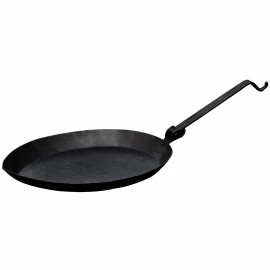
This traditional-style campfire frying pan has a round shape with a broad base, low, gently sloping sides and a smooth interior. Hand-forged from approximately 1.5 mm (0.06 in) thick steel, it has a rustic appearance that makes it particularly suitable for historical camp cooking.
A tall, arched handle made from a flat steel strip is attached to the sides of the pan. At its highest point sits a fixed curved hook, allowing the pan to be suspended from a chain, hook or suitable support above an open fire. With an adjustable suspension system, you can raise or lower the pan to control the heat reaching your food.
Thanks to its relatively flat base, the pan can also rest on a metal pan trivet or carefully arranged, stable heat-resistant stones. Always ensure that the pan is securely supported and cannot tip over.
The steel surface has no artificial non-stick coating. Instead, proper seasoning and regular use develop a dark protective patina that helps reduce food sticking and protects the metal against corrosion.
Historical Background: Cooking Over an Open Hearth
Iron frying pans were already part of European kitchen equipment during the Middle Ages. Alongside pottery vessels and suspended cauldrons, they were used for frying and cooking food in fat. Their shapes and construction varied according to the region, period and intended purpose.
During the High and Late Middle Ages, approximately the 12th to 15th centuries, European hearths employed various iron suspension systems, hooks and chains. These allowed cooks to adjust the distance between cooking vessels and the fire, helping them control the cooking temperature. Such arrangements were useful both in domestic kitchens and when preparing meals outdoors.
This hanging pan is a functional modern reproduction inspired by historical cooking equipment rather than a documented exact copy of a particular archaeological find. Its straightforward construction makes it especially suitable for portraying medieval and early modern camp kitchens.
Technical Specifications
| Specification | Details |
|---|---|
| Product type | Hanging frying pan for open-fire cooking |
| Material | Rust-prone steel |
| Manufacturing method | Hand-forged |
| Material thickness | Approx. 1.5 mm (0.06 in) |
| Pan diameter | Approx. 28 cm (11 in) |
| Overall height | Approx. 30.5 cm (12 in) |
| Height to the pan rim | Approx. 5.5 cm (2.2 in) |
| Weight | Approx. 1,380 g (3.04 lb) |
| Suspension system | Arched steel handle with integrated hook |
| Surface as supplied | Lightly oiled to prevent corrosion |
| Manufacturer / brand | ULFBERTH® |
The package contains the frying pan with its attached suspension handle and hook. The cooking tripod, hanging chain and any additional accessories are not included.
Before First Use: How to Season Your Steel Pan
Before cooking for the first time, this steel frying pan needs to be thoroughly cleaned and seasoned. Seasoning creates a protective layer that improves its cooking performance and helps prevent rust.
- 1. Clean thoroughly: Wash the pan with hot water, a sponge or brush and ordinary washing-up liquid. This removes the protective oil applied during manufacture. Rinse thoroughly and dry completely.
- 2. Heat with oil: Add enough high-temperature cooking oil, such as refined rapeseed or sunflower oil, to cover the base completely. Pork lard is also suitable. Heat the fat under constant supervision, taking care to prevent it from igniting.
- 3. Season with potatoes: Add raw potato peelings or slices and approximately one teaspoon of salt to the hot fat. Fry the potatoes, turning regularly, until they become dark brown and the surface of the pan begins to darken.
- 4. Finish the process: Allow the pan to cool, remove the potato remains and wipe the interior with kitchen paper. Leave a thin protective film of oil on the surface.
The dark patina that develops is a desirable characteristic of traditional iron and steel cookware, not a manufacturing defect. Regular cooking and proper maintenance will gradually improve its performance.
Care, Maintenance and Safe Handling
- After seasoning, clean the pan primarily with kitchen paper, using hot water and a soft brush when necessary.
- Avoid washing-up liquid during routine cleaning, as it may interfere with the seasoned surface.
- Never put the pan in a dishwasher. Prolonged exposure to moisture will cause rust.
- Dry the pan thoroughly after cleaning and apply a thin layer of edible oil to both the inside and outside surfaces.
- Store in a dry place. If surface rust appears, remove it and restore the protective seasoning.
- Only suspend the pan from a stable cooking tripod with a suitably strong, heat-resistant hanging system.
- Always wear appropriate heat-resistant gloves when handling the hot pan. The steel handle and hook can become extremely hot.
- Never leave hot cooking fat unattended. Do not attempt to extinguish burning fat with water.
- Do not plunge the hot pan into cold water or expose it to sudden, extreme temperature changes.
Recommended Accessories for Your Historical Camp Kitchen
To complete your cooking setup, we recommend an iron cooking tripod, a hanging chain with hooks, a metal pan trivet and a fire poker. These types of equipment are appropriate for recreating European camp kitchens of the High and Late Middle Ages (12th–15th centuries), as well as the early modern period (16th–17th centuries). Modern heat-resistant gloves are also a sensible addition for safe handling around an open fire.
We are here for you!