
 Čeština
 Deutsch


Knots, Spirals, and the Hidden Order of the World: Celtic Symbols and Their Meaning
 Interesting facts of the past
Celtic ornaments were never just decorative patterns. For the Celts, they were a visual language which helped them express the order of the world, natural cycles, and humanity’s place within their rhythm. All without using words. Even today, Celtic designs live on in modern jewellery and have found a strong following in tattoo studios around the world. In this article, we’ll show you how to read Celtic symbols, so you can understand their deeper meaning, not just admire their beauty.
Contents
- The Secrets of the Druids and “Celtic Geometry”
- Celtic Knots: The Endless Cycle of Life
- The Celtic Tree of Life: Where Earth Meets Spirit
- The Celtic Cross
- Spirals and the Triskelion: Growth and Transformation
- Separating Myth from History: Celtic Runes vs. Ogham
- Symbols on Everyday Objects: Weapons, Jewellery, and Coins
- The Celtic Horoscope: Trees and Animals
- Choosing a Celtic Symbol for a Tattoo
The Secrets of the Druids and “Celtic Geometry”
The Celts left behind plenty of physical traces across Europe, but surprisingly few clear instructions on how to truly understand them. Ancient authors tell us that druids relied mainly on oral tradition. Sacred knowledge and symbolism were memorized, not written in books.
Most Celtic Patterns Are Inspired by Nature and Geometry The circle symbolized the sun and repeating cycles. Interwoven lines expressed the interconnectedness of the world, spirals represented movement, growth, and transformation.
Rather than spelling out specific meanings, these shapes conveyed broader principles, such as ways of understanding nature, rituals, and the forces shaping everyday life of the Celts.
DID YOU KNOW... Many Celtic knot designs can be drawn in a single, uninterrupted line. That unbroken flow symbolizes continuity, and life without loose ends or final conclusions.
Celtic Knots: The Endless Cycle of Life
Celtic knots are the most iconic symbols of Celtic culture, representing unity, eternity, and connection to the endless cycle of life. The line weaves endlessly, yet it never truly begins or ends.
The meaning behind a Celtic knot is deeper – it’s not just decoration. Its intricate designs stand for lasting bonds and eternal rhythms.
Celtic knots most often symbolize:
- The eternal cycle of life and death
- The bond between a person, their lineage, the land, and the afterlife
- Balance and harmony
Interpretation can also depend on how and why the symbol is worn:
- The Celtic knot of life is often seen as a symbol of continuity and unity of a family.
- The Celtic love knot expresses devotion and a relationship that is meant to last.
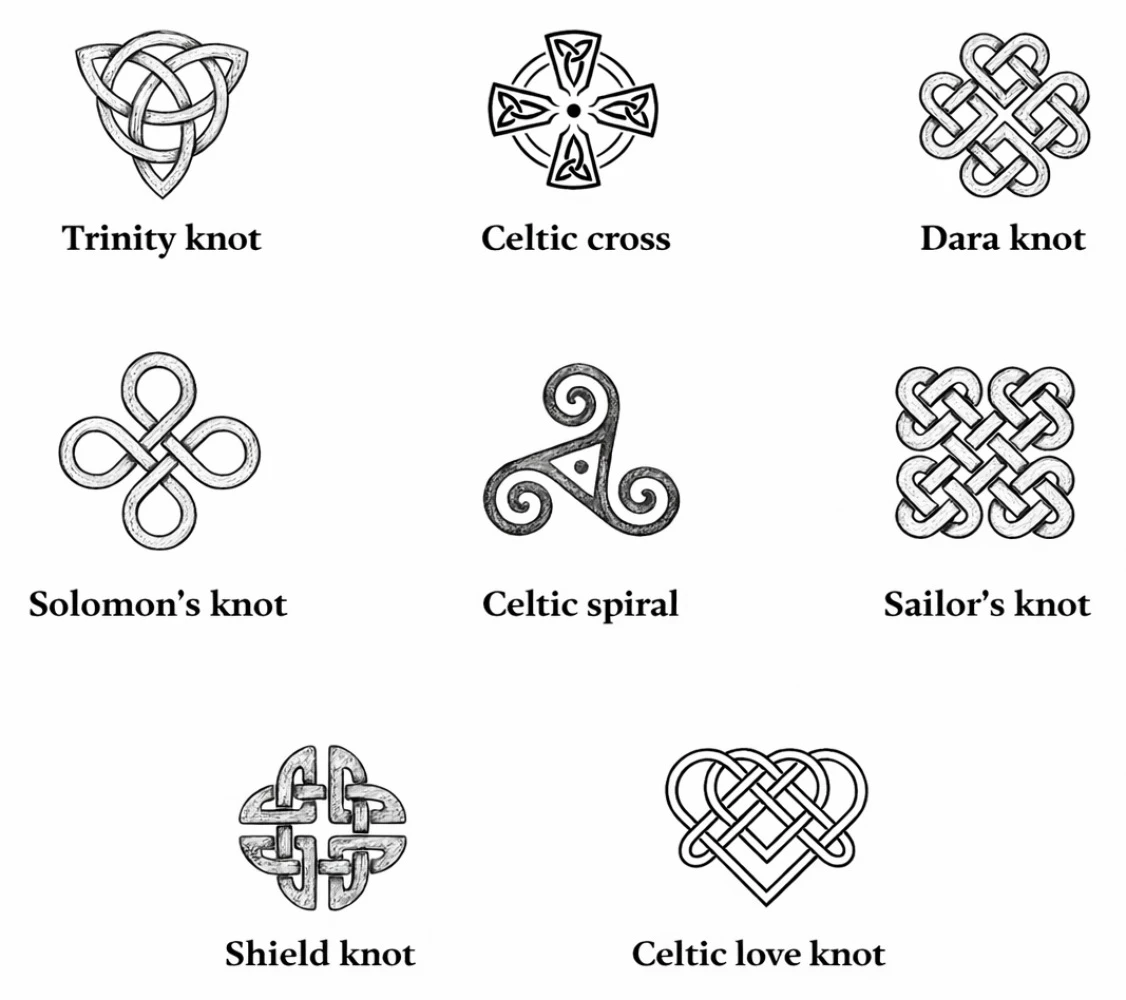
What are the most popular Celtic knots? Below are some of the best-known knot designs (often shown in modern interpretations, because the Celts didn’t necessarily use these exact names).
Triquetra (Trinity Knot)
The triquetra (often called the Trinity Knot) consists of three interlocking loops. While rooted in Celtic tradition, it later made its way into Christian symbolism.
For the Celts, it likely represented the cycle of life, death, and rebirth. Or the connection between land, sea, and sky. In Christianity, the triple knot came to symbolize the Holy Trinity: Father, Son, and Holy Spirit.
DID YOU KNOW... Some modern interpretations link the Triquetra to the female lineage of grandmother, mother, and daughter, making it a symbol of maternal continuity. While meaningful today, this is a modern idea rather than a confirmed historical fact.
Celtic Love Knot
Intricate interwoven patterns often symbolize loyalty, love, and devotion. The uninterrupted lines reflect a strong bond between two people.
The Celtic Tree of Life: Where Earth Meets Spirit
Another powerful Celtic symbol is the Tree of Life, representing order, balance, and the connection between worlds:
- Roots: the underworld and ancestors
- Trunk: the earthly realm, the world of the living
- Branches: the heavens
The Celts didn’t romanticize nature, they saw it as a tightly interconnected system holding the world together.
The Tree of Life also symbolized a certain type of “authority” and cosmic order, much like world trees in Norse and other ancient cultures.
The Celtic Cross
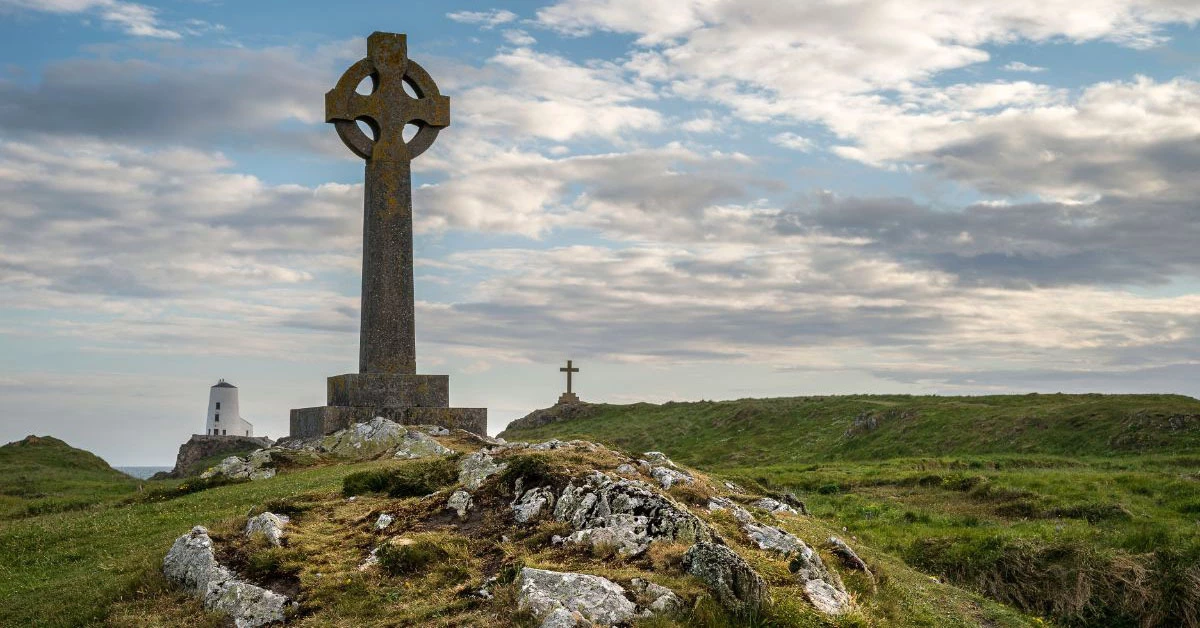
The Celtic cross first appeared in Ireland around the 7th century AD. It symbolizes the connection between the divine and human realms.
Visually, it combines a cross with a circle, blending pagan symbolism with Christian imagery. The Celtic cross expressed hope, harmony, and the bridge between the “old” and the “new” religious worlds.
The meaning behind the Celtic Cross still resonates today. You’ll see it used in jewellery, art, and even tarot, where it represents crossroads, or the bridge between different influences.
Despite the name, the popular tarot spread known as the “Celtic Cross” has no real historical connection to the ancient Celtic culture.
Spirals and the Triskelion: Growth and Transformation
In Celtic symbolism, spiral represents movement – growth, evolution, and change. Ancient cultures viewed the spiral as a visual metaphor for life’s winding path and the connection between the world and the cosmos.
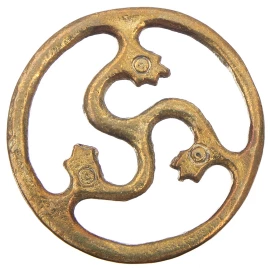
Triskelion (Triskele) - the symbol featuring three spirals emerging from a single centre. It represents the idea of perpetual motion, such as birth, life, and death, or the unity of body, mind, and soul.
Separating Myth from History: Celtic Runes vs. Ogham
A common question is whether the Celts used runes. While runes are often associated with “ancient” cultures, they were actually used mostly by peoples of the Germanic world, not the Celtic one.
The Celts had their own writing system called Ogham. Ogham consisted of a series of lines and notches carved into stone pillars or wooden surfaces. Before the spread of Christianity, this writing system was used to write the early Irish language.
Ogham could be written vertically or horizontally: vertical inscriptions were read bottom to top, and horizontal inscriptions from left to right. Each letter was represented by a sequence of one to five strokes.
The script was typically understood only by the educated Celts, mainly druids and possibly members of the tribal elite (“nobility”).
DID YOU KNOW... Ogham inscriptions were usually short and pragmatic. They marked family ties or territorial boundaries. And when boundaries were involved, those markings carried serious weight.
Symbols on Everyday Objects: Weapons, Jewellery, and Coins
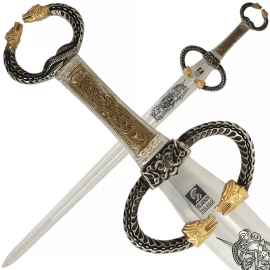
Celtic symbols weren’t just in sacred spaces, they appeared on various everyday objects as well. Engravings on Celtic swords or knives marked the status of their owner, and they were believed to protect the bearer in battle.
Celtic coins featured both military (horsemen) and mythological motifs (stylized horses or boars).
Even the Celtic stater (sometimes called a “rainbow coin”), minted between the 3rd and 1st centuries BC, was more than currency: its animal designs symbolized wealth, strength, and the luck of the family line.
Celtic jewellery carried meaning too. Torcs (big metal neck rings) were worn by influential figures and signalled authority, respect, and power within the community.
The Celtic Horoscope: Trees and Animals
Roman writers like Pliny the Elder suggested that druids observed the stars, but the “earthly” nature was equally important to them.
Seasons, tree cycles, and animal behaviour all played a major role in their worldview. Celtic horoscopes (often called “tree horoscopes”), still popular today, reflect this. While they are inspired by ancient beliefs, they are modern systems and romantic reconstructions rather than a historical fact.

Choosing a Celtic Symbol for a Tattoo
Although the exact meaning of some symbols has been lost to time, their beauty and modern symbolism still resonate with us.
Are you thinking about getting a Celtic tattoo? First of all, find a motif that speaks to you. If you’re looking for:
- Personal growth: Go for a spiral or Triskelion.
- Inner strength and stability: The Tree of Life is a great fit
- Spiritual depth: Consider the Triquetra or a tall Celtic cross.
And if you are curious about our advice: Choose a design that captures a timeless value, something that describes who you are in a single sentence. That kind of simplicity is the essence of Celtic symbolism.
Beyond Tattoos: Celtic Style You Can Wear If you are not into tattoos, but you love history, re-enactments, LARP, or festivals, check out our range of Celtic costumes, including Celtic shoes, and accessories that fit like they were made for you.
 Share
Share
 Share
Share
 Tweet
Tweet
Comments