Čeština
 Deutsch


Gurkha Regimental Kukri
3x


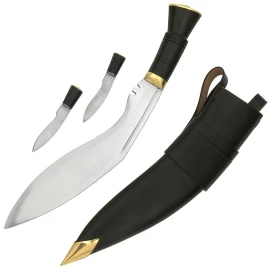
This imposing Gurkha Regimental Kukri is based on the traditional Nepalese knife that became one of the best-known symbols of Gurkha soldiers. Its characteristic forward-curving blade is hand forged from 1085 high-carbon steel, hardened to 48–52 HRC and fitted with a pronounced longitudinal groove and traditional cho notch. The grip is made from hardwood, while the set also includes a sheath and the traditional Karda and Chakmak accessories. Although its construction follows a military-style kukri, we offer this example exclusively as a decorative and collectable item. Further product information ...

 Delivery options
Gurkha Regimental Kukri Decorative Knife with Sheath
A Characteristic Nepalese Kukri in Regimental Style
The kukri, also spelt khukuri, is immediately recognisable by its distinctive forward-curving blade and broad belly. This unmistakable profile separates the Nepalese knife from most European knives and chopping blades. On this model, the blade measures approximately 30.8 cm / 12.13 in and reaches around 57 mm / 2.24 in at its widest point. A pronounced longitudinal groove runs along the blade, while the base of the cutting edge features the traditional cho or kaudi notch found on many Nepalese kukris.
The blade is made from 1085 high-carbon steel and, according to the supplied specifications, is hand forged. The hardwood grip widens towards the end, is secured by two visible metal fastenings and terminates in a metal butt plate. This shape follows the familiar appearance of military-style kukris and gives the complete set a particularly distinctive appearance for display.
Karda, Chakmak and Sheath
The set also contains two smaller traditional accessories known as the Karda and Chakmak. In Nepalese tradition, the Karda is a small utility knife intended for everyday minor tasks. The Chakmak traditionally serves as an auxiliary implement associated with kukri maintenance and, in some forms, could also be used with flint for producing sparks.
All three pieces can be carried together in the black sheath. It incorporates separate storage for the main kukri and the two smaller accessories, a reinforced throat area and a carrying loop. The tip is finished with a contrasting gold-coloured metal fitting. Together, these elements form a compact set well suited to a collection of military or ethnographic edged weapons.
The Kukri and Gurkha History
The precise origins of the kukri cannot be assigned securely to one particular year. This forward-curving type of knife has, however, been associated with Nepal for a long period and became internationally famous during the 19th and 20th centuries, particularly through Gurkha soldiers. The term Gurkha does not denote one single Nepalese ethnic group; it is primarily associated with soldiers from Nepal who served in Gurkha units within British and Indian military traditions.
Following the British-Nepalese conflicts of the early 19th century, Nepalese soldiers were increasingly recruited into British-led units. The kukri subsequently accompanied Gurkha formations through numerous campaigns and wars. Gurkha troops served during the events in India in 1857, on the Western Front during the First World War, in Asia during the Second World War and in the Falklands War of 1982.
The kukri was never solely a weapon. Its broad, strongly curved blade traditionally also served as a versatile working tool for chopping and other everyday tasks. This combination of practical implement, military equipment and cultural symbol helps explain why the kukri has become one of the world's most recognisable knife forms.
Why the Name Gurkha?
The name Gurkha is connected with the Nepalese town and historic kingdom of Gorkha. The term subsequently became associated with Nepalese soldiers serving in Gurkha units. The kukri became so closely linked with their military tradition that it is now one of their most recognisable symbols. The name Gurkha Regimental Kukri therefore refers to the military-style form of this traditional Nepalese knife.
Technical Specifications
| Specification | Details |
|---|---|
| Product type | Regimental kukri, decorative and collectable item |
| Blade material | 1085 high-carbon steel |
| Blade manufacture | Hand forged |
| Blade hardness | 48–52 HRC |
| Overall kukri length | approx. 43.2 cm / 17.01 in |
| Blade length | approx. 30.8 cm / 12.13 in |
| Blade width at widest point | approx. 57 mm / 2.24 in |
| Blade thickness | approx. 5 mm / 0.20 in |
| Cutting edge thickness | approx. 0.2 mm / 0.008 in, sharp |
| Kukri weight | approx. 680 g / 1.50 lb |
| Grip material | Hardwood |
| Grip termination | Metal butt plate |
| Accessories | Karda and Chakmak |
| Overall length of Karda and Chakmak | approx. 12.1 cm / 4.74 in |
| Blade length of Karda and Chakmak | approx. 8.5 cm / 3.35 in |
| Blade thickness of Karda and Chakmak | approx. 1 mm / 0.039 in |
| Weight of Karda and Chakmak | approx. 38 g / 1.34 oz combined |
| Total set weight | approx. 904 g / 1.99 lb |
| Sheath | Included |
| Manufacturer | Windlass Steelcrafts® |
The stated dimensions and weights are approximate and may vary slightly from one kukri to another.
Care of Your Kukri
High-carbon steel requires regular care because, unlike stainless steel, it can corrode when exposed to moisture. After handling, wipe the blade with a soft dry cloth and apply a very thin coating of suitable protective oil. Do not leave water, perspiration or fingerprints on the steel for prolonged periods. Always store the kukri and both smaller accessories dry. Do not soak the wooden grip or expose it for long periods to high humidity, direct heat or sudden changes in temperature.
Safety Information
We offer this product exclusively as a decorative and collectable item. It nevertheless has a sharp cutting edge approximately 0.2 mm / 0.008 in thick and may cause serious injury if handled carelessly. Do not use the kukri for chopping, cutting, combat practice, contact fighting or any other practical purpose. Never direct it towards another person and always ensure that there is ample clear space when drawing it from the sheath. Keep the complete set securely away from children and anyone unable to handle sharp objects safely.
Recommended Accessories
- Knife or edged-weapon display stand for securely presenting the kukri in a collection.
- Military leather belt inspired by the 19th–20th centuries as a thematic addition to a Gurkha display.
- British-Indian military equipment inspired by the 19th–20th centuries for a historically themed presentation.
- Military and expedition accessories from the First and Second World War periods for a collection focusing on Gurkha service during the 20th century.
We are here for you!