Čeština
 Deutsch


Fulford Viking LARP Axe, Ready For Battle

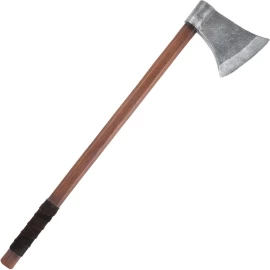
Are you setting off on a Viking expedition, defending your village against raiders or preparing for your next fantasy battle? The Fulford Viking LARP Axe by Epic Armoury is a lightweight, one-handed padded weapon with a simple historically inspired appearance and straightforward handling. Its broad, dark metallic-looking axe head and long brown haft with pronounced wood-grain detailing resemble an early medieval axe. Made with closed-cell foam, a latex coating and a fibreglass core, it is designed for controlled LARP combat. Measuring 60 cm (23.6 in) and weighing just 150 g (5.3 oz), it makes a practical weapon for beginners and experienced role-players alike. Further product information ...

Would you like to be notified as soon as the item is in stock?
You will receive a short e-mail as soon as we have it back in stock.
Fulford Viking LARP Axe, Ready For Battle, 60 cm
Simple Yet Impressive Viking Axe Design
This one-handed LARP axe from the Ready For Battle (RFB) range combines the understated appearance of early medieval axes with modern construction designed for role-playing. Its broad axe blade and straight haft create an instantly recognisable silhouette that complements historically inspired and fantasy equipment.
Notable design features include:
- Broad axe head: The blade section measures approximately 15 cm (5.9 in) in length and 14 cm (5.5 in) in height. Its distinctly expanded blade features a gently curved cutting-edge profile. The upper section extends into a broad point, while the lower section forms a deeper curved recess towards the haft.
- Slightly bearded blade profile: The downward extension of the cutting edge resembles certain historical bearded axe designs, where part of the axe blade extended below the level of the socket.
- Metal-effect finish: The axe head features dark grey to anthracite colouring with a fine granular texture. A lighter band along the cutting edge creates the appearance of a sharpened metal blade.
- Pronounced wood-grain effect: The straight haft is finished in brown and dark brown shades. Longitudinal blackish-brown lines imitate natural wood fibres and give the weapon a rustic appearance.
- Simple haft end: The lower end is relatively flat with slightly rounded edges. This understated detail maintains the axe's simple appearance without unnecessary ornamentation.
- Compact dimensions: The overall length of approximately 60 cm (23.6 in) makes the axe convenient to handle with one hand and easy to incorporate into a costume.
Important: The metallic-looking axe head and wooden-looking haft are decorative imitations. The weapon consists of foam padding with a protective latex coating and an internal fibreglass core. It is not a genuine axe and must not be used for chopping wood or other practical work.
Ready For Battle – Accessible Equipment for LARP
Ready For Battle (RFB) is an Epic Armoury product range focusing on simple, functional and more affordable padded LARP weapons. It is particularly suitable for players who prefer practical designs over elaborate decoration. Both beginners and experienced LARPers looking for a lightweight secondary weapon can appreciate its straightforward construction.
Beneath its realistic-looking surface is a modern construction developed for simulated combat:
- Closed-cell foam: Durable padding designed to help cushion the impact of controlled simulated strikes.
- Fibreglass core: Flexible internal reinforcement providing structural support and helping the weapon retain its shape.
- Protective latex coating: A continuous outer layer protecting the foam components while allowing a realistic decorative finish on both the axe head and haft.
- Low weight: Weighing just 150 g (5.3 oz), the axe is convenient to carry and relatively easy to control during simulated cutting strikes.
- Hand-finished appearance: Each piece is individually finished and painted, resulting in subtle differences between weapons.
With proper handling, the axe is suitable for repeated LARP activities. However, padded construction alone does not guarantee complete safety. Always ensure that the weapon meets the specific event organiser's requirements before using it.
History of Viking Axes: From Everyday Tools to Weapons of War
Axes were among the most widespread tools and weapons in Scandinavia during the Viking Age, approximately from the late 8th to the 11th century. Unlike swords, which required larger quantities of high-quality iron and specialised craftsmanship, simple axes were accessible to a broader section of society.
However, not every Viking axe was intended for combat. In everyday life, various types of axe were used primarily for felling trees, working timber, constructing ships and houses, and performing other craft activities. Alongside these practical tools, axes specifically suited to warfare were also produced.
Viking battle axes came in many forms. In addition to relatively narrow axe heads, there were broader varieties and the distinctive bearded axes, characterised by a downward extension of the blade below the level of the haft.
The Old Norse term skeggøx literally refers to an axe with a beard. The elongated lower section allowed a longer cutting edge while keeping the amount of metal relatively modest. In certain designs, this extension could also assist with weapon handling or hooking an opponent's equipment.
One-handed battle axes could be carried alongside round shields, providing the warrior with additional protection. Their characteristic shape offered different handling possibilities from those of a straight sword blade.
During the 10th and 11th centuries, larger two-handed battle axes, commonly known as Dane axes, also became widespread. These specialised weapons featured longer hafts and broader cutting edges and were used by Scandinavian and Anglo-Saxon professional warriors, among others.
The Fulford LARP Axe is a modern, historically inspired interpretation of a simple one-handed axe. Its appearance recalls early medieval examples, but it is neither an exact reconstruction of a particular archaeological find nor a reliably identifiable historical subtype.
Why Is This Axe Called Fulford?
Fulford is a historic location near York in northern England. On 20 September 1066, a significant battle took place there between the forces of the Norwegian king Harald III Hardrada, supported by Tostig Godwinson, and Anglo-Saxon troops led by the earls Edwin and Morcar.
The Norwegians won the battle and occupied York shortly afterwards. Their success was short-lived, however. On 25 September 1066, they were surprised and defeated by King Harold II of England at the Battle of Stamford Bridge, where Harald Hardrada was killed.
These events formed part of the last major Scandinavian military expeditions into England during the period traditionally known as the Viking Age.
We chose the name Fulford to commemorate the turbulent events of 1066 and the warrior traditions of the Norse peoples. This LARP axe is not a reproduction of any particular weapon discovered on the Fulford battlefield.
How to Use Your One-Handed LARP Axe
With its 60 cm (23.6 in) overall length and lightweight construction, the axe is well suited to one-handed handling. Grip the haft firmly so that it cannot slip from your hand during simulated cutting strikes. Use controlled movements and appropriate force throughout the game.
Its design and dimensions make it suitable for a wide variety of characters:
- Viking warrior: A one-handed axe to accompany a round LARP shield, tunic and Norse cloak.
- Anglo-Saxon fighter: A secondary weapon for a costume inspired by 10th- or 11th-century England.
- Norse raider: A practical-looking weapon for a Viking warband or adventurous expedition.
- Fantasy barbarian: A simple axe for a warrior who favours straightforward weapons without elaborate decoration.
- Dwarven warrior: A compact axe that complements fantasy dwarven equipment.
- New LARP player: A lightweight, manageable weapon for gaining initial experience with controlled simulated combat.
- Cosplay and theatre: A padded prop for costume events, photography and carefully choreographed stage combat.
Appropriate adult supervision is essential when children use the product. Always observe any age restrictions and safety rules established by the event organiser.
Technical Specifications
| Specification | Details |
|---|---|
| Product type | Padded one-handed LARP axe |
| Product range | Ready For Battle (RFB) |
| Model name | Fulford |
| Brand | Epic Armoury |
| Manufacturer | IRON FORTRESS ApS, Denmark |
| Historical inspiration | Early medieval and Viking Age axes |
| Historical period of inspiration | 8th–11th centuries |
| Padding material | Closed-cell foam |
| Core material | Fibreglass |
| Outer coating | Latex |
| Overall length | Approx. 60 cm (23.6 in) |
| Blade length | Approx. 15 cm (5.9 in) |
| Blade height | Approx. 14 cm (5.5 in) |
| Grip length | Approx. 55 cm (21.7 in) |
| Weight | Approx. 150 g (5.3 oz) |
| Axe head design | Single-edged, broad, with a gently curved cutting-edge profile |
| Axe head colour | Dark grey to anthracite, metal effect |
| Haft appearance | Brown wood effect with longitudinal grain detailing |
| Handling | One-handed |
| Finishing | Hand-finished and hand-painted |
| Intended use | LARP, fantasy role-playing, cosplay and theatrical use |
Please note: Each axe is individually hand-finished and painted. Minor variations in colour, shape and surface appearance are therefore natural. Individual pieces may differ slightly from the illustrated example.
Care Instructions and Safe Use of Your LARP Axe
To keep your Fulford Axe in good condition for as long as possible, we recommend regular maintenance and careful handling.
- Cleaning: After every use, remove mud, dust and other dirt with water and a soft cloth. Clean heavier soiling as soon as possible.
- Latex maintenance: We recommend applying a suitable silicone spray formulated for latex-coated LARP weapons after use. This helps maintain the flexibility of the coating and reduces drying.
- Heat protection: Avoid prolonged exposure to direct sunlight and high temperatures. Never leave the axe inside a hot vehicle for extended periods.
- Storage: Keep the axe in a dry place without prolonged bending of the haft or compression of the padded head.
- Pre-game inspection: Examine the axe head, cutting-edge area, latex coating and entire haft. Do not use the weapon if you notice cracks, damaged foam or signs of a compromised fibreglass core.
- Controlled strikes: Use appropriate force during simulated cutting attacks and follow the rules of the particular LARP event.
- Sensitive body areas: Avoid striking the head, face, neck, groin and other vulnerable parts of the body.
- Thrusting and haft strikes: Do not use the axe for thrusting, striking with the end of the haft or other techniques not expressly approved by the manufacturer and event rules.
- Improper use: The axe is not intended for HEMA, buhurt or full-contact combat. Do not use it against steel weapons or rigid training equipment, as a lever, as a throwing weapon or to chop solid objects.
- Cleaning products: Avoid solvents, harsh chemicals and abrasive sponges that could damage the latex coating.
Safety warning: Even a padded LARP weapon cannot completely eliminate the risk of injury. Safe use depends on the condition of the product, the strength and technique of strikes, and consideration for fellow players. Never use a damaged weapon.
Recommended Accessories for Your Viking Warrior
To complement the Fulford Axe, we recommend a round Viking LARP shield, woollen or linen tunic, cloak fastened with a brooch and leather belt. For a historically inspired character, consider clothing and equipment based on 9th–11th-century Scandinavian examples. You can also add a LARP seax, leather pouch, satchel and historically inspired footwear. For an 11th-century Anglo-Saxon warrior, a simple tunic, cloak and round shield make suitable additions. Together, these items create a convincing outfit for a Norse warrior, experienced adventurer or fantasy fighter.
We are here for you!