
 Čeština
 Deutsch


Perfect Axe for Chopping Wood and Camping [A Practical Guide]
 Weapons
![Perfect Axe for Chopping Wood and Camping [A Practical Guide]](https://www.outfit4events.cz/images/palette/shared/www/multimedia/jak-vybrat-sekeru-01.1443294657.1751292479.jpeg.webp)
Whether you’re splitting logs for a cosy campfire, building a shelter in the woods, or hacking your way through thick brush, with the right axe, you’re all set for whatever nature throws at you. We’ll help you pick and sharpen an axe that’s just right for your outdoor adventures as well as for everyday tasks around the house.
Contents
How to Pick the Right Axe – Tips for Beginners and Seasoned Adventurers
Today’s market is packed with all kinds of axes, from tiny camping hatchets to heavy axes for chopping large logs or felling trees.
So, the first question you need to ask yourself is: what will you be using the axe for?
You have several options (some axes go by different names and fit into multiple categories):
Axes for chopping wood
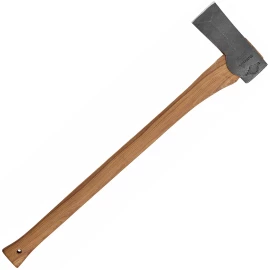
Splitting axes – Ideal for splitting logs and large wood rounds into smaller and manageable pieces. For tough, serious woodwork, you can use a sledgehammer and a splitting wedge.
Two-Handed Axes – Larger and heavier axes suitable for chopping large logs. The extra weight of these heavy axes gives extra momentum and impact force, but they’re best for experienced users who know how to handle the tool.
Carpenter’s axes – Precision tools designed for shaping wood, commonly used by carpenters and other craftsmen.
Survival and Outdoor Axes
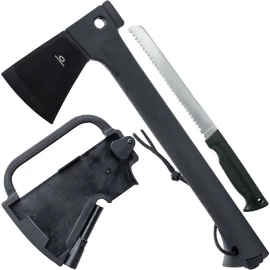
Tactical Axes – Versatile tools designed for a variety of outdoor tasks. They are ideal for survival or outdoor adventures as well as garden work.
Bushcraft Axes – Also known as hiking or outdoor axes, these lightweight, compact tools typically weigh just a few hundred grams and are around 40 cm in length. They are perfect for campers and bushcrafters.
Special Axes
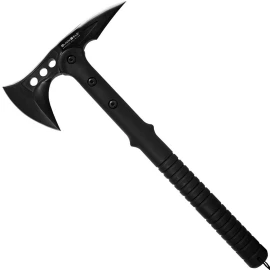
Tomahawks – Lightweight axes originally used by Native American tribes as both tools and weapons. Some tomahawks can be used as throwing axes.
Other Things to Consider When Picking an Axe
Besides type, consider these key axe features:
- Weight: Lighter axes are perfect for smaller tasks like trimming branches or for splitting kindling. Heavier axes are great for splitting larger logs or felling trees. The ideal weight is usually around one kilogram.
- Handle length: The length of your axe handle should roughly match your arm length. Test the shaft length by holding the axe just below the blade and stretching your arm forward. The end of the shaft should reach to your shoulder but not quite touch it. Test the grip too, because a comfortable hold makes all the difference!
- Handle material: Wooden handles are the go-to choice for most outdoor axes. Hickory is especially popular, because it’s one of the toughest hardwoods found in North America and known for its durability.
- Blade material: Outdoor axe blades are usually made from stainless or carbon steel. Carbon steel holds a sharp edge longer but needs a bit more care to prevent rust.
Why Choose a Modern Outdoor Axe?
Modern outdoor axes are designed to make your time in nature easier. Here’s why they’re so useful:
- Compact size and light weight: Easy to carry in your backpack, even on longer hikes. You’ll barely notice it’s there.
- Durable materials: Forged steel heads stand up to hard use and harsh weather.
- Non-slip grips: Help you hold on tight, even with sweaty hands or in the rain.
- Hanging holes: Some outdoor axes come with holes for easy storage.
DID YOU KNOW... You can upgrade your axe with spare parts and handy accessories that make maintenance and transport easy. Check out our range of practical axe accessories.
Sharpening an Axe
By sharpening your axe regularly, you'll keep it in top condition for a long time. You can use a whetstone, file, or grinder - each method has its strengths:
Using a whetstone:
Perfect for sharpening your axe outdoors or at home. For felling and carpentry, sharpen at a 15–20° angle. For chopping logs, go with a 25–30° edge.
It’s more durable and designed to stay sharp, even when the work gets rough.
![Perfect Axe for Chopping Wood and Camping [A Practical Guide]](https://www.outfit4events.cz/images/palette/shared/www/multimedia/jak-vybrat-sekeru-02.3068510588.1751292479.jpeg.webp)
Using a file:
Best for soft steel blades. After using the file, check the blade for chips and remove all uneven spots. Here is how you can check it: place the axe blade on a sheet of paper and trace its edge with a pencil. You’ll quickly see any uneven spots in the outline.
Using an electric grinder:
Recommended for hard steel blades. Use low speed and afine grinding wheel to avoid damage.
Water-cooled grinders are ideal to keep steel from overheating.
DID YOU KNOW... You should always wear safety glasses and gloves when using power tools. Safety always comes first!
If you prefer video guides, here’s a practical step-by-step tutorial:
Ready to Explore the Great Outdoors? Find a Trusty Blade!
A reliable axe is your best companion, whether you’re working in the shed or camping under the stars.
Care for it well, and it might just save your life someday. When your axe is past its prime, don’t hesitate to upgrade!
Our reliable splitting axes and tactical axes are built to perform, no matter where your adventures take you. Browse our axes and find the tool that catches your eye and will feel just right in your hand.
 Share
Share
 Share
Share
 Tweet
Tweet
Comments