Čeština
 Deutsch


Nidhöggr Viking Axe with Engraved Dragon Knotwork


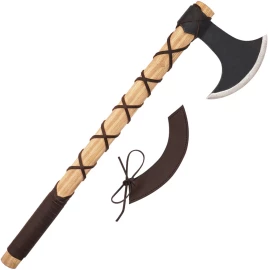
The striking Nidhöggr Viking axe combines the silhouette of a Norse fighting axe with decorative ornament inspired by Viking-Age interlace. Its 1065 high-carbon steel head has a broad, downward-swept blade engraved with a flowing linear composition resembling the intertwined body of a dragon or serpent. The solid hardwood haft measures approximately 26.38 in (670 mm) and has an oval profile that gives the hand a natural sense of edge alignment. Its name refers to Nidhöggr, a creature from Norse mythology associated with the roots of the world tree Yggdrasil. A distinctive piece for a collection, Viking costume or historical display. Further product information ...

Would you like to be notified as soon as the item is in stock?
You will receive a short e-mail as soon as we have it back in stock.
Nidhöggr Viking Axe with Engraved Dragon Knotwork
An Axe Inspired by the Viking Age
Axes were important both as tools and weapons in Scandinavia during the Viking Age, from the late 8th to the 11th century. Fighting axes could employ relatively light heads with expanded cutting edges, providing useful reach and striking potential without excessive weight. Historical one-handed axes could be paired with a round shield, while larger and longer forms were intended for different styles of use.
With its strongly expanded, downward-projecting blade, this model resembles the group generally described today as bearded axes. It is not, however, presented as an exact replica of a particular archaeological find. Its engraved decoration is better understood as a stylised interpretation of Norse interlace and animal ornament.
1065 High-Carbon Steel Head
The axe head is made from 1065 high-carbon steel. It measures approximately 5.91 in (150 mm) from the cutting edge to the haft, while the total length of the head from edge to rear is approximately 7.44 in (189 mm). The blade measures about 4.69 in (119 mm) at its widest point and approximately 1.41 in (35.8 mm) at its narrowest.
The blade itself is approximately 0.18 in (4.6 mm) thick, while the cutting edge is stated to measure approximately 0.035 in (0.9 mm). Although the axe has functional proportions suitable for one-handed handling, it is not expressly specified for HEMA, contact reenactment or practical combat. For safety, we therefore recommend treating it as a decorative and display replica.
Engraved Dragon Knotwork
The most distinctive feature is the engraved ornament covering much of the axe blade. A long interwoven line creates a motif inspired by Norse knotwork, terminating at one end in a stylised animal or dragon head. The dark linear engraving stands out clearly against the smooth metal surface and gives the axe a strongly Scandinavian character.
Interlaced zoomorphic ornament was widely used in Viking-Age art. Related designs appeared on metalwork, carved wood, jewellery and other prestigious objects. Their exact forms changed over time and differed according to region and artistic style.
Solid Hardwood Haft
The axe has an approximately 26.38 in (670 mm) solid hardwood haft. It is largely straight and retains an oval cross-section along its length. Close to the axe head, the profile measures approximately 0.81 × 1.41 in (20.7 × 35.7 mm), while the grip area measures about 1.31 × 0.97 in (33.4 × 24.6 mm).
An oval haft helps the hand sense the orientation of the cutting edge without needing to look at the axe. The head is mounted over the upper part of the haft, with the wood projecting visibly above the eye. Total weight is approximately 1.87 lb (846 g), and the point of balance lies about 4.33 in (110 mm) from the metal head.
Nidhöggr – the Dragon Beneath Yggdrasil
Nidhöggr, Old Norse Níðhöggr, is a creature of Norse mythology described as a serpent or dragon associated with the subterranean region around the roots of Yggdrasil, the world tree. In Eddic tradition it gnaws at one of Yggdrasil's roots. The name is therefore particularly appropriate for an axe decorated with an elongated interlaced dragon motif.
Yggdrasil connects different parts of the cosmos in Norse mythology and remains one of the best-known concepts of Old Norse religion. The beings associated with its roots and branches form a world in which growth, decay and renewal exist alongside one another.
Using the Axe for Historical Display
For reenactment, LARP, photography or display, you can combine the axe with clothing and equipment inspired by Scandinavia of the 9th–11th centuries. Historically, a one-handed axe could be carried alongside a Viking round shield and other personal equipment.
We do not recommend combat use of this modern replica. The supplied information does not state that its construction or heat treatment is designed for repeated impacts against other weapons, shields or hard targets. At events, use it as a costume and display weapon and protect the cutting edge with a suitable cover during transport.
Technical Specifications
| Specification | Value |
|---|---|
| Type | One-handed Viking axe |
| Historical inspiration | Viking Age, approximately 8th–11th century |
| Name | Nidhöggr |
| Axe head material | 1065 high-carbon steel |
| Haft material | Solid hardwood |
| Haft length | approx. 26.38 in (670 mm) |
| Haft profile at axe head | approx. 0.81 × 1.41 in (20.7 × 35.7 mm) |
| Haft profile at grip | approx. 1.31 × 0.97 in (33.4 × 24.6 mm) |
| Head length from edge to haft | approx. 5.91 in (150 mm) |
| Total head length from edge to rear | approx. 7.44 in (189 mm) |
| Maximum blade width | approx. 4.69 in (119 mm) |
| Minimum blade width | approx. 1.41 in (35.8 mm) |
| Blade thickness | approx. 0.18 in (4.6 mm) |
| Cutting edge thickness | approx. 0.035 in (0.9 mm) |
| Metal haft socket thickness | approx. 1.26 in (32.1 mm) |
| Point of balance | approx. 4.33 in (110 mm) from the metal head |
| Decoration | Engraved interlaced dragon / zoomorphic motif |
| Weight | approx. 1.87 lb (846 g) |
| Intended use | Decorative and display replica; not expressly specified for contact combat |
| Manufacturer | Windlass Steelcrafts® |
The stated dimensions, weight and other technical values may vary slightly from one piece to another.
Care and Safety
- After handling, wipe the steel head with a soft, dry cloth to remove fingerprints, perspiration and moisture.
- Regularly protect the high-carbon steel with a thin coating of suitable blade or gun oil.
- Keep the wooden haft dry and avoid prolonged soaking, extreme heat and severe changes in humidity.
- The timber may occasionally be treated with a suitable oil or wax intended for wooden handles.
- Before handling, check that the axe head remains firmly seated and inspect the haft for cracks or other damage.
- The approximately 0.035 in (0.9 mm) edge is not safely blunt and may cause serious injury.
- Do not use the axe for HEMA, buhurt, contact reenactment or choreographed person-to-person fighting.
- Do not strike other weapons, metal, stone, concrete or similarly hard objects, as this may damage the cutting edge, head or haft.
- Maintain a safe distance from other people whenever handling the axe and never swing it in a crowded area.
- For transport, we recommend fitting a suitable leather edge protector.
Recommended Accessories
- Viking round shield – an appropriate companion for portraying a Scandinavian warrior of the 9th–11th centuries.
- Leather axe edge protector – practical protection during storage and transport, suitable for Viking-Age equipment.
- Viking belt and axe hanger – suitable accessories for clothing and equipment inspired by the 9th–11th centuries.
- Viking seax – another characteristic edged tool and weapon associated with the early medieval period.
- Viking tunic, trousers and cloak – a useful basis for a Scandinavian costume of the 9th–11th centuries.
- High-carbon steel care oil – for regular protection of the axe head against corrosion.
We are here for you!