Čeština
 Deutsch


Bedford English War Hammer, circa 1430
1x


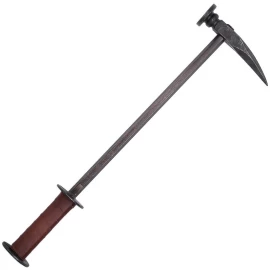
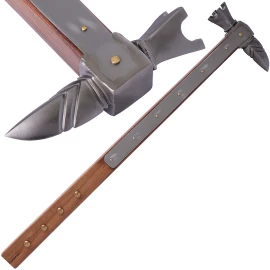
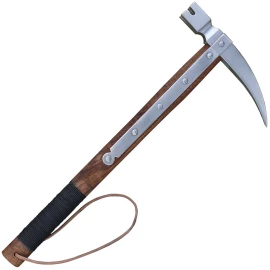
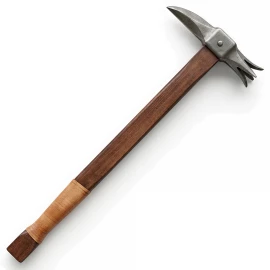
The Bedford English war hammer is based on European knightly and horseman's hammers of the first half of the 15th century. Its metal head combines a small square hammer face with a long curved beak designed to concentrate the force of a blow onto a very small area. The wooden haft is reinforced beneath the head by long metal langets, while the lower grip is covered in black leather with contrasting brown wraps. At approximately 1.64 lb (742 g), the weapon is notably slender and agile. It is a fully functional replica, although its sharp point makes it unsuitable for stage combat or person-to-person contact fencing. Further product information ...

Would you like to be notified as soon as the item is in stock?
You will receive a short e-mail as soon as we have it back in stock.
Bedford English War Hammer, circa 1430
An English War Hammer of the Early 15th Century
The manufacturer dates this model to approximately 1430 and states that its original was encountered in a private collection. The first half of the 15th century was a period in which European plate armour had reached a high level of development and weapons capable of concentrating impact over a small area became increasingly important alongside the sword.
A war hammer was not a universal replacement for a sword, but a specialised weapon with particular value against an armoured opponent. Its compact hammer face could transmit considerable impact through a plate without necessarily cutting through it, whilst the opposing beak concentrated the force even further. Weapons of this kind could be used both on foot and on horseback.
Double-Ended Head with Hammer Face and Beak
The metal head measures approximately 6.30 in (160 mm) overall. One side has a short, decoratively profiled neck terminating in a square striking face measuring approximately 0.83 × 0.84 in (21.05 × 21.37 mm). On the opposite side is a long, slightly downward-curving beak terminating in a pronounced point.
At the decorative grooves, the beak has a cross-section of approximately 0.69 × 0.54 in (17.43 × 13.8 mm). Several moulded transitions and transverse decorative lines give the otherwise practical head an elegant late-medieval appearance.
Reinforced Wooden Haft
The long wooden haft is reinforced in its upper section by two metal langets approximately 10.20 in (259 mm) long. They extend through the area of the hammer head and are secured to the timber by several visible fasteners. This arrangement reinforces the portion of the haft most exposed to impact and protects its sides.
The lower part forms a rectangular grip covered with black leather. The complete leather-covered section is approximately 9.17 in (233 mm) long, of which the black section measures about 6.65 in (169 mm). Brown leather wraps finish both ends. A metal pommel cap terminating in a small spherical button completes the weapon.
How a War Hammer Was Used
A hammer of this type was wielded in one hand. Depending on circumstances, the user could employ either the flat hammer face or the pointed beak. The objective was not necessarily to cut through plate armour. A concentrated blow could transmit substantial force through the armour, damage parts of the defensive equipment or target areas offering less protection.
The comparatively long haft provided reach and leverage, while the modest overall weight helped retain speed and responsiveness. Historically, the grip could also be shifted along the haft to alter the effective reach according to the circumstances of combat.
Why the Name Bedford?
The name Bedford refers to John of Lancaster, Duke of Bedford, an important English prince and military commander of the first half of the 15th century. As regent of the English territories in France, he played a major role during the later stages of the Hundred Years' War and died in 1435. His period of activity therefore closely matches the circa-1430 dating of this English war hammer.
Technical Specifications
| Specification | Value |
|---|---|
| Type | English one-handed war hammer |
| Historical period | Circa 1430, first half of the 15th century |
| Overall length | approx. 24.88 in (632 mm) |
| Haft length to metal head | approx. 24.02 in (610 mm) |
| Total haft length according to supplied specification | approx. 25.00 in (635 mm) |
| Metal head length | approx. 6.30 in (160 mm) |
| Blunt hammer face profile | approx. 0.83 × 0.84 in (21.05 × 21.37 mm) |
| Beak profile at decorative grooves | approx. 0.69 × 0.54 in (17.43 × 13.8 mm) |
| Leather-covered grip profile | approx. 0.91 × 1.26 in (23 × 32 mm) |
| Wooden haft profile without leather | approx. 1.19 × 0.81 in (30.1 × 20.6 mm) |
| Metal langet length | approx. 10.20 in (259 mm) |
| Metal pommel cap profile | approx. 1.04 × 1.30 in (26.3 × 33 mm) |
| End button diameter | approx. 0.78 in (19.9 mm) |
| Total leather covering length | approx. 9.17 in (233 mm) |
| Black leather section length | approx. 6.65 in (169 mm) |
| Point of balance | approx. 8.27 in (210 mm) from the metal head |
| Weight | approx. 1.64 lb (742 g) |
| Construction | Wooden haft, metal head, two long metal langets and leather-covered grip |
| Head configuration | Square hammer face and long curved beak |
| Practical use | Fully functional replica; unsuitable for stage combat or contact fencing because of the sharp point |
| Manufacturer | Windlass Steelcrafts® |
The stated dimensions, weight and other technical values may vary slightly from one piece to another. The supplied specifications give an overall weapon length of approximately 24.88 in (632 mm) whilst also stating a total haft length of approximately 25.00 in (635 mm); both measurements are therefore retained as supplied.
Care and Safety
- After handling, wipe the metal components with a soft, dry cloth to remove moisture, perspiration and fingerprints.
- Regularly protect the metal surfaces with a very thin film of suitable weapon or preservation oil.
- Keep the wooden haft away from prolonged moisture, high humidity and severe temperature changes.
- Keep the leather grip dry and occasionally treat it with a suitable product for smooth natural leather.
- Before handling, check that the head, reinforcing langets and all fasteners remain secure.
- The beak is sharp and can cause severe or potentially fatal injury.
- Do not use this hammer for stage combat, contact HEMA, buhurt or choreographed person-to-person fighting.
- Always maintain a large clear area when practising handling and keep other people outside the weapon's reach.
- Striking stone, concrete or other extremely hard materials may damage the beak, hammer face, head mounting or haft.
- For transport, we recommend fitting a secure protective cover over the pointed beak.
Recommended Accessories
- Late-medieval sword – a suitable companion weapon for an English warrior of the first half of the 15th century.
- Plate gauntlets – appropriate knightly equipment for the 15th century.
- Gothic plate armour – suitable for portraying a European knight of the 15th century.
- Gambeson or arming doublet – an appropriate foundation layer beneath 15th-century armour.
- Leather weapon hanger or belt loop – useful for a 15th-century historical impression.
- Weapon care oil – for routine protection of metal components against surface corrosion.
We are here for you!