Čeština
 Deutsch


Black Wood Samurai Katana with Black Scabbard
1x


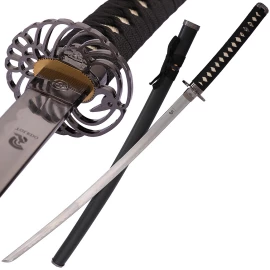
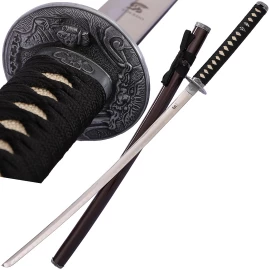
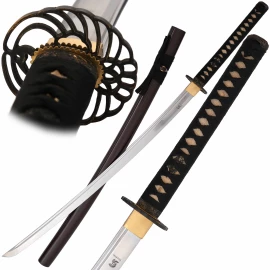
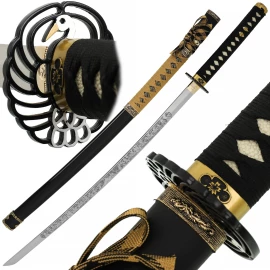
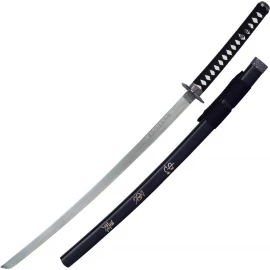
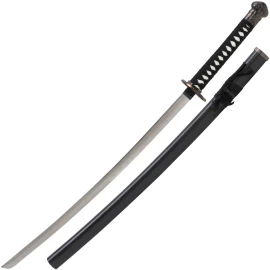
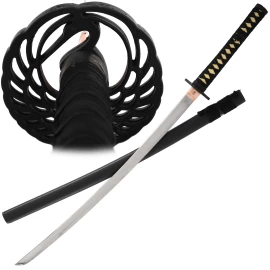
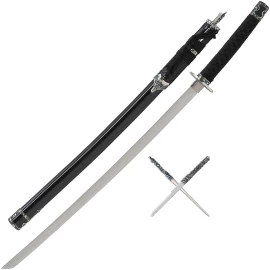
Looking for an elegant samurai katana that makes an immediate impression? The Black Wood katana by Spanish manufacturer MARTO combines traditional Japanese aesthetics with beautifully crafted decorative details. Its black cord-wrapped grip contrasts with the pale imitation rayskin beneath, whilst the silver-coloured guard features intricate reliefs of samurai warriors. A long, polished blade with a decorative hamon line and a sleek black scabbard complete the striking design. Manufactured in the renowned Spanish sword-making city of Toledo, this decorative Japanese-style sword is an attractive addition to any collection and a distinctive display piece for enthusiasts of Japanese history and samurai culture. Further product information ...

 Delivery options
Black Wood Decorative Samurai Katana with Black Scabbard
Elegant Black Katana with Intricate Decorative Details
The Black Wood katana stands out for its restrained black-and-silver colour scheme, complemented by pale details on the grip. Its appearance draws inspiration from traditional Japanese swords, although its components are designed primarily for decorative purposes.
- Blade (nagasa): The long, slightly curved blade is made from hardened X30Cr13 stainless steel. It has a polished finish and the characteristic single-edged geometry of a Japanese katana. An irregular pale line runs along the blade, resembling a traditional hamon. On this model, the effect is created mechanically for decorative purposes rather than through traditional differential hardening.
- Guard (tsuba): The circular, silver-coloured guard features an openwork design with exceptionally detailed raised decoration. Both sides depict Japanese warriors, mounted horsemen, pine trees and stylised sea waves. Darkened recesses emphasise the three-dimensional relief work.
- Grip (tsuka): The elongated grip is covered with pale imitation rayskin (samegawa), over which black cotton cord (tsuka-ito) is wrapped in a regular criss-cross pattern. Small decorative fittings are visible beneath the wrapping.
- Pommel cap (kashira): The metal end cap features a raised depiction of a Japanese warrior on horseback. The silver-coloured relief stands out against a darker, finely textured background and is surrounded by a polished border.
- Grip collar (fuchi): The metal collar immediately behind the guard is also decorated with reliefs featuring Japanese warriors and horses.
- Blade collar (habaki): The pale metal fitting at the base of the blade adjoins the guard and helps secure the blade within the mouth of the scabbard.
- Scabbard (saya): Made from lacquered aluminium with a black finish, the scabbard resembles the appearance of traditional lacquered wooden saya. A black securing cord is fitted near its opening.
The blade is hardened to a stated 48–52 HRC. However, this hardness rating does not indicate that the sword is suitable for practical fencing or cutting. Its construction is intended for decorative and collectible purposes rather than combat use.
The History of the Katana – The Sword of the Samurai
The katana is a traditional Japanese sword with a single-edged, usually gently curved blade and a grip long enough to accommodate two hands. Its development was closely connected with changes in Japanese warfare during the late medieval period.
The katana became increasingly widespread during the Muromachi period (1336–1573), particularly in its later centuries. Unlike the older tachi, which was generally suspended with its cutting edge facing downwards, the katana was normally worn through the sash (obi) with its cutting edge facing upwards. This arrangement allowed the sword to be drawn quickly and, when necessary, brought directly into a cutting movement.
During the Edo period (1603–1868), the katana became an important symbol of samurai status. Together with the shorter wakizashi, it formed a pair of swords known as the daishō. Wearing these swords was closely associated with the social position and identity of the samurai class.
Interestingly, although the katana has become an internationally recognised symbol of Japanese warriors, it was not the only weapon used by the samurai. Depending on the historical period, they also employed bows, yari spears, naginata polearms and, later, firearms. The katana was therefore one element of a much broader military tradition.
What Does the Name Black Wood Mean?
The model name Black Wood refers to the sword's dark, traditionally inspired appearance. The black scabbard in particular recalls the lacquered wooden saya used with historical Japanese swords. According to this model's technical specifications, however, its scabbard is manufactured from lacquered aluminium rather than wood.
Black has a long history in Japanese decorative arts and craftsmanship. It was used for lacquered armour, sword scabbards and various other components of samurai equipment. This restrained colour scheme lends the Black Wood katana a dignified and timeless appearance.
A Collectible Katana from the Famous City of Toledo
This model is manufactured by the Spanish company MARTO in Toledo, a city celebrated for its long tradition of sword and blade production. Although inspired by Japanese swords, it is neither a traditionally forged Japanese original nor an exact reproduction of a particular historical katana.
Its principal appeal lies in its decorative craftsmanship. We recommend it particularly for:
- collections of samurai swords and historically inspired bladed weapons,
- an eye-catching display in a study, living room or library,
- complementing a collection of Japanese art and Asian-inspired objects,
- static photographic arrangements and exhibition displays,
- an original gift for enthusiasts of Japanese history, samurai culture and traditional martial arts.
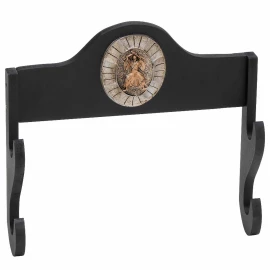
For display, we recommend a stable Japanese sword stand, traditionally known as a katana-kake. Before placing the sword on the stand, make sure the blade is safely seated in its scabbard and the stand is sufficiently stable.
Technical Specifications of the Black Wood Katana
| Specification | Details |
|---|---|
| Product type | Decorative samurai katana |
| Model | Black Wood |
| Historical inspiration | Japanese katanas, particularly 15th–19th centuries |
| Overall length | Approx. 96 cm (37.8 in) |
| Blade length | Approx. 69.5 cm (27.4 in) |
| Guard diameter (tsuba) | Approx. 7.8 cm (3.1 in) |
| Blade width at the habaki | Approx. 28.5 mm (1.12 in) |
| Blade edge thickness | Approx. 0.2 mm (0.008 in) |
| Weight without scabbard | Approx. 890 g (1.96 lb) |
| Weight with scabbard | Approx. 1,080 g (2.38 lb) |
| Blade material | X30Cr13 stainless steel |
| Blade hardness | 48–52 HRC |
| Hamon finish | Mechanically created decorative line |
| Grip | Pale imitation rayskin with black cotton wrapping |
| Guard | Circular openwork metal tsuba with samurai reliefs |
| Scabbard material | Lacquered aluminium |
| Scabbard colour | Black |
| Colour scheme | Black, silver-coloured metal and pale grip details |
| Intended use | Decorative and collectible purposes only |
| Manufacturer | MARTO |
| Place of manufacture | Toledo, Spain |
Important Safety Information
This katana is strictly a decorative item and is not intended for practical use as a weapon.
- Not suitable for contact fencing: Never use this sword for duelling, sparring, stage combat or practice involving contact with another weapon.
- Not intended for tameshigiri: Do not attempt test cutting against tatami mats, bamboo, bottles or other objects. The construction is not specified as suitable for these mechanical stresses.
- Not suitable for practical iaidō training: For repeated drawing exercises and technique practice, use a purpose-made training sword such as an iaitō or bokken.
- Beware of the point and cutting edge: Even a decorative blade with a factory-ground edge bevel can cause deep cuts. Careless handling may result in serious or potentially fatal injuries.
- Prevent damage: Do not bend the blade, use it for levering or strike it against hard objects.
- Safe storage: Keep the sword inside its scabbard and out of the reach of children. All handling is undertaken at your own risk.
How to Care for Your Katana
The stainless-steel blade requires less intensive maintenance than traditional carbon steel, but it is not completely immune to corrosion or damage caused by improper handling.
- After handling, wipe the blade with a soft, dry cloth to remove fingerprints, perspiration and moisture.
- For long-term storage, you may apply a very thin layer of suitable protective oil to the blade.
- Avoid abrasive cleaning products and polishing compounds, which could damage the polished surface and decorative hamon.
- Clean the black lacquered scabbard with a soft, dry or slightly damp cloth, then dry it thoroughly.
- Protect the cotton grip wrapping from soaking, grease and prolonged exposure to direct sunlight.
- Store the katana in a dry environment, away from significant temperature fluctuations.
Recommended Accessories
For this decorative katana, we recommend a horizontal Japanese sword stand (katana-kake), allowing you to display the sword and its scabbard securely and attractively. Comparable stands were also used in Japanese households during the Edo period (17th–19th centuries).
If you are interested in Japanese sword-making traditions, consider complementing your collection with a shorter wakizashi or a decorative tantō dagger, both inspired by weapons used by samurai during the 16th–19th centuries. For practising basic sword movements safely, we recommend a separate wooden training sword (bokken) instead of this decorative katana.
We are here for you!