Čeština
 Deutsch


Konrad von Feuchtwangen Type XIIIa Sharp War Sword


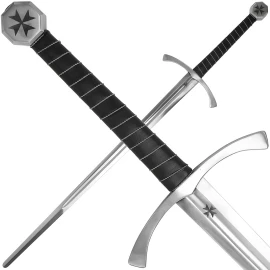
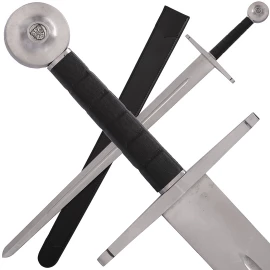
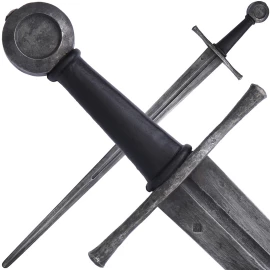
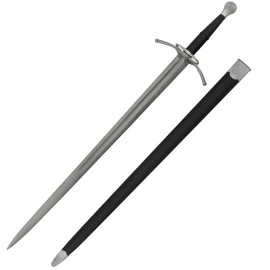
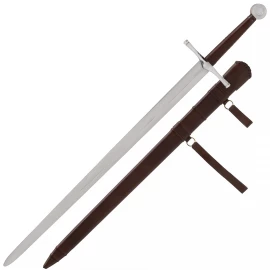
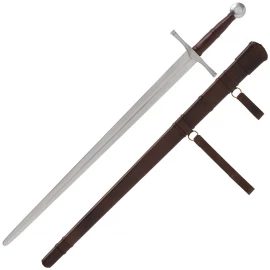
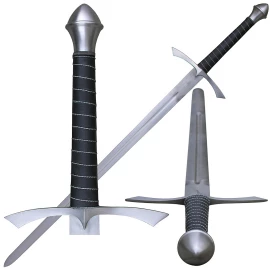
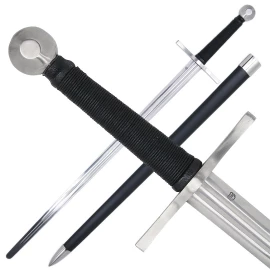
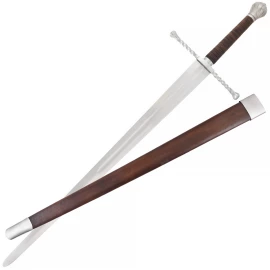
Fencer, if you are looking for a sharp medieval sword in which handling matters just as much as historical appearance, this hand-and-a-half war sword deserves serious attention. Angus Trim designed it as a performance-orientated interpretation of Oakeshott Type XIIIa, the large European war sword associated with the 13th and 14th centuries and particularly suited to powerful cuts. Its broad 9260 spring-steel blade is combined with a long hilt, restrained curved crossguard and disc pommel. As a genuinely sharp sword, it is intended primarily for collecting, historical presentation and controlled cutting practice rather than contact fencing. Further product information ...

Would you like to be notified as soon as the item is in stock?
You will receive a short e-mail as soon as we have it back in stock.
Konrad von Feuchtwangen Type XIIIa Sharp War Sword
The Great War Sword of the 13th and 14th Centuries
Oakeshott Type XIIIa represents one of the characteristic great war swords of the High Middle Ages. Surviving examples are generally associated with the period from the middle of the 13th century to the latter half of the 14th century. Typical features include a long, broad blade with relatively little profile taper, an extended hand-and-a-half or two-handed grip and, on historical originals, a comparatively rounded or spatulate point. The principal strength of the design was cutting performance.
Mail armour had already been well established in Europe for centuries when these swords appeared. During the 13th century, however, mail was increasingly supplemented by individual plate defences and constructions such as the coat of plates, in which metal plates were secured inside a textile or leather garment. Large war swords offered additional reach and a longer grip with which the swordsman could generate greater leverage and blade acceleration.
These weapons should not be confused with the enormous Renaissance two-handed swords of later centuries. Type XIIIa instead occupies an important place between the traditional single-handed knightly sword and later forms of longsword. The modern terms “hand-and-a-half sword” and “Oakeshott Type XIIIa” would, of course, have meant nothing to a medieval warrior. Oakeshott's typology was developed in the 20th century as a scholarly method of comparing surviving European sword blades.
A Performance-Orientated Angus Trim Design
This model is not a rigid copy of a single museum original. It is a modern functional interpretation of the medieval war sword designed by respected American sword maker and designer Angus “Gus” Trim. His approach places particular emphasis on weight distribution, profile and distal taper and the harmonic behaviour of the complete sword.
At approximately 1.5 kg, the sword retains the authoritative character of a large medieval weapon without becoming needlessly cumbersome. Its point of balance lies approximately 15.2 cm (6 in) in front of the guard, giving the sword deliberate blade presence appropriate to the cutting-orientated character of Type XIIIa.
Broad 9260 Spring-Steel Blade
The blade is made from tough 9260 spring steel and finished with an attractive satin surface. It is flat ground and incorporates a long, prominent central fuller, a longitudinal channel that removes unnecessary material and mass whilst allowing the blade to retain its impressive width.
Unlike many historical Type XIIIa swords with comparatively rounded or spatulate points, this model is built as a performance-orientated sharp sword. It has sharpened edges and a pointed tip. This makes it suitable for properly controlled cutting practice on suitable inanimate targets, but entirely unsuitable for contact HEMA sparring, stage combat or reenactment battles.
Long Hilt with Black Leather Grip
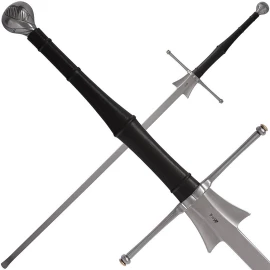
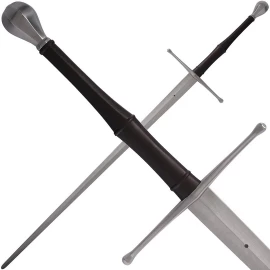
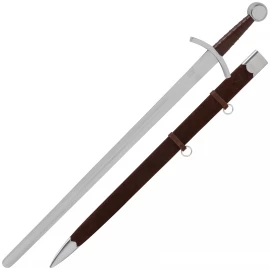
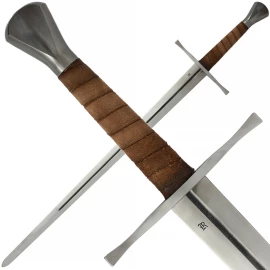
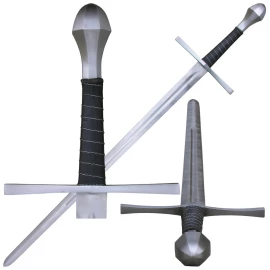
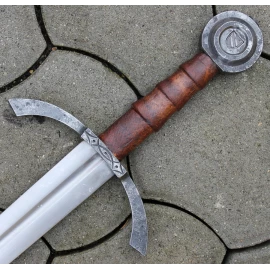
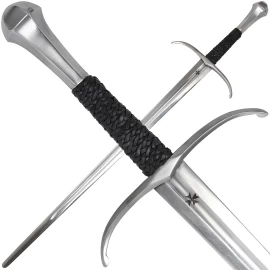
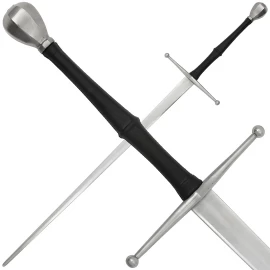
The hilt has a restrained and purposeful appearance. Its long stainless-steel crossguard is slender and gently curved, complementing the straightforward working character of the sword. A prominent disc pommel with a raised circular centre completes the hilt.
The grip uses a solid wooden core reinforced with cord and covered with textured black leather. Fine transverse ribbing improves purchase and helps the hands perceive the orientation of the blade. The extended hilt provides ample room for controlled two-handed use.
Leather-Covered Wooden Scabbard
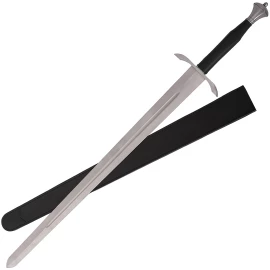
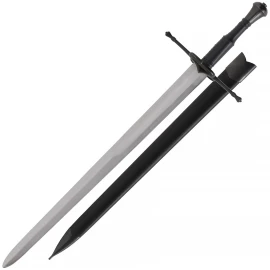
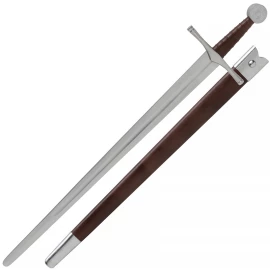
The sword is supplied with a wooden scabbard covered in dark brown leather. A contrasting reddish-brown leather collar reinforces the mouth, whilst a stainless-steel chape protects the lower end. Besides making transport safer and more convenient, the scabbard gives the complete sword a much more convincing historical presentation.
Technical Specifications
| Specification | Value |
|---|---|
| Sword type | Sharp hand-and-a-half war sword |
| Typology | Oakeshott Type XIIIa |
| Historical period | Approx. mid-13th to latter half of the 14th century |
| Blade character | Broad, moderately tapering, with central fuller |
| Blade material | 9260 spring steel |
| Blade finish | Satin finish |
| Blade grind | Flat ground |
| Overall length | Approx. 109.9 cm (43.3 in) |
| Blade length | Approx. 83.2 cm (32.8 in) |
| Grip length | Approx. 25.4 cm (10 in) |
| Weight | Approx. 1.5 kg (3 lb 5 oz) |
| Point of balance | Approx. 15.2 cm (6 in) in front of the guard |
| Blade point | Sharp and pointed |
| Blade edge | Sharp, up to 0.5 mm (0.02 in) category |
| Grip core | Wood with cord reinforcement |
| Grip covering | Textured black leather |
| Crossguard and pommel | Stainless steel |
| Scabbard | Leather-covered wooden core |
| Scabbard chape | Stainless steel |
| Suitable use | Collecting, historical presentation, solo handling and controlled cutting practice |
| Not suitable for | Contact HEMA, stage combat, contact reenactment or LARP |
Because the sword receives a degree of manual finishing, the stated dimensions, weight and other specifications should be regarded as approximate. Individual supplied examples may vary slightly.
Konrad von Feuchtwangen – A Knight at a Turning Point
Konrad von Feuchtwangen was one of the prominent officials of the Teutonic Order during the second half of the 13th century. His career included senior positions in Austria, Prussia and Livonia, and he served as Grand Master of the Teutonic Order from 1291 until 1296. His lifetime therefore falls squarely within the historical period associated with Type XIIIa great war swords. Following the fall of Acre in 1291, the Order entered a decisive period of transformation as its centre of activity increasingly shifted towards Central and Eastern Europe. This sword bears Konrad's name in his honour, recalling the martial culture of the late 13th century.
Care and Maintenance
- After handling, wipe the blade with a clean, soft and dry cloth. Fingerprints contain moisture and salts that can encourage corrosion.
- Apply a very thin film of suitable sword, gun or mineral oil to the clean blade.
- After cutting practice, inspect the edge, point, guard, pommel and grip. Do not continue using a visibly damaged sword until it has been properly assessed.
- Do not leave the sword inside a damp scabbard for prolonged periods. Leather can retain moisture and encourage corrosion of carbon steel.
- Treat the leather grip sparingly with a product intended for natural smooth leather. Do not saturate it with blade oil.
- Do not strike the edge against other steel weapons, stone, concrete, metal objects, hard knots in timber or other unsuitable targets.
- Never use the sword as a pry bar, axe or general-purpose tool.
Safe Use of a Sharp Sword
This is a genuinely sharp functional sword, not a safe fencing simulator. Never use it for partner drills, HEMA sparring, reenactment battles or contact LARP. Controlled cutting practice should be performed only on suitable inanimate targets, with ample clear space around the user and no other people within the possible path of the blade. Carry the sword covered by its scabbard and always observe the rules of the venue and the laws applicable where the sword is being transported or used.
Recommended 13th–14th Century Accessories
- Sword belt and scabbard suspension based on 13th–14th century examples for a more convincing historical presentation.
- Gambeson in a 13th–14th century style as a basic garment and foundation for High Medieval armour.
- Mail hauberk or mail coif based on 13th-century equipment, particularly appropriate to the period in which great war swords became established.
- Coat of plates based on examples from the later 13th and 14th centuries for a portrayal reflecting the increasing use of plate protection.
- Sword stand or wall mount for displaying a sharp sword securely and away from unauthorised handling.
- Blade oil and a soft maintenance cloth as modern essentials for regular care of the spring-steel blade.
Kingston Arms and Angus Trim Sword Design
Kingston Arms is a premium brand of the American company CAS Iberia, established in 2016. It specialises in functional European swords for historical enthusiasts, fencers and collectors. A particularly important part of its range consists of designs by Angus “Gus” Trim, whose work is respected for harmonic balance, dynamic handling and a strong emphasis on practical sword performance.
This Atrim Type XIIIa illustrates that philosophy particularly well. Its tough 9260 spring-steel blade is combined with a solid wooden grip core, cord reinforcement and textured leather covering, quality metal fittings and a leather-covered wooden scabbard. Kingston Arms consequently occupies an attractive middle ground between affordable production swords and considerably more expensive bespoke swordsmithing. If you are looking for a sharp medieval hand-and-a-half sword with cutting performance and responsive handling at the centre of its design, the Atrim range is well worth your attention.
We are here for you!