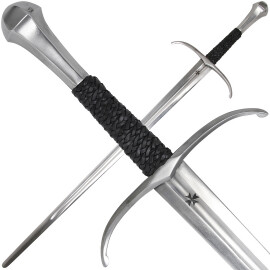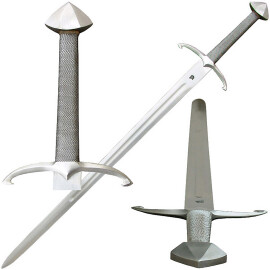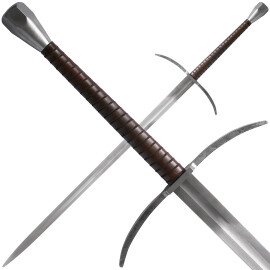

Tourney Hand-and-a-Half Reenactment Sword
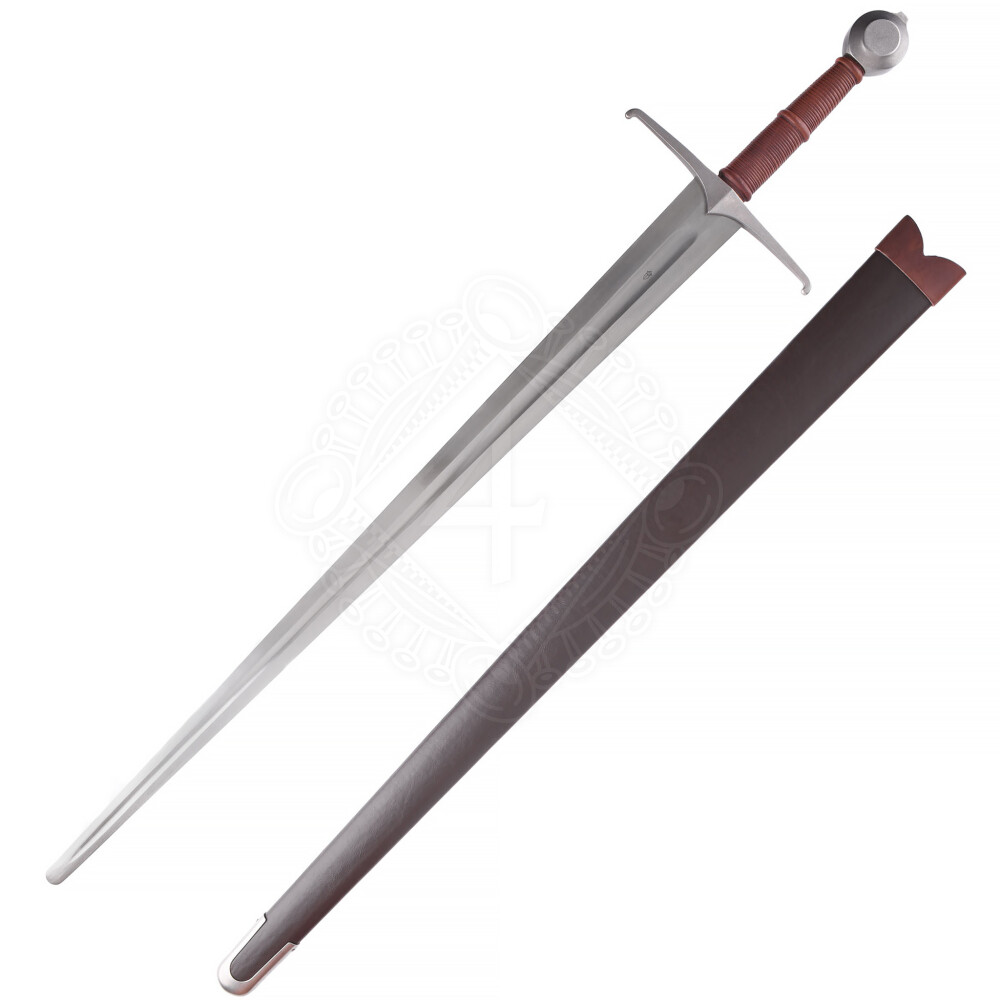
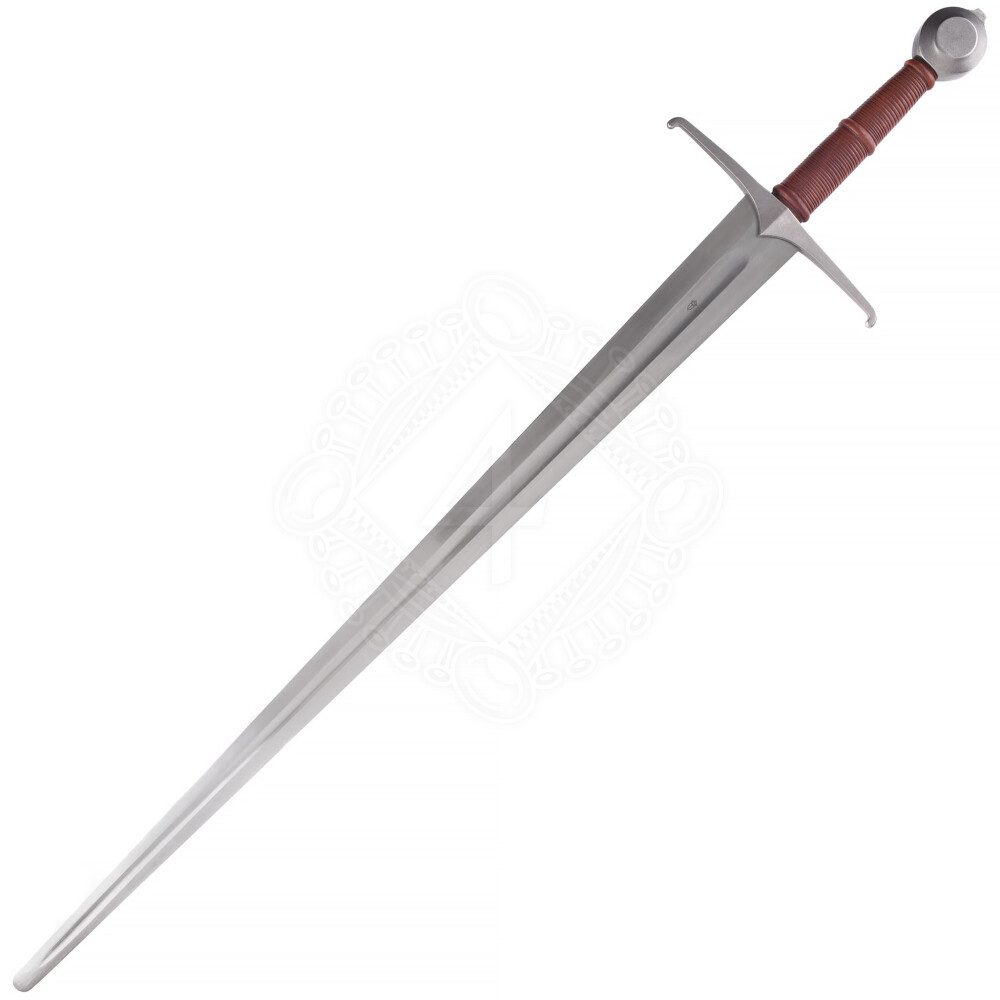
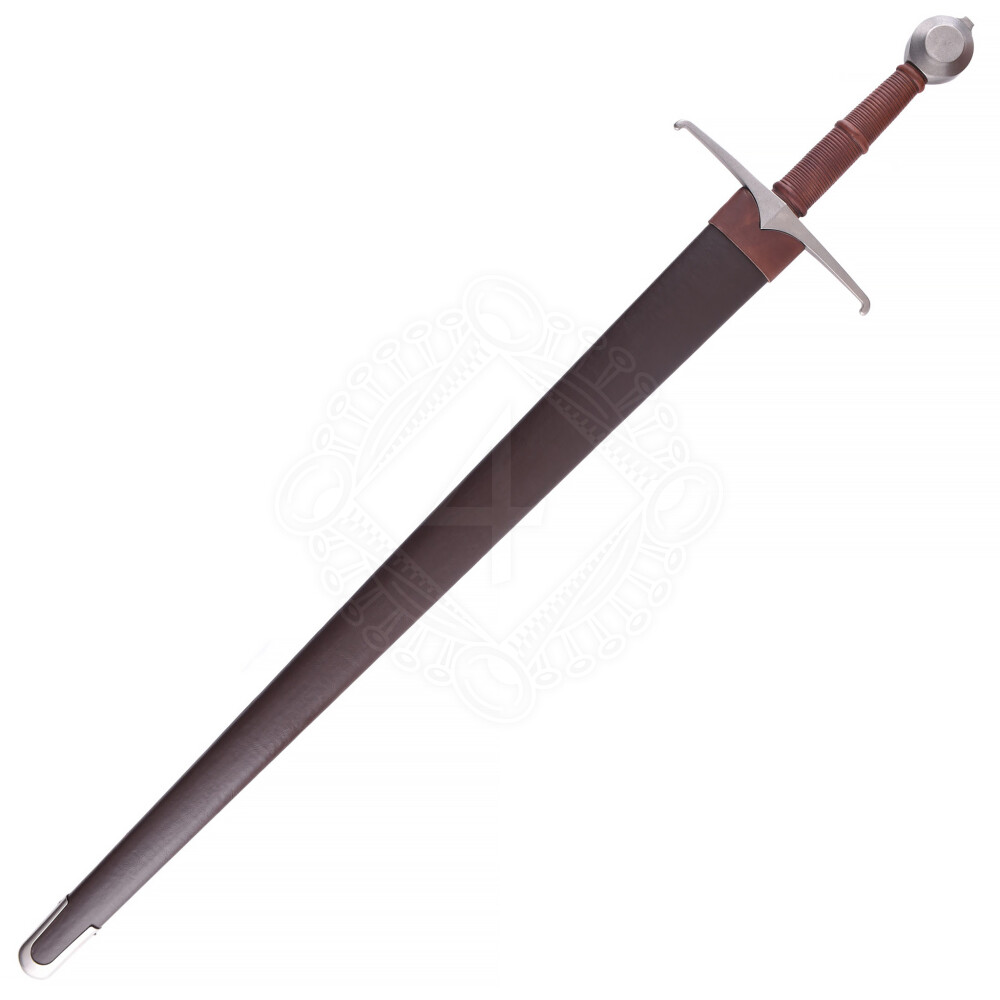
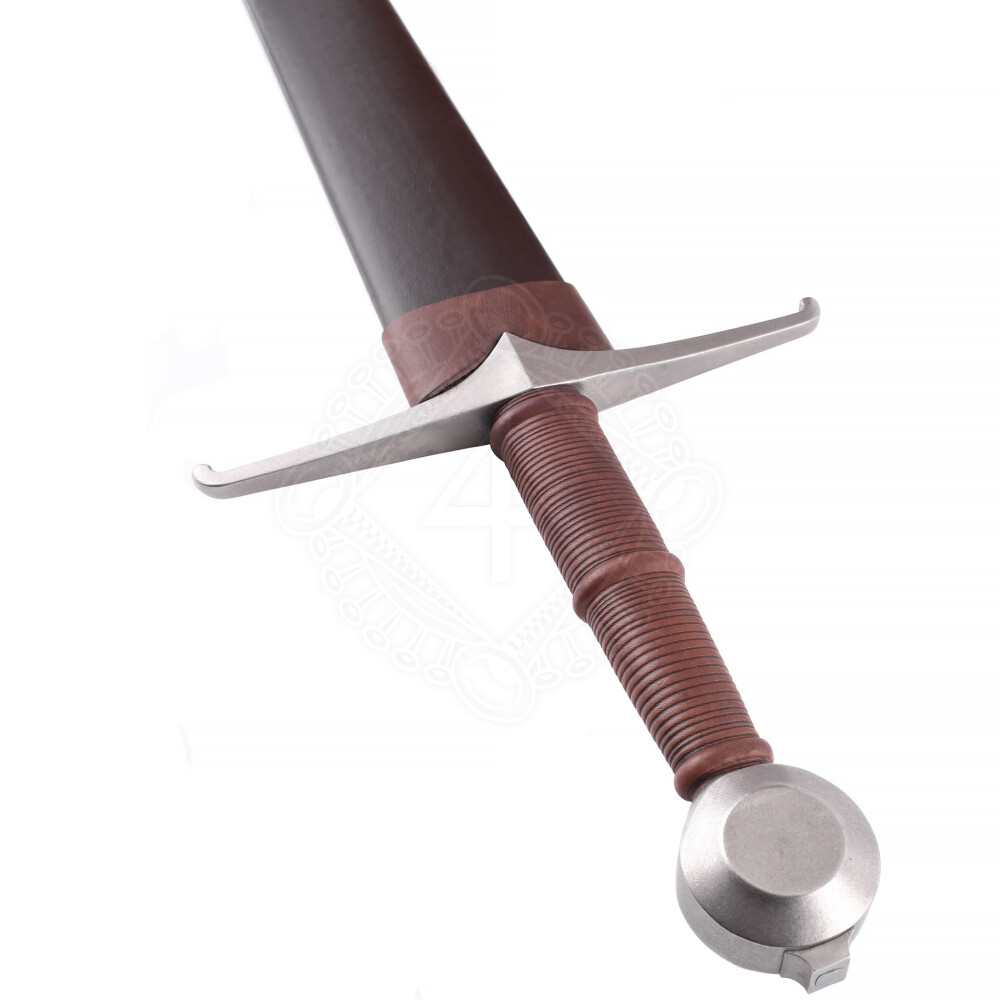
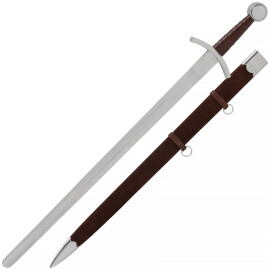
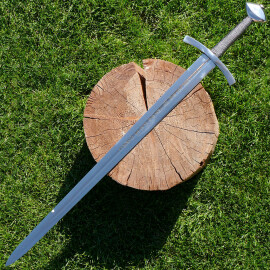
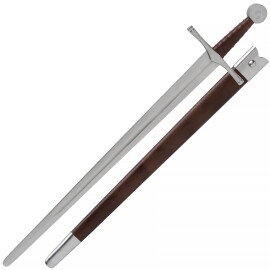
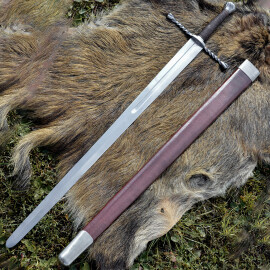
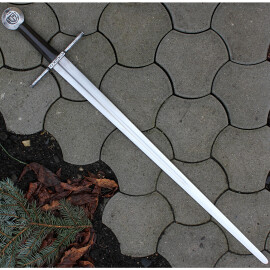
If you are looking for a blunt hand-and-a-half sword capable of regular reenactment use without sacrificing the proportions and handling of a late medieval weapon, this Tourney model is a compelling choice. It combines a tough 9260 spring-steel blade, rounded point, approximately 2 mm blunt striking edges and a long grip with ample room for a gloved hand. Its form is inspired by Oakeshott Type XVIIIa swords but deliberately adapted for reenactment and stage combat. A dark brown leather-covered wooden scabbard is also supplied with the sword. Further product information ...
Would you like to be notified as soon as the item is in stock?
You will receive a short e-mail as soon as we have it back in stock.
Sigmund Ringeck Tourney Hand-and-a-Half Reenactment Sword
A Late Medieval Sword Inspired by Oakeshott Type XVIIIa
The historical inspiration belongs to the Oakeshott Type XVIIIa family, associated particularly with the second half of the 14th and the first half of the 15th century. This was a period in which plate armour developed rapidly. European swords consequently evolved towards slimmer and stiffer blades with more effective points, retaining useful cutting ability while becoming better suited to accurately directed thrusts towards less protected areas of armour.
Type XVIIIa swords are generally characterised by a relatively slender blade with pronounced profile taper and an extended hilt. Such proportions allowed a weapon to be controlled with either one or two hands, depending on circumstances. Terms such as “Type XVIIIa” and “hand-and-a-half sword” are modern classifications rather than medieval names. Ewart Oakeshott developed his typology in the 20th century to help scholars classify surviving medieval swords.
The Tourney version retains the overall appearance of a late medieval longsword while deliberately altering important details for reenactment and stage combat. Instead of the acute point and sharpened edges of a battlefield sword, it has a broadly rounded tip and approximately 2 mm thick rounded striking edges.
Built for Reenactment and Controlled Contact
9260 Spring-Steel Blade
The blade is forged from 9260 spring steel and hardened to approximately 50 HRC. This steel provides a useful combination of resilience, toughness and resistance to breakage. A pronounced longitudinal fuller reduces unnecessary blade mass and contributes to the sword's balanced handling.
The point is intentionally blunt and rounded. Its rounded striking edges measure approximately 2 mm (0.08 in) and are therefore classified as blunt. This does not make the sword harmless: a steel weapon weighing around 1.6 kg can still cause serious injury when used without adequate control and protective equipment.
Long Grip and King-Peen Construction
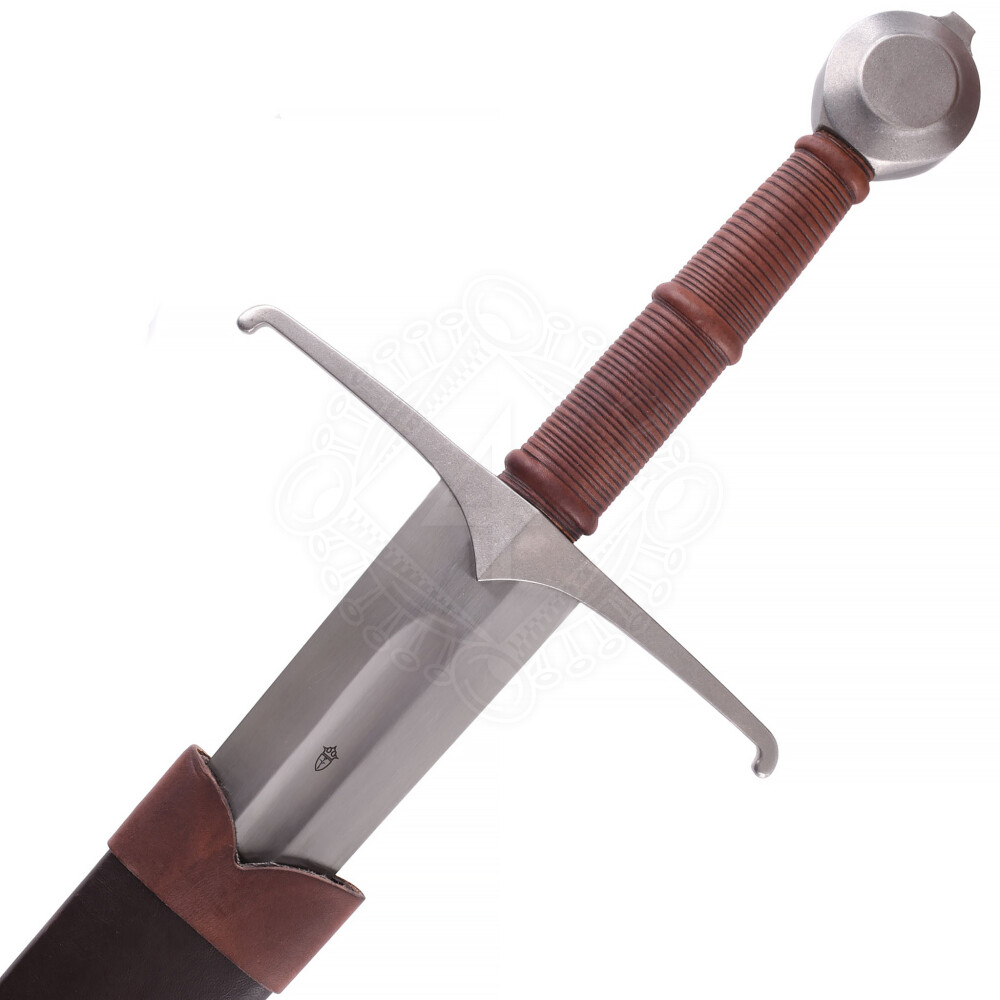
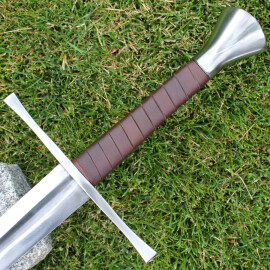
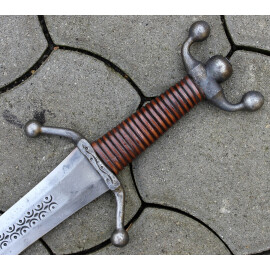
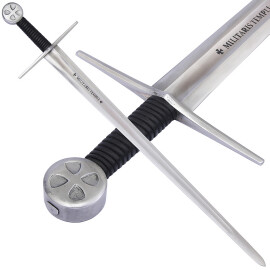
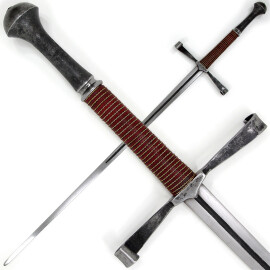
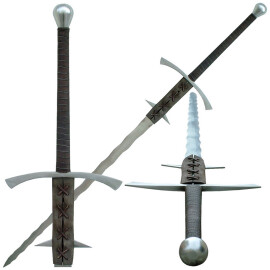
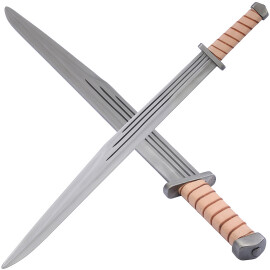
The steel crossguard has long, elegantly curved quillons terminating in gently hooked ends. The wooden grip core is covered with brown leather and features pronounced cord ribbing for a secure hold. Its oval cross-section also helps you feel the orientation of the blade without looking at it. The generous grip provides sufficient room for larger fencing or armoured gloves.
A notable feature is the King-Peen system. A steel retaining element within the guard engages with the blade tang and helps prevent the crossguard from gradually loosening under repeated impacts. The faceted wheel-shaped pommel, with its raised central boss, is firmly fitted to the tang and additionally peened in place.
Leather-Covered Wooden Scabbard
The sword is supplied with a wooden scabbard covered in dark brown leather. A contrasting leather collar reinforces the throat, while a metal chape protects the lower end. Besides making transport and storage more convenient, the scabbard gives the sword a much more convincing appearance when worn as part of a late medieval reenactment kit.
Technical Specifications
| Specification | Value |
|---|---|
| Type | Hand-and-a-half sword, longsword |
| Historical inspiration | Oakeshott Type XVIIIa, late 14th to first half of the 15th century |
| Intended use | Reenactment, stage combat and controlled historical fencing practice |
| Blade material | 9260 spring steel |
| Blade hardness | Approx. 50 HRC |
| Overall length | Approx. 104.8 cm (41.3 in) |
| Blade length | Approx. 83.2 cm (32.8 in) |
| Grip length | Approx. 15.2 cm (6.0 in) |
| Weight | Approx. 1.6 kg (3 lb 8 oz) |
| Point of balance | Approx. 10.2 cm (4.0 in) in front of the guard |
| Blade point | Blunt and rounded |
| Blade edge | Blunt, approx. 2 mm (0.08 in), rounded |
| Grip | Wooden core, leather covering, cord ribbing |
| Guard and pommel | Steel |
| Guard construction | King-Peen system |
| Scabbard | Leather-covered wooden core with metal chape |
Because the sword receives a degree of manual finishing, the stated dimensions, weight and other specifications are approximate. Individual supplied examples may vary slightly.
Sigmund Ringeck and the German Longsword Tradition
The model takes its name from Sigmund Ringeck, a 15th-century German fencing master associated with the tradition of Johannes Liechtenauer. His surviving gloss on the fencing tradition is one of the important sources used in the modern reconstruction of historical European martial arts. Its longsword material reflects a sophisticated system based on initiative, timing, line, blade contact and tactical responses to an opponent's actions. We have chosen his name as a tribute to the historical fencing masters whose surviving teachings allow today's HEMA practitioners and reenactors to study medieval martial arts in practical detail.
Care and Safe Use
- After every use, wipe the blade completely dry and remove fingerprints, perspiration and dirt. Carbon spring steel can corrode when left unprotected.
- Apply a very thin film of suitable sword, gun or mineral oil to the clean blade.
- Avoid storing the sword inside a damp scabbard for extended periods. Leather can retain moisture and encourage corrosion.
- Before every fencing session, inspect the guard, pommel, grip, edges and point. Do not use a sword showing cracks, severe burrs or a loose hilt.
- For contact fencing, always use suitable protection for the head, throat, hands and torso and comply with the rules of your reenactment or fencing organisation.
- A rounded point is not a guarantee of safety. Thrusts must remain controlled and should only be used where the rules and protective equipment specifically permit them.
- Do not sharpen the edges if the sword is to remain a reenactment or stage-combat weapon.
- Do not strike stone, concrete, structural steel or other extremely hard objects, and never use the sword as a lever or general-purpose tool.
- For contact LARP, use this steel sword only where the event rules explicitly permit steel weapons. Most conventional LARP systems require padded weapons instead.
Recommended 14th–15th Century Accessories
- Sword belt and scabbard suspension in a 14th- or 15th-century style for historically appropriate wear.
- Padded or plate gauntlets based on 14th–15th century equipment; for contact fencing, always choose protection suitable for the applicable ruleset.
- Gambeson or padded arming garment of a late 14th- or 15th-century pattern as the foundation of a historical protective outfit.
- Bascinet, sallet or another period-appropriate helmet to suit your chosen portrayal; for modern training we recommend purpose-made certified fencing protection as well.
- Rondel dagger or another late medieval sidearm from the 14th–15th century to complete a period fighting kit.
Kingston Arms – Functional Swords for Serious Fencers
Kingston Arms is a premium brand introduced by the American company CAS Iberia in 2016. Its range focuses on functional reproductions of European edged weapons for historical fencing, reenactment and HEMA. Selected Kingston Arms swords have also been developed in collaboration with renowned sword designer Angus “Gus” Trim, whose work is particularly respected for harmonious balance and dynamic handling. The Tourney range combines robust spring steels with construction intended for regular training use. On this particular sword, the King-Peen system further helps keep the hilt assembly secure under repeated loading. Kingston Arms therefore occupies an attractive middle ground between affordable production swords and considerably more expensive bespoke swordsmithing.
We are here for you!